
When Elena Morris, a maintenance supervisor in Toledo, Ohio, USA, opened a machine-panel door and applied a breaker lockout before a conveyor repair, the device rocked loose when she tested the handle. The team stopped immediately; the visible failure was a poor fit. The reversal came after a panel survey: the kit had been chosen by breaker name and voltage, while the actual handle width, clearance, and multi-person work method had never been specified. The root cause was selection and procedure, not simply a defective product.
An electrical kit combines personal padlocks, tags, breaker restraints, hasps, and storage. The mix depends on technician mobility, concurrent users, and whether inventory is controlled beside a panel. Treat the kit as an extension of the written energy-control procedure.
Lockout Tagout Kit Electrical selection begins with the isolation point
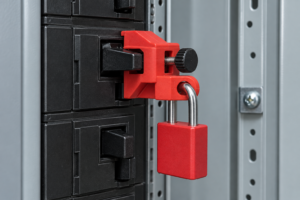
Start with the device that must be isolated, not with a catalogue category. Photograph the breaker or disconnect, record handle width and profile, note pole arrangement and operating direction, and measure clearance around the handle. A device that fits one miniature breaker may not fit a moulded-case breaker, even when both are described as circuit breakers.
For a measured handle within the approved range, a Lockout Tagout Kit Electrical breaker lockout can be evaluated during a controlled sample fit. Confirm that the lockout holds the handle in the intended safe position, accepts the assigned lock, and does not interfere with the panel or nearby controls. A visual resemblance is not compatibility evidence.
Lockout Tagout Kit Electrical fit must be proven before standardization
Have an authorized employee install the device on a de-energized representative panel, test that the handle cannot be moved toward ON, and record the approved breaker family. This is a site fit check, not a claim of certification. The procedure must still address notification, shutdown, isolation, stored energy, verification, and restoration.
Lockout Tagout Kit Electrical design should follow the work sequence
A useful kit makes the approved sequence easy to perform: notify affected employees, shut down equipment, isolate every identified source, apply locks and tags, release or restrain stored energy, and verify the zero-energy condition. A lock and tag support that sequence; they do not replace the employer’s written procedure or the qualified person’s electrical testing method.
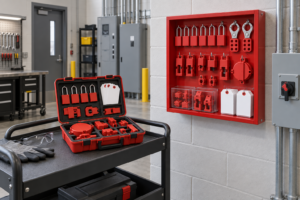
Separate personal control from shared equipment. Each exposed worker should be able to apply and remove a personal lock under the site’s group-lockout process. For mobile work, an electrical LOTO kit keeps the approved devices together and reduces search time, but it needs an issue list and replenishment check. For fixed work areas, a station can make common devices visible and easier to inspect.
Lockout Tagout Kit Electrical options show different workflow costs
Portable kits and wall-mounted stations solve different logistics problems. The comparison below is a procurement framework; actual value depends on panel variety, travel distance, work frequency, and the number of authorized employees.
| Option | Best fit | Operational advantage | Cost or control issue |
|---|---|---|---|
| Portable kit | Mobile technicians, contractors, dispersed assets | Travels with the work order and supports point-of-use issue | Can become incomplete without custody and replenishment checks |
| Wall-mounted station | Fixed maintenance areas and repeatable tasks | Visible inventory, quick access, easier shared inspection | Does not follow a technician to a remote asset |
| Personal issue set | One authorized technician and defined equipment | Clear ownership and low carrying burden | May lack devices for unfamiliar breaker families |
| Group-control set | Outages involving several technicians | Supports hasps, lockboxes, and individual accountability | Requires a documented handover and release process |
An illustrative cost check exposes hidden waste: 6 minutes of searching across 40 monthly isolations equals 240 minutes of avoidable handling time. This is not a product guarantee; compare search, downtime, replenishment, and training in the site’s own records.
Lockout Tagout Kit Electrical procurement should reflect compliance duties
OSHA 29 CFR 1910.147 applies to covered hazardous-energy control work in the United States and places duties on the employer: procedures, training, periodic inspection, and suitable lockout or tagout devices. OSHA’s eTool explains program elements and verification expectations. Neither source makes a particular kit “OSHA approved.” ANSI/ASSP Z244.1 offers consensus guidance on lockout/tagout and alternative methods, while ISO 45001 concerns an occupational health and safety management system.
CE marking or RoHS statements, where relevant to a product and destination market, have specific scope and should not be presented as proof that an employer’s lockout program complies with OSHA. Procurement language should identify materials, dimensions, intended applications, and supporting documentation without turning a product feature into a broad legal claim.
Lockout Tagout Kit Electrical selection becomes practical with four checks
- Survey the actual panels and list every breaker or disconnect that must be secured.
- Approve a physical fit sample, including handle restraint, lock clearance, and panel access.
- Set quantities from simultaneous work, personal-control rules, replacement needs, and storage location.
- Assign inspection, replenishment, training, and record ownership before the first issue.
QD LOTO can support a measured specification with configurable lockout devices, organized storage, and product information for distributor or end-user review. A non-conductive padlock may be relevant to an electrical application, but the purchaser should still review its construction, key-control needs, and task conditions rather than infer suitability from the product name.
Frequently Asked Questions
What should an electrical LOTO kit include for circuit breaker isolation?
It commonly includes compatible breaker lockouts, personal safety padlocks, warning tags, and a hasp or group-control accessory where more than one person may be exposed. Storage, spare tags, and a replenishment list are useful for mobile teams. The final contents should be mapped to the site’s actual isolation points and procedure.
Should I buy a portable electrical LOTO kit or a wall-mounted lockout station?
Choose a portable kit when technicians move between panels or contractors carry equipment to the job. Choose a wall-mounted station when work is concentrated in a fixed area and shared inventory must remain visible. Many facilities use both, provided the contents and ownership rules are documented.
How do I choose the right breaker lockout for my electrical panel?
Record the breaker model or family, handle width and profile, pole arrangement, operating direction, and surrounding clearance. Then conduct a controlled fit check on a de-energized representative panel and confirm the device holds the handle in the intended safe position. Do not choose by voltage or amperage alone.
Is a lockout station suitable for multiple technicians?
Yes, when the station contains enough individually identified locks and the site has a group-lockout method for shared work. The station improves access and visibility, but it does not by itself provide personal control or define who may remove a lock. Match its inventory to the maximum number of exposed authorized employees.
References
When your panel survey is ready to become a fixed point-of-use solution, review QD LOTO’s lockout station option and contact QD LOTO to discuss the device mix, quantities, and documentation for your application.