
Illustrative procurement scenario: When a maintenance planner named Alex in Manchester encountered a padlock that would not pass through a machine’s lockout fitting, he tried the newly delivered sample during a planned shutdown. The shackle stopped at the opening. Replacing the lock with another from the same carton changed nothing: the order had specified a body color and key type, but no interface dimensions.
Summary: Select a LOTO padlock through two separate checks: who controls its key, and whether its shackle and body fit the intended device. Under 29 CFR 1910.147(c)(5), protective hardware must also meet durability, standardization, substantiality and identification requirements. Confirm the key arrangement, dimensional drawing and actual sample before approving the purchase.
A “Padlock Loto” search often starts with a product photograph. The purchasing decision needs more detail. A personal lock belongs within an employer’s hazardous-energy-control program, with procedures, training and verification. A closed padlock alone does not establish that equipment is isolated.
Specify keying around personal responsibility
Begin with the authorized employee and the equipment procedure. Section 1910.147(e)(3) generally requires each device to be removed by the employee who applied it. An employer-directed exception requires a specific procedure and safeguards. A convenient key arrangement must not create routine access to another worker’s personal locks.
Compare these three common arrangements by access, rather than by the number of keys supplied in a box. Confirm the supplier’s terminology in writing because abbreviated catalogue descriptions can be ambiguous.
| Arrangement | What the arrangement means | Purchasing decision |
|---|---|---|
| Keyed different | Specified locks use different operating keys. | Define the required non-interchange group and how additional orders will be checked. |
| Keyed alike | A defined group of locks shares an operating key. | Consider only where the written program preserves personal control, such as a group assigned to one worker. |
| Master-keyed system | A controlled master key opens a defined group in addition to its operating keys. | Confirm whether the program permits it, who holds access and how exceptional removal is governed. |
A supplier’s key-code record helps manage an order, but it does not prove unlimited non-interchangeability across every lock ever supplied. Request a defined keying plan, cross-opening checks for the specified group and controlled records for extensions. Keep spare keys under the employer’s approved access rules. For shift changes, use a documented continuity procedure rather than informal key sharing; the key-control and shift-handover guide addresses that separate operational task.
Check shackle clearance and the space around the body
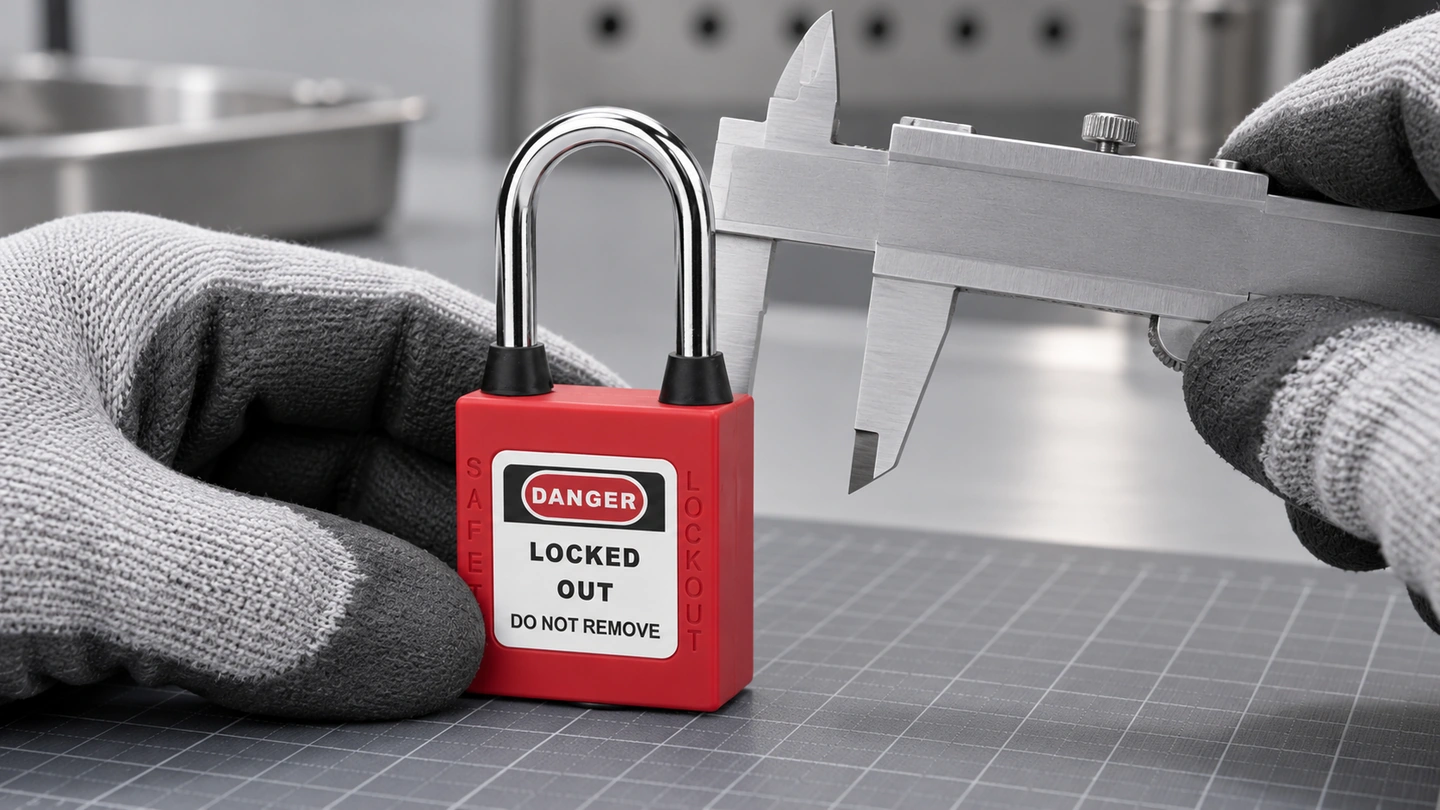
Record three shackle dimensions: diameter, inside height and inside width. Then check the body envelope, access for handling and the device manufacturer’s permitted padlock specification. Section 1910.147(d)(4) requires the lockout device to hold the energy-isolating device in a safe position. Merely passing a shackle through a hole does not demonstrate that requirement.
| Field | Evidence to request | Sample check |
|---|---|---|
| Shackle diameter | Dimensioned drawing and the lockout device’s permitted range | Check passage and retention without forcing or modifying either item. |
| Inside height | Clear internal dimension with the shackle closed | Check the required reach and the manufacturer’s installation method. |
| Inside width | Clear internal width at the relevant working area | Check the intended engagement, not only a photograph of the opening. |
| Body and working space | Body dimensions and actual installation context | Check neighboring devices, covers and practical access. |
Use the real combination of padlock and lockout hardware during an authorized, safely controlled trial. Record acceptance against the relevant instructions. A longer shackle is not automatically a better choice: additional reach can change the engagement or leave unwanted movement. Where several workers use a lockout hasp, check the actual padlock interfaces and available space.
Match materials and key retention to actual service conditions
Section 1910.147(c)(5)(ii)(A) requires devices to withstand the environment for the expected exposure period. Make two material entries in the specification: body material and shackle material. A polymer body can be supplied with a metal shackle, so a body description does not establish the properties of the whole assembly.
List relevant moisture, contamination, chemicals and service temperatures, then request documentation for the exact model and exposure. Do not assign an electrical rating, corrosion class or chemical-resistance limit from appearance. The body-versus-shackle material guide explains this distinction.
Where key retention is specified, check its actual function on the sample: can the operating key be withdrawn while the shackle is open, and does normal closure release it as documented? A key-retaining cylinder is an accountability aid. It cannot detect stored energy, verify isolation or prove that a lock has been attached to the correct point.
Apply the right rule without treating it as product certification
For covered US machinery servicing, 29 CFR 1910.147 addresses hazardous-energy control. Its four hardware headings are durable, standardized, substantial and identifiable. Standardization within a facility must use at least one of color, shape or size; the rule does not prescribe one universal padlock color or shackle length.
Electrical work has a separate scope boundary. Section 1910.147 excludes exposure to electrical hazards from work on, near or with conductors or equipment in electric-utilization installations covered by Subpart S. Section 1910.333 provides relevant electrical-work practices, including de-energization and verification requirements. Identify the work before selecting the applicable procedure.
Neither citing a regulation nor buying a padlock described as “LOTO” creates an OSHA product certification. For other markets, confirm local requirements. CCOHS guidance explains lockout as part of a complete program and discusses Canadian practice; it does not replace the destination jurisdiction’s rules.
Approve the sample before approving the order
For a QVAND inquiry, send the operating context and acceptance criteria with the requested quantity. Use four purchasing actions:
- Define personal assignment, permitted key groups and spare-key custody.
- Request a drawing covering shackle diameter, internal clearance and body dimensions.
- Confirm model-specific materials, identification options and any required key-retaining function.
- Document a sample trial with the actual lockout device, then retain the approved specification for repeat orders.
Compare total purchasing cost as product cost plus identification, key administration, acceptance checks and replacement handling. A low unit price can lose its advantage when incompatible locks must be relabeled or reordered. No savings percentage can be justified without the buyer’s actual workload and costs.
Frequently asked questions
What makes a LOTO padlock suitable for personal maintenance protection?
It must work with the intended lockout device, support the authorized employee’s control and remain suitable for the service environment. Identification and the employer’s procedure matter alongside the product. A lock alone does not provide the whole protective system.
What are the requirements for a LOTO padlock?
For work covered by 29 CFR 1910.147, the hardware requirements include durability, standardization, substantiality and employee identification. Lockout devices must also be dedicated to energy control rather than other purposes. Confirm additional requirements from the actual job and jurisdiction.
What does OSHA require for lock out tag out?
For covered activities, the employer needs an energy-control program, appropriate procedures, training and periodic inspections. Isolation, control of stored energy and verification form part of application. Selecting a compliant-looking lock is not a substitute for these duties.
Who should control the key to a personal safety padlock?
The authorized employee should retain control under the employer’s procedure. Spare or master keys must not allow routine removal of another person’s lock. Exceptional removal needs the safeguards applicable to the work.
What environmental conditions matter when selecting a safety padlock?
Consider exposure duration, moisture, contamination, chemicals and temperature, together with handling conditions. Request evidence for the exact body, shackle and cylinder configuration. Avoid transferring one material’s properties to the complete lock.
How should padlocks and keys be recorded when locks are issued?
Record the lock identifier, assigned employee, key group or controlled key reference, issue date and any spare-key custody. Record returns and reassignment so an old owner association does not remain active. Do not leave sensitive key information available for unrestricted use.
References
- 29 CFR 1910.147: The control of hazardous energy
- 29 CFR 1910.333: Selection and use of work practices
- CCOHS: Lockout/Tag out
The useful specification connects one person’s control with the actual isolation interface.
Review QVAND’s safety padlock range and contact the team with your keying plan, device details and sample requirements.