
Illustrative issue-desk scenario: When a maintenance stores coordinator named Priya in Birmingham encountered two returned red padlocks with unreadable owner labels, she compared them with the issue register before reassignment. Neither could be reliably matched to its recorded user. The locks still operated, but the purchasing and identification process had failed to keep ownership traceable.
Summary: A lockout safety padlock purchase needs a usable identity and issue system as well as suitable hardware. Under 29 CFR 1910.147(c)(5), devices must identify the employee applying them and meet four hardware requirements: durability, standardization, substantiality and identification. Confirm labeling, key access, service conditions and real-device fit before release to workers.
This checklist focuses on the gap between receiving a carton and issuing personal locks. It does not replace an employer’s energy-control procedure. The padlock is one part of a system that also includes appropriate isolation hardware, trained people, stored-energy control and verification.
Keep the owner identity and issue record connected
Section 1910.147(c)(5)(ii)(D) requires lockout and tagout devices to indicate the identity of the employee applying them. Department color alone can leave several possible owners. Establish an identity method that the people using the procedure can read and associate with the correct authorized employee.
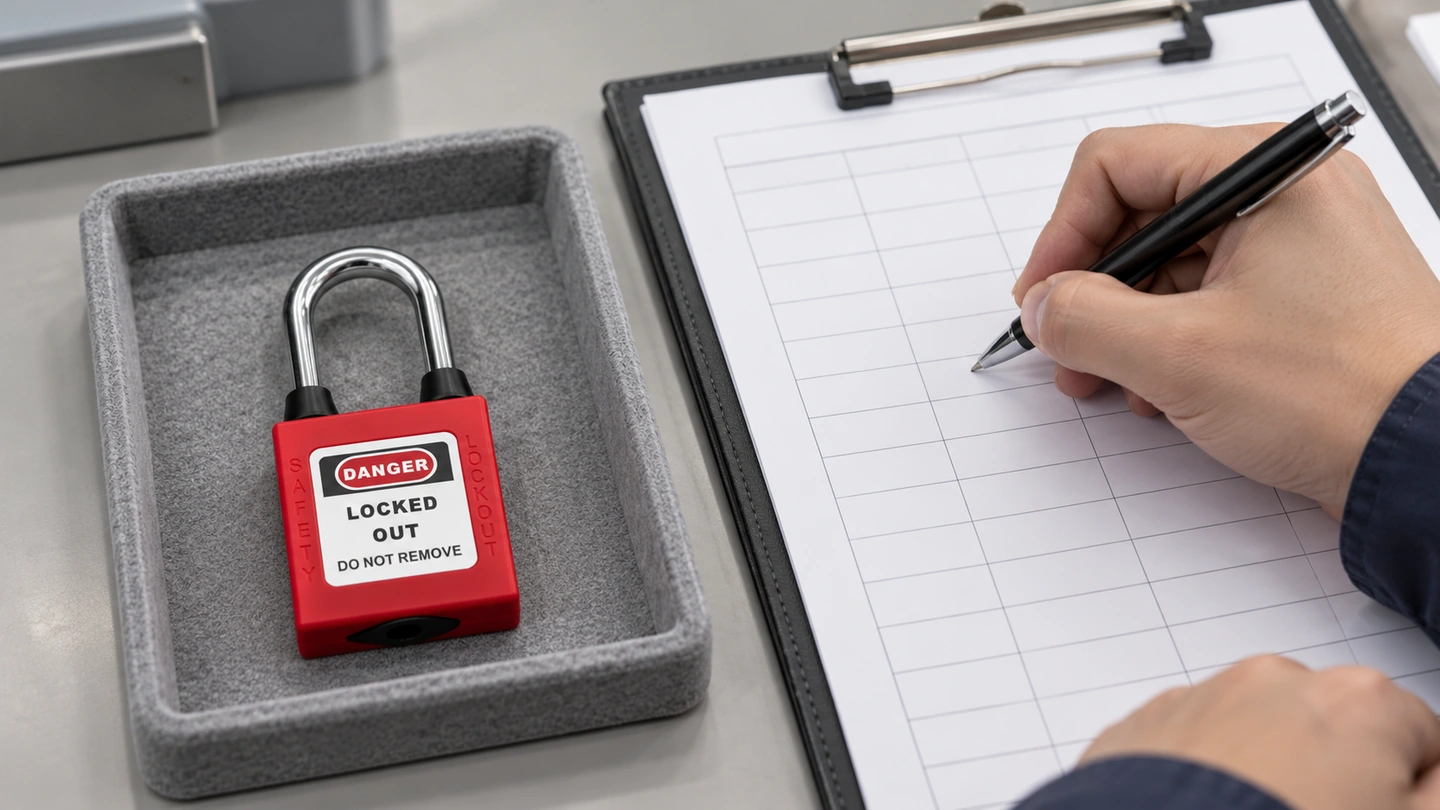
Specify two linked elements: the identification carried by the lock or associated device, and the controlled issue record. Engraving, a suitable label or another documented method may be practical, but the regulation does not mandate one engraving technology. Agree where identification can be placed without obscuring warnings or interfering with operation.
A useful issue register records the lock identifier, assigned employee, department, key arrangement, issue date and current disposition. Record returns, replacement and reassignment. Do not imply that this exact register format is an OSHA requirement; it is a purchasing and administration method for keeping the required identity usable.
Separate personal key control from purchasing convenience
Check two access questions before choosing keyed-alike or keyed-different supply: who operates each lock, and who can obtain another key? Under 1910.147(e)(3), the employee applying a device generally removes it. The employer’s exceptional-removal procedure must provide the specified protections rather than treating an available spare as permission to remove a lock.
| Order choice | Potential administrative benefit | Control to establish |
|---|---|---|
| Different operating keys | Separates the specified locks’ ordinary key access. | Confirm the required non-interchange group and the records for repeat orders. |
| One keyed-alike group for one worker | Can reduce the keys that worker manages. | Prevent the group from extending to unrelated workers’ personal locks. |
| Spare or master-key provision | Provides a defined administrative access route where permitted. | Control custody and exceptional use through the employer’s procedure. |
Get the supplier’s keying definitions and proposed group boundaries in writing. A catalogue abbreviation does not establish how the buyer’s entire site will be keyed. For a deeper discussion of dimensions and keying decisions, use the LOTO padlock keying and shackle-selection guide.
Translate the work environment into acceptance checks
Section 1910.147(c)(5)(ii)(A) ties durability to the actual environment and expected exposure period. Separate three questions: will the mechanism function, will the owner identity remain readable, and will the lock work with the intended device? An attractive finish or a material name cannot answer all three.
| Check | Information to supply | Evidence or trial to agree |
|---|---|---|
| Owner identification | Identifier format and intended marking location | A marked sample checked for readability and association with the issue record |
| Environmental suitability | Relevant moisture, chemicals, contamination and temperature | Model-specific documentation and a defined assessment for the intended exposure |
| Narrow isolation point | Device model, opening and surrounding space | Drawing review and a safely controlled trial of the actual padlock-device combination |
| Repeated supply | Approved model, key group and identification requirements | Comparison with the retained approved sample and current specification |
Check shackle diameter, internal clearance and body access rather than ordering by an advertised shackle length alone. A polymer body does not establish the material of the shackle or an electrical-protection rating. If identification becomes unreadable in service, follow the employer’s controlled replacement process. The padlock inspection and replacement guide covers that later lifecycle decision.
Confirm what locks, tags and standards actually mean
Under 1910.147(c)(2), lockout is generally required for an energy-isolating device capable of being locked out unless the employer demonstrates that tagout provides full employee protection under the applicable requirements. Section 1910.147(c)(3) addresses that demonstration and additional measures. Tags communicate a warning; they do not supply a lock’s physical restraint.
Do not interpret the 50-pound minimum unlocking strength in 1910.147(c)(5)(ii)(C)(2) as a padlock-shackle test. That provision concerns tagout-device attachment means. Padlock selection instead needs the applicable lockout requirements and documented suitability for the actual device and use.
The rule requires facility standardization in at least one of color, shape or size, alongside employee identification. It does not make a red general-security lock a personal lockout device merely because it matches the site’s color. Devices used for energy control must be dedicated to that purpose, not also used for lockers or toolboxes.
Apply the correct jurisdiction and work scope. Section 1910.147 concerns covered hazardous-energy-control work, while electrical hazards from work on or near conductors or equipment in electric-utilization installations are addressed by Subpart S, including 1910.333. Neither regulation is a product certification. CCOHS provides useful Canadian lockout-program guidance, which should be read in its own jurisdictional context.
Build an issue-ready purchase specification
QVAND’s published padlock information includes identification and keying options. Confirm the available configuration for the exact model and order, rather than transferring every option across the range. Send the buyer’s acceptance requirements in four parts:
- Personal assignment: define the employee identifier, department field and issue-record method.
- Controlled access: specify operating-key groups, spare-key custody and any permitted administrative access.
- Suitability: document the environment, isolation device and required physical clearance.
- Acceptance: approve a marked sample and retain its specification for later deliveries.
Cost comparisons should include marking, receiving checks, key administration and replacement handling as well as the lock itself. Ask for those costs separately. A sample that operates correctly but arrives with the wrong key group or unreadable identification can still create rework before anyone can use it.
Frequently asked questions
How should a lockout safety padlock be identified for its authorized user?
Use a readable method that identifies the employee applying the device under the employer’s program. A department name or shared color may help organization but may not identify one person. Keep the displayed identity consistent with controlled assignment records.
Are lockout tags safer than locks?
Tags and locks perform different functions: a tag warns, while a lock provides physical restraint in the intended arrangement. For lockable devices covered by 1910.147, replacing lockout with tagout requires the applicable demonstration of full employee protection and additional measures. It is not a choice based on convenience.
What is a safety lockout padlock?
It is a padlock selected and dedicated to hazardous-energy control within an appropriate procedure. It must suit the lockout hardware, service environment and personal-control arrangement. The product name alone does not establish an effective isolation system.
What environmental conditions matter when selecting a safety padlock?
Identify moisture, contamination, chemical exposure, temperature and the expected exposure period. Check the mechanism and identification method as well as body and shackle materials. Request documentation for the exact supplied configuration.
How should padlocks and keys be recorded when locks are issued?
Link each lock’s identifier to its assigned employee, key group or controlled reference, issue date and status. Record returns and reassignment, and control information about spare keys. A record should support personal accountability without exposing unrestricted access to other workers’ locks.
How does a safety padlock differ from a general security padlock?
A general security padlock is commonly chosen to protect property. A personal lockout padlock must serve a dedicated energy-control role with appropriate identification, key control and device compatibility. Neither appearance nor a high-security sales claim proves suitability for that role.
References
- 29 CFR 1910.147: Energy-control program and protective hardware requirements
- 29 CFR 1910.333: Electrical work practices
- CCOHS: Lockout/Tag out responsibilities and procedures
A personal lock should arrive ready for a named user, a defined task and a controlled record.
Compare QVAND’s safety padlock options and send your identification, keying and application requirements for a model-specific quotation and sample discussion.