
When a maintenance coordinator in Leeds prepared a lock for the next shift, the padlock looked intact but its cylinder operated inconsistently. In this illustrative scenario, cleaning the exterior did not resolve the uncertainty. The useful decision was to remove the suspect lock from issue and investigate its condition and key records, rather than send it back because the body still looked new.
Summary: Inspect a lockout safety padlock as a working assembly: body, shackle, locking action, keys and readable identification. Quarantine unreliable devices and replace them through the employer’s controlled issue process. 29 CFR 1910.147(c)(5) sets hardware requirements, but it does not prescribe one universal service life or replacement interval for every safety lock.
Inspect the complete lock, not just the painted body
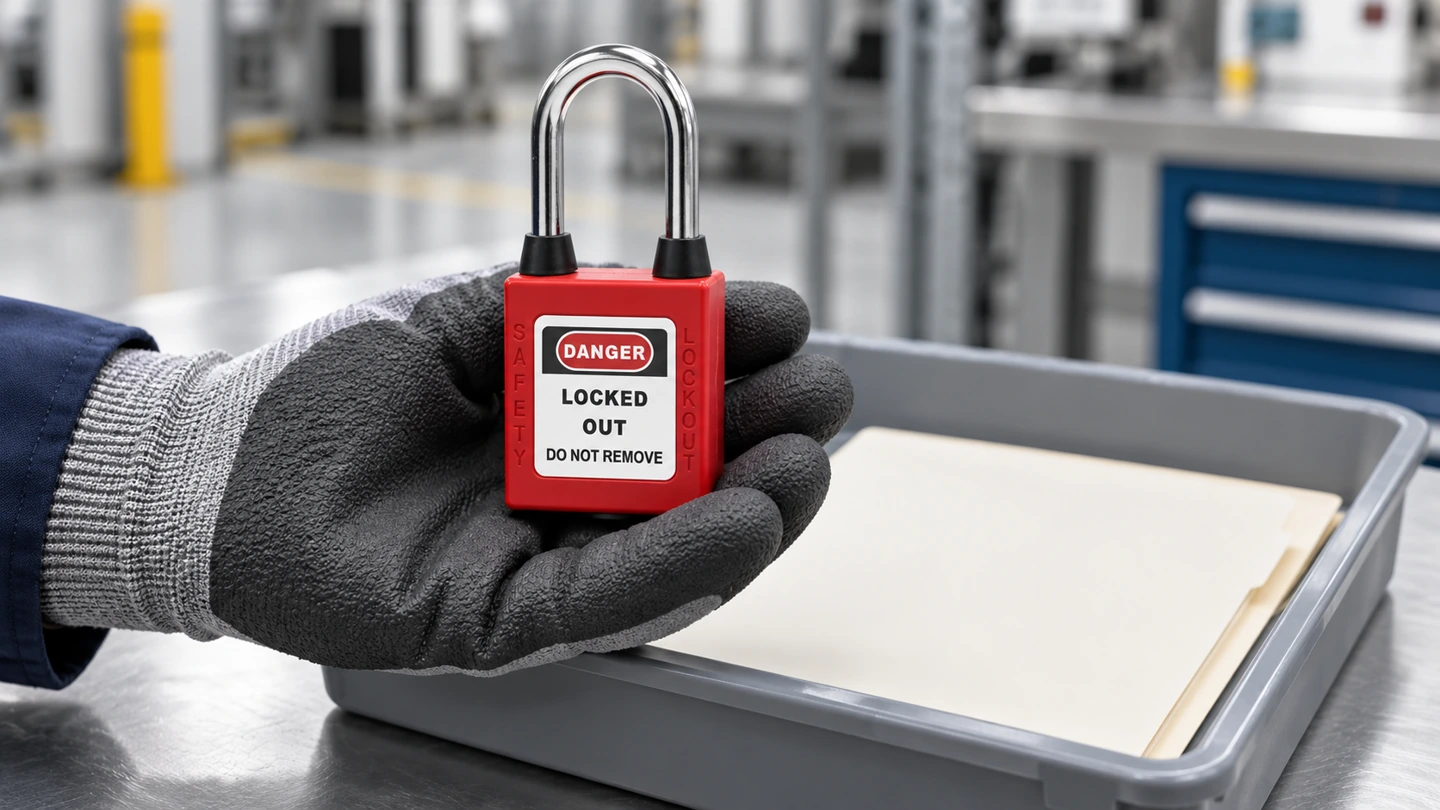
A useful pre-use check asks whether the lock can perform its intended function with the approved device. Look for cracking, deformation, corrosion, loose parts, damaged keys and identification that no longer links the lock to its assigned employee. Operate the lock as instructed by its manufacturer in a controlled setting; do not invent a force test or apply an unapproved lubricant.
A fault list is a screening aid, not a repair manual. A sticky cylinder, uncertain latch or altered shackle should be referred for competent review. Where the supplied model includes key retention, check its operation against that model’s instructions. Some locks intentionally behave differently, so lack of retention alone cannot be declared a defect for every design.
| Inspection area | Question | Response to uncertainty |
|---|---|---|
| Body and shackle | Any damage or deformation affecting function? | Remove from ready issue and review |
| Cylinder and key | Is operation reliable under the instructions? | Do not force; follow supplier guidance |
| Locking action | Does the assembly close and retain correctly? | Quarantine a doubtful result |
| Identification | Can the assigned worker be identified? | Restore controlled identification before use |
Quarantine the lock and control its replacement
Keep the suspect device out of ready stock and record its identifier, observed problem and assigned employee. An inspection should not create a gap in protection on an active job. Any transition involving an applied lock must follow the employer’s procedure, with continuity maintained; it is not an invitation to cut the lock off for convenience.
A replacement may have a different shackle, body size or key arrangement even when it looks similar. Recheck the intended accessory and update the issue record before release. The personal lock and key-control guidance explains why a spare key requires administrative control, while the device selection guide puts that replacement in its wider isolation context.
| Event | Record to update | Additional check |
|---|---|---|
| Damaged lock returned | Condition and quarantine record | Impact on any active work |
| Replacement issued | Worker and lock identity | Key allocation and device fit |
| Key lost or duplicated | Key-control exception record | Potential unintended access |
| Repeated similar failures | Supplier and exposure review | Whether the specification needs changing |
Keep condition checks distinct from procedure inspections
Under 29 CFR 1910.147(c)(6), an energy control procedure inspection is required at least annually and must meet the specified independence and review requirements. That is a program check. It does not mean a padlock may go unchecked between annual inspections, nor that every lock must automatically be discarded after one year.
The employer should establish condition checks and replacement criteria consistent with manufacturer guidance and exposure. A lock used in wet washdown, abrasive dirt or aggressive chemicals needs an evidence-based suitability review. Do not assign an insulation rating, chemical resistance or lifetime from the body color or a general product photograph. OSHA’s hardware and program rules apply within the standard’s scope; they are not a brand approval scheme.
Release replacement locks through an accountable process
Use a clear sequence: identify and segregate the suspect lock, assess any effect on active protection, authorize replacement, then verify identification, key ownership and compatibility before issue. QVAND padlock options can be reviewed against that specification. Retain a simple record of recurring faults so procurement can distinguish normal wear from unsuitable exposure or a changed product variant. Replacement cost should include administrative time and interruption as well as the lock’s purchase price, without assuming an unverified failure rate.
Frequently asked questions
Which defects should be included in a lockout padlock inspection?
Include the body, shackle, cylinder, key, locking action and readable employee identification. Check any model-specific feature such as key retention against the supplied instructions.
When should a damaged or unreliable padlock be replaced?
Remove a lock from ready use when damage or unreliable operation casts doubt on its function. The employer’s process should determine replacement or supplier review; appearance alone is not an acceptance criterion.
How should replacement locks preserve the site's key-control and identification system?
Record the new lock identifier and assigned employee, control the keys and verify the replacement against the approved device. Retire or segregate the old lock so it cannot return unnoticed.
What is a safety lockout padlock?
It is a padlock used within an established hazardous energy control arrangement. Its suitability depends on function, identification, environment and compatibility, not simply a safety label.
Why should lockout padlocks be dedicated to energy control?
Dedicated use supports the singular identification and energy-control-only requirement in 29 CFR 1910.147(c)(5)(ii). A lock used for a toolbox should not casually circulate as a personal isolation lock.
Which insulation or durability claims require model-specific evidence?
Insulation, temperature and chemical-resistance claims need evidence for the actual model and conditions. A polymer body does not prove that the shackle or the whole assembly is nonconductive.
Which padlock dimensions must match the lockout device?
Check shackle diameter, usable internal height and width, and the body’s clearance around the device. Also verify space to operate the key and remove the padlock without disturbing the arrangement.
References
- 29 CFR 1910.147 — Control of hazardous energy
- CCOHS — Lockout/Tag out
- CCOHS — Hazardous Energy Control Programs
A replacement is complete only after protection, identity and key control have all been preserved.
Compare the relevant QVAND product options against your documented application, and contact the team with the actual equipment details, photographs and evidence requirements.