
When a maintenance planner in Cleveland tried to prepare a conveyor shutdown, the new lockout kit could not secure the compressed-air valve handle. In this illustrative scenario, the electrical disconnect accepted a lock, but the mechanical work still could not start. The purchasing problem was an incomplete isolation-point survey: the kit had been selected by its piece count instead of the machine’s energy sources.
Summary: Select lockout devices to hold each identified energy-isolating device in its required safe position. Under 29 CFR 1910.147, the employer’s program also needs procedures, training and periodic inspections, with procedure inspections at least annually. Build a point-by-point device list, check the actual padlock and hardware fit, and verify isolation before servicing begins.
This guide focuses on choosing and managing hardware. A device purchase supports an energy-control program, but it cannot establish that a machine has been isolated or that stored energy is controlled.
Identify the isolation point before choosing hardware
The regulation distinguishes an energy-isolating device from the lockout device that secures it. A manually operated disconnect, circuit breaker, line valve or block may isolate energy. A lockout accessory and padlock hold that isolator in the required position. Push buttons, selector switches and other control-circuit devices are not energy-isolating devices under 1910.147(b).
Begin with the equipment-specific procedure and trace all relevant sources: electrical, pneumatic, hydraulic, mechanical, thermal and any other hazardous energy. CCOHS explains that residual energy can remain after the primary supply is disconnected. Closing an air supply valve, for example, does not establish that downstream pressure has been released.
Record the isolator location, required position, accessible locking feature and stored-energy controls. For an illustrative machine with one electrical disconnect and one pneumatic isolation valve, the inventory contains at least two distinct isolation points. That count is a planning example, not a prescription for other equipment.
The scope of 1910.147 is servicing and maintenance where unexpected energization, startup or stored-energy release could injure employees. Electrical exposure from work on or near conductors involves Subpart S requirements as well. Decide the applicable work practice before buying devices.
Compare lockout devices by the job they perform
Use the following comparison to define the purchasing requirement. Each entry describes a hardware role, not a promise that every product in that category fits every isolator.
| Device category | Primary job | Fit evidence to obtain | Important limit |
|---|---|---|---|
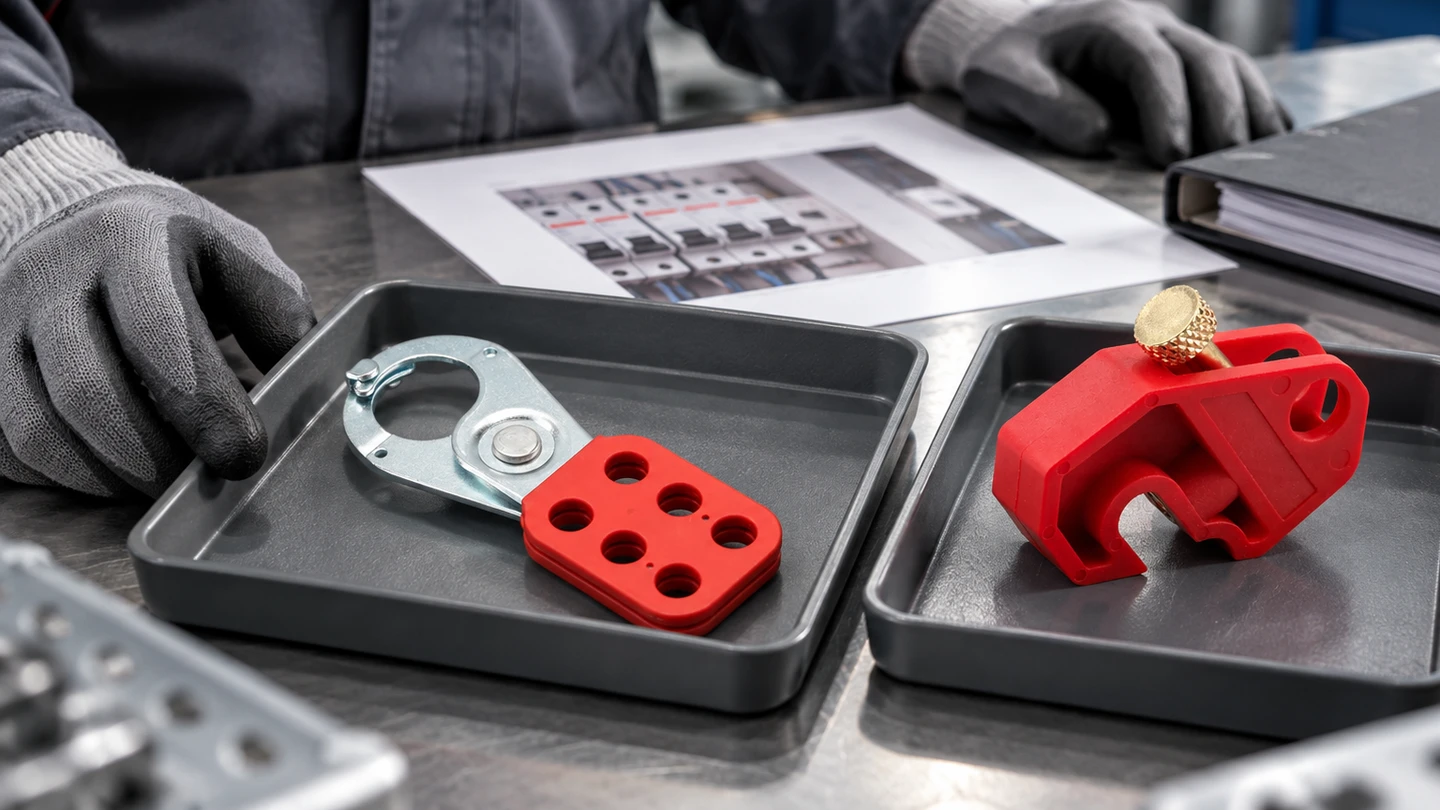
| Lockout padlocks | Provide the locking means and identifiable personal control | Shackle diameter, usable clearance and key-control arrangement | A padlock cannot secure an incompatible attachment point |
| Breaker lockout accessories | Retain a specified breaker operating mechanism in its required position | Breaker model, handle or pin geometry and installed clearance | Handle position alone does not verify absence of voltage |
| Valve lockout devices | Restrict operation of the specified valve mechanism | Valve type, handle geometry, operating position and nearby obstructions | They do not drain pressure or establish valve seat integrity |
| Lockout hasps | Allow multiple personal locks at a suitable point | Jaw fit, closure geometry and simultaneous padlock clearance | A hasp is not the complete group-control procedure |
| Cable lockout systems | Secure appropriate irregular or multiple locking features | Approved routing, tension and device-specific retention instructions | A loose cable or unsuitable routing can leave movement possible |
Under 1910.147(c)(5), lockout and tagout devices must meet requirements for durability, standardization, substantial construction and identification. The rule does not provide a universal model list or certify a supplier’s entire catalog. Review the product against its application and the employer’s procedure.
For valve work, the valve lockout guide explains why valve form and the isolation task must be considered together. Do not infer fit from nominal pipe size alone.
Build a device-to-point purchasing matrix
A short matrix makes missing evidence visible before ordering. Keep the acceptance criteria specific enough for another trained person to repeat the fit review. Section 1910.147(c)(4) requires procedures to address placement, removal and transfer of devices, responsibilities, and verification requirements.
| Planning dimension | Record before purchase | Acceptance evidence |
|---|---|---|
| Equipment identity | Machine ID, procedure revision and isolation-point reference | The proposed accessory is assigned to the correct point |
| Physical interface | Locking feature, operating travel and access constraints | Model drawing and a controlled sample-fit review |
| Personal locking | Selected padlock, key assignment and expected workers | Locks fit and the required control arrangement is maintained |
| Environment | Moisture, chemicals, temperature and handling exposure | Manufacturer documentation appropriate to actual conditions |
| Verification | Method for confirming energy control before work | Procedure-specific checks by trained personnel |
| Replacement supply | Approved device revision and reorder information | Substitutions receive fit review before issue |
For a mixed maintenance inventory, examine lockout padlocks and valve lockout devices as separate purchasing lines. Combining them in one kit does not remove the need to confirm each interface.
Keep application and verification as separate tasks
The application sequence in 1910.147(d) has six numbered elements: preparation for shutdown, machine shutdown, isolation, device application, stored-energy control and verification. These are regulatory elements, not permission to replace the equipment-specific procedure with a generic six-line checklist.
After applying the hardware, address hazardous residual or stored energy. Where reaccumulation is possible, the regulation calls for continued verification until servicing is completed or the possibility no longer exists. A visible padlock is therefore evidence of an applied lock, not proof that every hazard has been eliminated.
For group work, 1910.147(f)(3) requires protection equivalent to personal lockout. Each authorized employee must attach a personal device to the group lockout device, group lockbox or comparable mechanism when beginning work and remove it when stopping work. Define responsibility for the overall isolation and continuity across crews.
Tags communicate warnings and identification. They do not provide the physical restraint of a lock. Where tagout is used on a lockable isolator, the employer must demonstrate the equivalent protection required by the regulation. A tag’s attachment requirement of at least 50 pounds unlocking strength under (c)(5)(ii)(C)(2) concerns the attachment means, not a strength rating for a padlock.
Purchase for repeatable use and controlled replacement
Use five procurement actions: complete the isolation survey, identify the exact hardware interface, check the intended padlock, obtain a sample for the approved fit review, and record the accepted configuration. Ask QVAND for model-specific information and samples when sourcing devices, rather than treating a broad catalog compatibility statement as acceptance evidence.
Total cost includes selection work, training, issue control, replacement stock and downtime caused by an unsuitable device. As an illustrative purchasing calculation, a sample review costing $120 would cost less than a $200 return-and-reorder exercise, before any delay is counted. Those amounts are hypothetical, not quoted product prices or documented savings.
For U.S. general-industry applications, use 29 CFR 1910.147 for its applicable hazardous-energy-control duties. Use 1910.333 where the work involves the electrical exposures it covers. CCOHS guidance describes Canadian practice and references CSA Z460, so it provides useful technical context without replacing applicable U.S. rules. Neither an OSHA citation in a brochure nor a CE logo establishes that a complete employer program complies.
Frequently asked questions
What are lockout devices?
Under 1910.147, a lockout device uses a positive means such as a lock to hold an energy-isolating device in a safe position and prevent energization. Selection must match the actual isolator and the employer’s established procedure.
What types of lockout devices are available?
Common categories include padlocks, breaker accessories, valve covers or restraints, cable systems and group-locking hasps. The appropriate combination depends on the equipment’s energy sources and physical interfaces, not simply the number of items in a kit.
How are lockout padlocks used?
Authorized employees apply them to appropriate energy-isolating devices or accepted lockout accessories under the established procedure. Personal identification, key control, stored-energy measures and verification remain necessary parts of the work.
What are valve lockout devices?
They are accessories used to secure specified valve operating mechanisms in the position required for isolation. A closed and locked handle does not itself prove pressure release, leak-tight isolation or control of every connected source.
Does buying a lockout kit make a workplace OSHA compliant?
No. Hardware is one part of the employer’s program, which also includes appropriate procedures, training and periodic inspections. Confirm that the kit fits actual points and supports the applicable work practices.
References
- 29 CFR 1910.147, control of hazardous energy, via Cornell LII, especially (b), (c)(4)–(6), (d) and (f)(3).
- 29 CFR 1910.333, electrical work practices, via Cornell LII.
- CCOHS: Lockout/Tag out.
- CCOHS: Hazardous Energy Control Programs.
A useful lockout inventory starts with the equipment’s isolation points and ends with a configuration the workforce can apply consistently.
Review QVAND’s lockout devices range, then send your isolation-point details for selection support. Include equipment identification, interface photographs and the intended personal locking arrangement.