
When Houston EHS manager Maria Lopez stopped a planned pump-maintenance job, she had just seen a locked handwheel move enough to reopen a steam line. The visible failure looked like a weak lock, but the review found the clamp was sized for a smaller stem, the procedure omitted a closed-position check, and the device clashed with the valve guard. The lesson was selection and process control—not simply “buy a better product.”
How Valve Lockout controls hazardous energy in practice?
A useful valve lockout sequence has five checks: identify every energy source, shut and isolate the valve, apply a personal lock and tag, release or restrain residual pressure, and verify isolation at the point of work. A supervisor should record the valve ID, normal position, lockout method, and test result; a 10-minute review can prevent hours of rework after a near miss.
Valve geometry determines the control method. A quarter-turn handle may need a compact enclosure, while a rising-stem gate valve may need a split device with a measured stem range. A valve lockout device should prevent operation without bending the handle, obscuring identification, or creating a new pinch point. For a process with multiple operators, a group box or hasp can preserve personal control while one isolation point serves the whole crew.
For a practical reference on fixed valve isolation, see the safety valve lockout range; the procedure still needs site-specific engineering review.
Which Valve Lockout designs fit common isolation points?
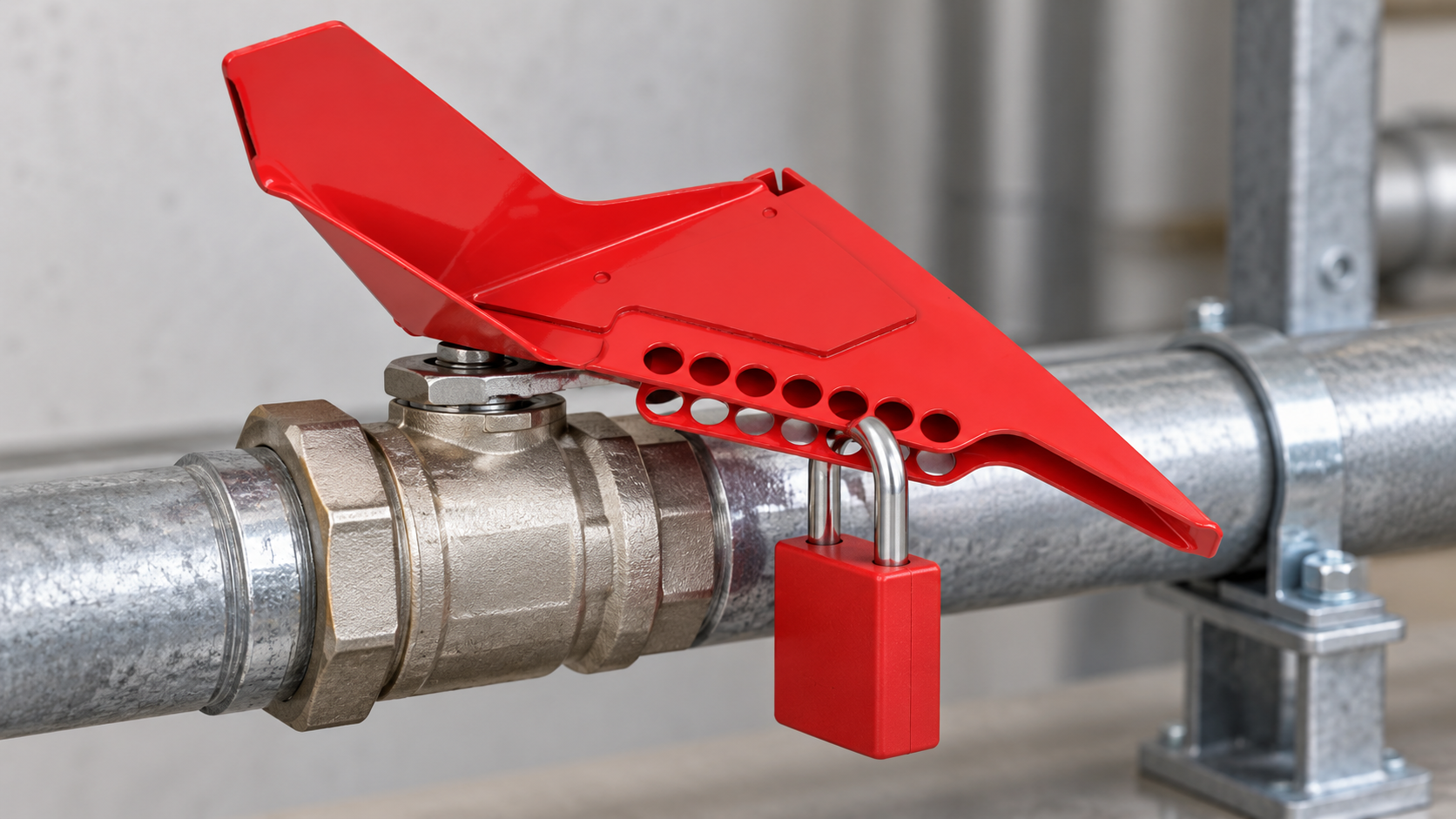
Selection should follow the valve, not the other way around. Compare the handle travel, stem diameter, access angle, temperature, chemical exposure, and whether the valve is in a guarded or congested location. A ball valve lockout must stop the handle from reaching the open position and leave enough room for a lock body and tag to remain visible.
| Isolation point | Typical control | Primary fit check | Operational trade-off |
|---|---|---|---|
| Quarter-turn ball valve | Two-piece or sliding enclosure | Handle width, stem and pipe clearance | Fast application; limited by unusual handle shapes |
| Gate or globe valve | Wheel cover or adjustable device | Wheel diameter and stem rise | Broad coverage; larger storage footprint |
| Butterfly valve | Handle-blocking device | Handle profile and travel arc | Compact; verify the disc cannot creep |
| Pneumatic or hydraulic valve | Dedicated isolator plus bleed-down | Actuator layout and residual pressure | More steps; stronger energy verification |
Use the ball valve lockout product family when a quarter-turn valve is confirmed; do not substitute it for a gate-valve device because both are red and look similar at a distance.
How to select Valve Lockout with a defensible procurement process
- Map the isolation point: valve type, dimensions, operating position, access, and stored-energy path.
- Specify the failure mode to prevent, then require a fit trial and a closed-position verification step.
- Review environmental exposure, lock and tag visibility, group-locking needs, cleaning, and inspection intervals.
- Compare TCO using rework, training, replacement, and return data; label any forecast as illustrative.
- Request drawings, material information, inspection guidance, and traceable documentation before approving a purchase.
QD LOTO can support this process with configurable lockout products and sourcing documentation; the buyer remains responsible for the site risk assessment and procedure approval. A restrained specification review is usually more valuable than choosing a device from a photograph.
Frequently Asked Questions
What are the different types of valve lockout devices?
Common types include ball-valve enclosures, gate-valve wheel covers, butterfly-valve handle blockers, adjustable devices, and cable systems. Choose by geometry and energy state, then verify that the applied device prevents operation and remains identifiable throughout the job.
What are four types of LOTO devices?
Four broad groups are lockout hardware, tagout labels, hasps or group lock boxes, and cable or specialized isolation devices. The exact mix depends on the energy source; a tag alone does not provide the physical restraint required where lockout is feasible.
How to lockout a ball valve?
Identify the valve, turn the handle to the approved closed position, fit a correctly sized ball valve lockout, attach the personal lock and tag, bleed or restrain residual energy, and verify zero energy. If the handle or clearance does not match, stop and select another device rather than forcing the fit.
What is valve lockout?
Valve lockout is the physical isolation of a valve so it cannot be operated while servicing is underway. It is one part of a broader hazardous-energy procedure that also covers notification, shutdown, stored-energy release, verification, and controlled restoration.
References
- eCFR, 29 CFR 1910.147
- Canadian Centre for Occupational Health and Safety, Lockout
- UK HSE, HSG253: The safe isolation of plant and equipment
- UK HSE, PUWER guidance
The reliable lockout is the one that fits the asset, survives the environment, and is verified by the person doing the work. Review your next isolation list with QD LOTO and request product and sourcing support before the shutdown window is fixed.