
When a maintenance supervisor in Dayton prepared an overnight pump repair, the incoming technician found that the replacement padlock shared a key with an untracked spare. In this illustrative scenario, work paused before handover. The lock body was usable, but the issue register could not establish who controlled its removal. The problem came from key management rather than the padlock’s appearance.
Summary: A padlock LOTO arrangement needs an identifiable lock, a defined key custodian and a handover procedure that preserves protection. Section 1910.147(f)(4) requires orderly transfer during shift or personnel changes. Match the keying arrangement to the employer’s personal-control procedure, control duplicate keys and confirm the selected lock fits its isolation hardware.
This guide addresses custody and transfer rather than repeating general padlock selection advice. The term “lockout safety padlock” identifies the intended use, but it does not describe a complete key-management system.
Define who controls each lock and key
Under 29 CFR 1910.147(c)(5), lockout and tagout devices must be singularly identified, dedicated to energy control, suitable for their environment and standardized within the facility in at least one specified way. Identification must indicate the employee applying the device. Color can support the facility’s system, but OSHA does not prescribe one universal padlock color.
A practical issue record links a lock identifier, authorized employee, key code or key-system reference, and date of issue. Keep that information separate from the equipment-specific procedure, which describes where and how the lock is used. An accurate record helps prevent an apparently identical spare from being substituted without review.
CCOHS describes the lockout device as an individually keyed means of securing an energy-isolating device under Canadian guidance. For a U.S. site, evaluate the actual personal-control arrangement against the applicable OSHA requirements and employer procedures. Avoid presenting every keying option offered by a supplier as automatically suitable for personal lockout.
For example, issuing one personal lock and retaining one uncontrolled duplicate key creates two potential paths to removal. The number of keys supplied is not itself a compliance conclusion. The relevant question is who can use them, under what procedure, and how access is recorded.
Compare keying arrangements before ordering
Keying names describe which keys operate which locks. They do not establish who should hold those keys. Specify the intended relationship in plain language on the purchase order and test the delivered samples against it.
| Arrangement | Key relationship | Potential purchasing use | Control question |
|---|---|---|---|
| Keyed different | Locks are intended to have different operating keys | Separate personal lock assignments | How are duplicate keys and code collisions controlled? |
| Keyed alike | One operating key opens a defined set of locks | A defined set controlled within an approved arrangement | Could another exposed worker’s protection be removed? |
| Master-keyed | Individual keys operate assigned locks; a master key opens a defined group | Only where employer policy permits and controls the arrangement | Who holds the master key, and what prevents routine bypass? |
A master key is not authorization to remove a worker’s protection. Under 1910.147(e)(3), devices normally must be removed by the employee who applied them. The exception requires employer direction, specific documented procedures and training, and safeguards including checking that the employee is absent, making reasonable efforts to contact them, and ensuring they know about removal before returning to work.
For background on the key relationship itself, see the existing keyed-different lockout padlock guide. Procurement documents should identify the requested keying system without assuming that a marketing abbreviation defines the site’s removal authority.
Make the shift handover a controlled transfer
Section 1910.147(f)(4) requires specific procedures that preserve continuity of protection during shift or personnel changes. It does not provide one handover method suitable for all sites. The procedure must define how outgoing and incoming personnel transfer responsibility without leaving an unprotected interval.
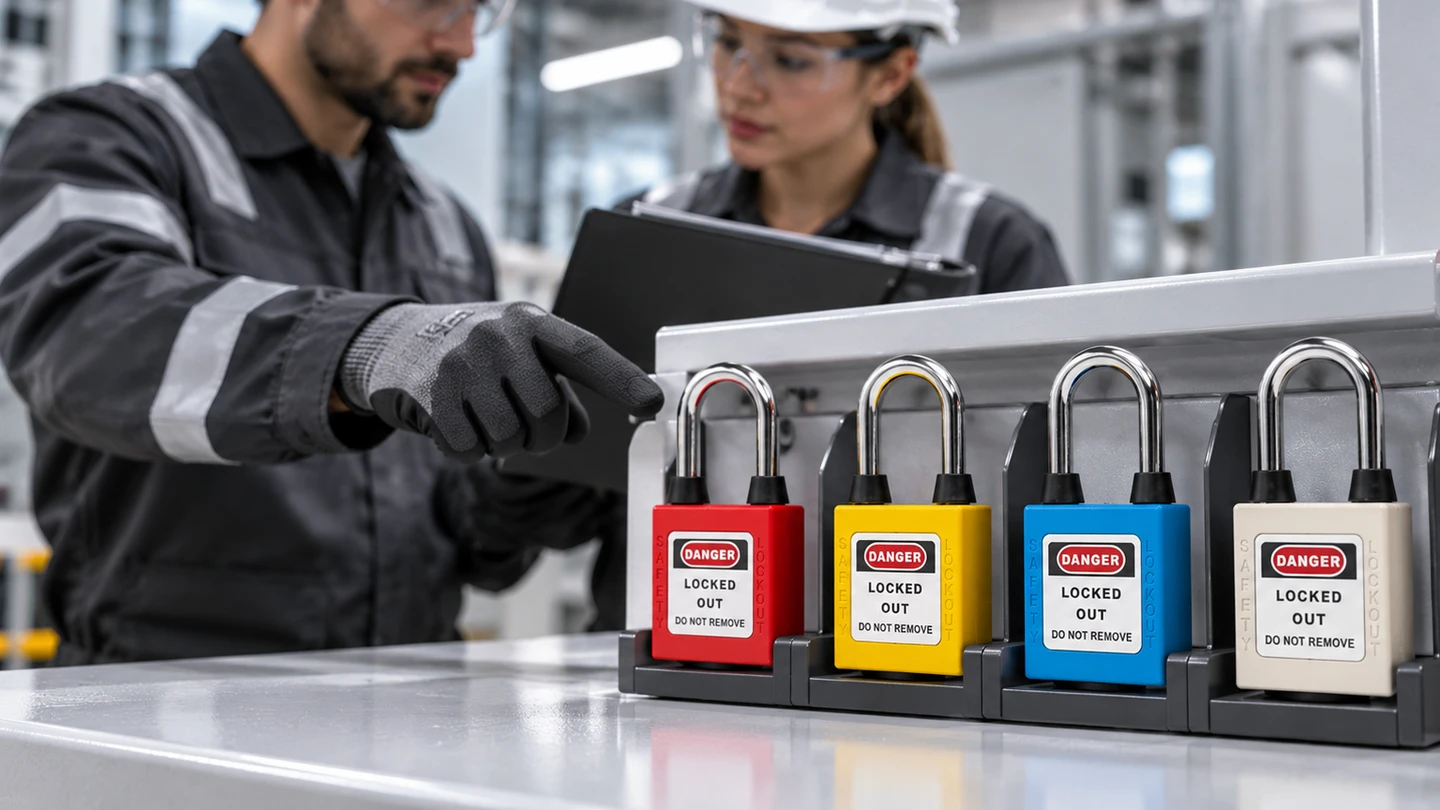
Before handover, identify the equipment, active isolation points, workers covered, outstanding work and stored-energy controls. Determine the locking arrangement required for the incoming employee under the approved procedure. Establish a clear acceptance of responsibility before the outgoing protection is released in the manner that procedure permits.
For group work under 1910.147(f)(3), each authorized employee attaches a personal device to the group lockout device, group lockbox or comparable mechanism when beginning work, and removes it when stopping work. Assign overall responsibility and a way to determine each group member’s exposure status. A shared key ring alone does not document these responsibilities.
Keep the record short enough to use during a real shift change. An illustrative entry might identify one pump, two isolation points and the procedure revision, then list outgoing and incoming responsibility. Those quantities describe an example only. The actual equipment survey determines the required isolation scope.
Inspect the physical padlock and the issue record together
A correct key assignment cannot compensate for a shackle that does not pass through the accessory, and a correct physical fit cannot compensate for uncontrolled removal access. Review both sides before releasing the lock for service. Section 1910.147(c)(5) sets functional requirements rather than a universal shackle dimension.
| Record or component | Check before issue | Reason to stop and resolve |
|---|---|---|
| Lock identification | Readable ID linked to the assigned employee | Missing, duplicated or unreadable identity |
| Operating key | Specified key opens only the intended lock or defined set | Unexpected cross-opening or ambiguous code |
| Duplicate or master key | Documented custody and access limits | Uncontrolled copies or unassigned holders |
| Shackle and accessory | Diameter, reach, closure and access checked together | Lock cannot close, accessory remains removable or fit is uncertain |
| Body, label and mechanism | Readable identification and reliable mechanical operation | Damage, binding or deterioration affecting intended use |
Choose from safety padlock configurations after documenting the required interface. A plastic body or nylon component does not by itself establish an electrical-insulation rating for the entire assembly. Obtain appropriate product evidence and follow the applicable electrical work practices.
Specify a manageable replacement and audit process
Use four purchasing actions: define the key relationship, assign key custody, confirm the physical fit, and record how replacements enter the system. QVAND can be asked for a model-specific keying proposal, identification options and sample locks for the buyer’s own acceptance checks. Resolve ambiguous catalog wording before approving an order.
Include replacement-lock administration in total cost. As a hypothetical example, checking a replacement batch for 30 minutes at an internal labor allowance of $40 per hour creates a $20 review cost. This illustrates a budgeting method, not a product price or a measured return on investment. Compare that cost with the time needed to investigate unidentified keys or incorrectly issued locks.
Under 1910.147(c)(6), the periodic procedure inspection must occur at least annually and be performed by an authorized employee other than those using the procedure being inspected. The issue register can support that review, but it does not replace the required review of procedure implementation and employee responsibilities.
For U.S. applications, OSHA requirements govern the employer’s program where applicable. CCOHS material provides Canadian context and refers to CSA Z460. A keying arrangement, custom label or claimed “OSHA padlock” designation is not independent certification that the employer’s program meets either framework.
Frequently asked questions
What does padlock LOTO mean?
It refers to using a padlock as part of lockout/tagout energy control. The padlock secures an appropriate isolation point or lockout accessory, while procedures define identification, application, verification and removal.
Is a lockout safety padlock different from a security padlock?
The intended management role is different: lockout hardware is dedicated to energy control and must support the applicable identification and device requirements. An ordinary security lock should not be substituted merely because it fits the hole.
Should every worker’s LOTO padlock have a different key?
Individually controlled keys are a common way to support personal control. Define the site’s requirements, control spare keys and confirm the delivered keying relationship rather than relying on the abbreviation “KD” alone.
Can a supervisor remove another employee’s lock?
Normal removal is by the employee who applied it. Removal under the employer’s exception procedure must satisfy 1910.147(e)(3), including the documented safeguards and employee awareness requirements. Supervisory status or possession of a master key alone is insufficient.
How should LOTO padlocks be transferred between shifts?
Use the employer’s specific shift-change procedure to maintain continuous protection and an orderly transfer of responsibility. Record the equipment and isolation status, apply the required incoming protection, and release outgoing protection only as the approved procedure allows.
References
- 29 CFR 1910.147, via Cornell LII, especially (c)(5)–(6), (e)(3) and (f)(3)–(4).
- CCOHS: Lockout/Tag out, individual responsibility and program guidance.
- CCOHS: Hazardous Energy Control Programs, energy identification and control context.
Personal protection is easier to manage when the lock, key and responsible person remain traceable throughout the job.
Review QVAND’s steel-shackle LOTO padlock options and request a keying and sample-fit review. Provide the proposed key-custody arrangement, identification needs and the accessory the padlock must secure.