
When a maintenance supervisor in Suzhou found a production line still energized after a planned shutdown, she checked the isolation point, the tags, and the shift log. The visible failure was rapid: a contractor had removed the wrong red padlock after finding a key that turned. A second check showed the root cause was selection and key control, not a broken product; several locks had been supplied with interchangeable keys.
A Lockout Padlock Keyed Different clarifies the personal-control principle
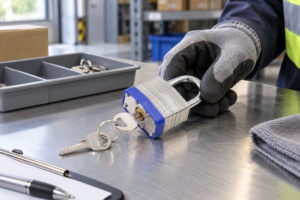
Keyed different means each padlock is cut to a different key combination, so a key issued to one person should not operate another person’s lock. In practical terms, the arrangement makes the lock a visible ownership device: the employee applies it, retains its key, and removes it only under the site’s authorized procedure. This is different from simply choosing a brightly colored body or printing a name on a label.
The distinction matters most where several workers share an isolation point. A lock can be physically strong and still create a control weakness if the keys are interchangeable. The honest specification therefore combines key uniqueness with durable identification, an inventory record, and training. Under OSHA 29 CFR 1910.147(c)(6), the employer’s periodic inspection must occur at least annually, so the review should include whether personal locks and records still correspond. A keyed-different plan also needs a controlled approach to replacements, because a lost key, a damaged shackle, or a changed employee assignment can otherwise break traceability.
A Lockout Padlock Keyed Different separates keys when a group lockout expands
During group work, an authorized employee isolates the hazardous energy source and places a group device over the isolation hardware. Each exposed worker then attaches a personal padlock to the device. A lockout hasp provides the extra openings that let every worker keep an individual lock in place; removing the isolation protection is not possible until the last personal lock is removed according to the procedure.
Keyed different supports that sequence by keeping personal keys separate. It does not replace the energy-control procedure, verification of zero energy, or the employer’s rules for an absent worker. OSHA 29 CFR 1910.147 is process-centered: the employer must define authorized employees, shutdown steps, verification, training, and periodic inspection. The padlock is one control element within that system.
Why interchangeable keys create an operational blind spot
When a keyed-alike set is used without a narrowly defined purpose, a worker may be able to open a colleague’s lock without permission. That can make a lockout appear complete while weakening personal ownership. A keyed-different arrangement does not prevent every human error, but it makes an unauthorized key match less likely and gives supervisors a clearer audit trail.

A Lockout Padlock Keyed Different affects total cost beyond the unit price
Procurement teams often compare a keyed-different lock with a keyed alike padlock by unit price alone. The more useful calculation includes key-code administration, replacement control, receiving inspection, spare inventory, and the cost of investigating an ambiguous removal. An illustrative calculation might compare 100 locks at two different unit-cost tendencies, then add a fixed allowance for recording each key code and a realistic reserve for lost or damaged units. The result is not a promised saving; it is a way to reveal whether a lower purchase price creates more administration later.
There are also efficiency effects. Distinct keys can slow a hurried replacement if codes are not recorded, while clear numbering and a small controlled spare stock can reduce that friction. Returns become easier to diagnose when the purchaser can match a body number, key code, worker, and purchase batch. For distributors, a documented keying plan can also reduce mixed-carton errors and make repeat orders more predictable.
A Lockout Padlock Keyed Different can be compared with other keying arrangements
| Dimension | Keyed different | Keyed alike | Procurement implication |
|---|---|---|---|
| Personal ownership | Each lock has its own key combination. | One key can operate a defined group of locks. | Choose based on who must retain control at the isolation point. |
| Group work | Works with a hasp when every worker keeps a personal lock. | Can simplify common-key access but may blur individual control. | Document the permitted operating model before ordering. |
| Key administration | Needs an accurate code and assignment register. | Needs strict control of shared or duplicate keys. | Budget for records, spares, and controlled issuance. |
| Replacement and returns | Matching the specific lock and key is important. | Replacement can be simpler within the same key group. | Set a replacement rule and carton-label check. |
| Misuse exposure | Accidental key interchange is less likely. | Interchange is an intended feature of the set. | Do not present either arrangement as automatic compliance. |
A Lockout Padlock Keyed Different fits decisions that depend on exposure
| Situation | Keying question | Useful control | Inspection evidence |
|---|---|---|---|
| One worker, one isolation point | Must the worker’s key operate only one personal lock? | Issue one identified lock and retain the key. | Worker assignment and lock number. |
| Several workers on one machine | Can every exposed person attach a separate lock? | Use a group device with separate personal locks. | Hasp or group-box record and names. |
| Multiple shifts | How will ownership transfer without sharing keys? | Define shift handover and replacement rules. | Handover log and authorized-employee list. |
| Distributor or multi-site program | Can repeat orders preserve the approved key plan? | Control codes, labels, cartons, and spares. | Purchase specification and receiving check. |
| Wet, dusty, or electrically sensitive area | Does the body material and shackle fit the environment? | Confirm application, clearance, and site requirements. | Product record and site-specific assessment. |
A Lockout Padlock Keyed Different supports a program but does not certify compliance
OSHA 29 CFR 1910.147 describes an employer’s control-of-hazardous-energy program. In broad terms, the program covers energy-control procedures, authorized and affected employees, training, periodic inspections, and the use of lockout or tagout devices that are durable, standardized, substantial, and identifiable for exclusive energy-control use. The regulation applies in the United States; a buyer must also check the destination market and the equipment-specific hazard assessment.
OSHA does not certify individual padlocks as compliant products. Keyed-different is a key-control choice that can support the program’s personal-control logic, not a blanket compliance certificate. ANSI Z244.1 can provide context for alternative methods and hazardous-energy control, while ISO 45001 can frame an occupational health and safety management system; neither should be presented as a product certification unless a recognized body and applicable scope are actually documented.
Commercially, unsupported certification language can mislead the purchaser, create tender disputes, and weaken an otherwise sound safety program. Ask for the intended-use description, material and dimensional information, identification method, keying schedule, and available inspection or test documentation. Treat any claimed standard, test method, or certificate as a statement that must be checked for scope and issuer.
A Lockout Padlock Keyed Different should be specified through five purchasing actions
- Define ownership. State whether each worker, crew, or authorized role receives a dedicated lock and who retains each key.
- Define the key plan. Request keyed-different combinations where personal key control is required, and record approved codes without printing sensitive key information in an open document.
- Check fit and environment. Confirm shackle clearance, body material, identification space, and compatibility with the isolation hardware; for electrically sensitive areas, review the site risk assessment.
- Plan the group method. Select the group device, such as a multiple-opening group device, and verify that every exposed worker can apply a personal lock.
- Inspect the supply. At receiving, match quantity, color or identification, keying arrangement, labels, and packaging against the purchase specification before distributing locks.
QD LOTO can support a buyer that needs configurable lockout products and a clear sourcing specification. For example, its Lockout Padlock Keyed Different product route can be evaluated alongside the site’s key register, environment, and group-lockout method; the final decision should remain tied to the employer’s documented program.
Frequently Asked Questions
Can lockout locks be keyed alike?
Yes, a keyed alike padlock arrangement can be selected when a documented operating model requires one key to work across a defined set of locks. It should not be treated as a universal substitute for personal ownership; the employer must assess who may hold the shared key and how access is controlled.
What are the seven steps of a lockout/tagout procedure?
The familiar sequence is preparation, shutdown, isolation, lockout/tagout application, release or restraint of stored energy, verification, and return to service. The exact written procedure must match the machine, energy sources, authorized employees, and employer program under the applicable regulation.
What are the different types of lockout locks?
Common categories include safety padlocks with different keying arrangements, non-conductive bodies for specified environments, and specialized designs such as laminated or pin-style padlocks. The correct type depends on the energy-control task, physical fit, identification needs, and documented site assessment rather than color alone.
How does a lockout hasp work?
This device attaches to an isolation point and provides multiple openings for individual worker locks. Each exposed worker keeps a personal lock in place, so the hasp cannot be removed until the authorized removal process allows the last lock to come off.
References
- OSHA 29 CFR 1910.147, The control of hazardous energy.
- OSHA, Control of Hazardous Energy (Lockout/Tagout).
- eCFR, 29 CFR 1910.147.
- Canadian Centre for Occupational Health and Safety, Lockout/Tagout.
A key that opens only its assigned lock is a small specification with a large ownership signal; the real safeguard is the complete system of people, records, verification, and disciplined removal.
When your team is setting a keyed-different schedule or replacing mixed lock stock, review the application with QD LOTO and request a documented quotation. The laminated pin padlock option can be considered as part of that final product and key-control decision.