
Toledo EHS manager Maria Keller had technicians lock a conveyor disconnect with a six-hole hasp during a jam. A reset attempt moved the handle—one lock sat in an incompletely closed shackle hole. The issue was mismatched shackle size and an unverified step, not a faulty hasp.
How do lockout hasps hold an isolation point for several workers?
The hasp is installed after shutdown and isolation, before each worker applies a lock. Its interlocking jaws prevent the device from opening while any shackle occupies a hole. These lockout hasps do not dissipate electrical, hydraulic, pneumatic, or gravitational energy; they only prevent operation of the isolating control. OSHA 1910.147(d)(3) requires authorized employees to verify isolation, so a successful fit check must be followed by a start attempt or other documented verification.
Hole count is a capacity limit, not a safety rating. A four-hole model supports four personal locks; a six-hole model supports six, with a group lockbox used when the crew is larger. A simple pre-job count prevents a late substitution that would violate the written procedure.

A group lockout succeeds when every worker controls one visible hole and one personal key.
Which design details make lockout hasps reliable in daily use?
Specify jaw opening, hole diameter, body material, and clearance together. A 1/4-inch shackle hole may accept a typical safety padlock, while a 3/8-inch hole can suit heavier shackles but may not fit a compact disconnect eye. Powder-coated steel improves visibility and corrosion resistance; stainless steel is useful in washdown or outdoor areas. Inspect the hinge or sliding joint for free movement and check that a closed jaw cannot be pulled past the isolation eye.
Use a documented visual inspection at each application and a periodic functional check. OSHA 1910.147(c)(6) requires periodic inspection of the energy-control procedure at least annually; include hasp condition, hole integrity, and legibility of attached tags in that review. The honest cost measure is total cost of ownership: a few seconds spent matching dimensions can avoid a line restart, rework, or a recordable exposure.
In a group lockout, the hasp is the mechanical handoff between the isolation point and each person’s control. One jaw fits the disconnect eye or a group lockbox point; the opposite plate provides separate holes for personal safety padlocks. In supplier catalogs, loto hasps and a group lockout hasp describe this same multi-person control pattern. If any lock remains, the hasp cannot be removed and the isolation cannot be restored. The U.S. OSHA rule treats this hardware as part of an overall energy-control program, while Canada’s CCOHS guidance emphasizes identification, isolation, verification, and release in the same sequence.
How should buyers compare lockout hasps for a real job?
| Option | Performance | Efficiency | Durability and maintenance | Compatibility and TCO |
|---|---|---|---|---|
| Economy steel, 4-hole | Basic multi-person control | Fast for small crews | Inspect coating and joint each use | Low unit-cost tendency; returns rise if hole or jaw is wrong |
| Heavy-duty steel, 6-hole | More users on one point | Reduces lockbox handoffs | Better resistance to bending; clean after wet work | Moderate unit-cost tendency; lower changeover cost for planned teams |
| Stainless, 6-hole | Stable in corrosive service | Supports washdown routines | High corrosion resistance; still inspect deformation | Higher unit-cost tendency; may lower replacement and downtime costs |
| Non-conductive coated model | Useful near identified electrical hazards | Simple visual differentiation | Check coating for chips; do not infer electrical certification | Compatibility depends on the site procedure, not color alone |
How can teams select lockout hasps without slowing the job?
- Map each isolation point and record the eye diameter, available clearance, energy type, and maximum crew size.
- Match jaw and hole dimensions to the site’s personal padlocks; trial-fit a sample with gloves before approving a SKU.
- Write the hasp step into the sequence: shutdown, isolate, apply hasp and personal locks, release stored energy, then verify.
- Set replacement triggers for bent plates, distorted holes, seized joints, illegible tags, and failed fit checks.
QD LOTO can help teams configure a hasp around the measured isolation point and documentation needs. Start with the lockout hasps range, then cross-check a safety padlock hasp against the padlocks already issued.
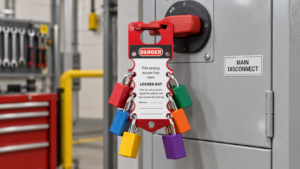
Application detail: the hasp jaw must fully capture the disconnect eye before locks are added.
What questions do lockout hasps answer for supervisors?
What is a hasp in LOTO?
A hasp is a lockout device with interlocking jaws and multiple holes so several authorized workers can attach personal padlocks to one isolation point. It keeps the control unavailable until every lock is removed. Confirm the hasp fits the specific disconnect and procedure before use.
What are two types of lockout devices?
Two broad types are energy-isolation devices, such as breaker or valve lockouts, and securing devices, such as hasps, lockboxes, and safety padlocks. The first blocks the energy-control mechanism; the second controls who can remove that block. A complete program normally uses both categories.
What does a lockout hasp do?
It lets multiple people place their own locks on one isolation point and prevents removal while any lock remains. It does not prove zero energy, so the authorized employee must release stored energy and perform the procedure’s verification step.
What are the four types of LOTO?
LOTO includes personal, group, complex and verification activities; terminology varies by procedure and jurisdiction. OSHA 1910.147 centers on authorized/affected employees and documented energy control steps. Use your site’s categories and train on actual equipment.
For a fixed installation, a safety padlock lockout station can keep compatible locks and hasps visible at the point of work.
References
- U.S. eCFR, 29 CFR 1910.147: The control of hazardous energy.
- Canadian Centre for Occupational Health and Safety, Lockout/Tagout.
- UK HSE, HSG253: The safe isolation of plant and equipment.
- UK HSE, Provision and Use of Work Equipment Regulations (PUWER).
When the last lock comes off, the decision should be boring: the isolation was measured, the device fit, and every person accounted for. Keep that certainty by specifying the hasp from the real dimensions, then review QD LOTO products or contact the team for a documented match to your equipment.