
When Maria Lopez, an EHS manager at a food-processing facility in Toledo, Ohio, issued six red padlocks for a conveyor repair, the night crew found that one lock slipped off the disconnect handle during the first isolation check. The visible failure looked like a weak product, but a review showed a different cause: the shackle was too short for that handle, the key-control procedure was unclear, and no one had verified zero energy before work began. Re-specifying the lock and correcting the sequence stopped the repeat failure.
Summary: Select a lockout padlock as part of an energy-control system, not as a color-only purchase. OSHA 29 CFR 1910.147 requires an employer’s written procedure, authorized-worker training, and verification of isolation; it does not certify padlocks. Measure the hasp and isolation point, define key ownership, then pilot the chosen configuration on every equipment family before standardizing it.
Safety Lockout: Start With Energy-Control Logic
A padlock prevents operation of an isolation point only when the device fits and the procedure assigns control to a specific person. Begin with the machine’s energy map: electrical, hydraulic, pneumatic, gravity, thermal, chemical, and stored mechanical energy. OSHA’s control-of-hazardous-energy guidance treats lockout as a sequence of shutdown, isolation, lock/tag application, release or restraint of stored energy, and verification.
The first specification decision is whether workers need personal locks, group-lock boxes, or both. A personal lock should identify its owner and remain under that person’s control. A group arrangement can use a lock box or multi-lock hasp, but each authorized worker still applies an individually controlled lock before entering the job. In a practical audit, record the isolation point, device model, shackle clearance, and verification method for each asset.
For Safety Lockout planning, treat fit as a measurable control: a 6 mm shackle may pass through one disconnect hole while a 9 mm shackle will not, and a body that is too wide can prevent the hasp from closing. A simple fit sample on the three most common disconnects often reveals more risk than a catalog comparison.
Safety Lockout Tagout: Match Device to Procedure
OSHA distinguishes a lockout device from a tagout device. A lock physically holds an energy-isolating device in a safe position; a tag communicates status and ownership but does not provide the physical restraint of a lock. Where an employer permits tagout, the program must provide equivalent employee protection through additional measures specified in the standard. See an example of durable warning tags for industrial status communication when building the visual part of that system.

In a Safety Lockout Tagout procedure, the padlock is one control point in a documented chain. Specify how an authorized employee notifies affected employees, shuts down equipment, isolates each source, applies locks and tags, dissipates stored energy, and proves a zero-energy state. Include restoration steps and a process for removing another person’s lock only under the employer’s written procedure.
Key policy matters as much as hardware. Keyed-different locks support individual accountability; keyed-alike sets can simplify a supervisor’s controlled set but increase the consequence of a lost key. Master keys should be tightly governed, logged, and available only under the site’s emergency-removal process. Do not print personal data on a lock that could create a privacy or security concern; use an asset or employee code tied to a controlled register.
Safety Lockout Padlocks: Specify the Hardware
When buying Safety Lockout Padlocks, write a performance-oriented specification instead of relying on “industrial” wording. Define body material and corrosion environment, shackle material and diameter, useful shackle height, body dimensions, keying plan, label area, and temperature or chemical exposure. Ask for dimensional drawings and samples so the procurement team can verify clearance on actual disconnects, valves, and hasps.
Non-conductive nylon bodies can reduce incidental electrical-conductivity concerns, while a metal body may suit impact-heavy areas; neither choice removes the need to de-energize and verify. Stainless or plated shackles may be appropriate for washdown or corrosive rooms, but confirm compatibility with the site’s cleaners. A retained-key cylinder can help keep a lock engaged until the key is returned, yet the site should still manage spare and replacement keys.
Color coding is useful for fast recognition—red for personal locks, for example—but it is not a safety control by itself. Agree on a color legend, engraving or durable label method, and a replacement trigger for unreadable identification. Test the lock with the intended hasp, breaker attachment, or valve cover while wearing the gloves used during maintenance; difficult handling is a human-factors defect that invites workarounds.
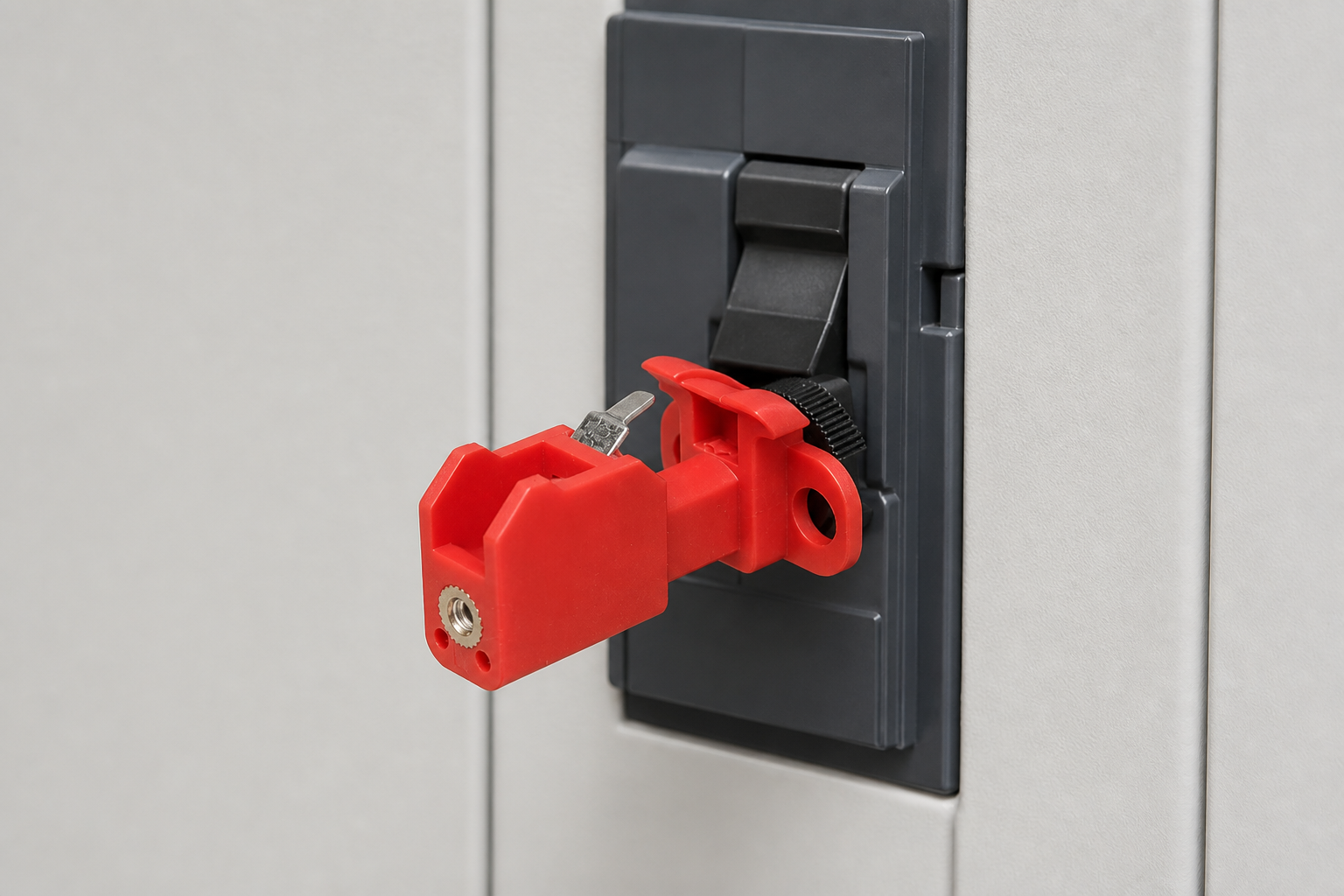
For a breaker device, check toggle profile, mounting screw access, panel depth, and whether the attachment can be pulled without moving the breaker. The authorized worker should attempt the normal operating control after application, then use the site’s electrical test method to verify absence of energy. Compare the geometry with a miniature breaker attachment where that equipment family is in scope. A lock that fits visually but prevents reliable verification is not a suitable selection.
Application Comparison for Maintenance Teams
The table below compares common configurations by the control problem they solve. The second occurrence of Safety Lockout Padlocks belongs in this decision context: the right choice depends on application and process, not on a lowest unit price.
| Configuration | Best use | Strength | Watch point | TCO implication |
|---|---|---|---|---|
| Personal keyed-different nylon lock | Individual electrical or mechanical isolation | Clear ownership and low conductivity concern | Requires disciplined key register and replacement stock | Moderate purchase cost; lower ambiguity during audits |
| Personal metal lock | Impact-prone, outdoor, or high-abrasion areas | Robust body options | Check corrosion and electrical-use restrictions | Potentially longer service life when environment is suitable |
| Keyed-alike supervisor set | Controlled task kits or one custodian’s locks | Fewer keys to manage within a defined set | Loss of one key can affect several locks | Efficient for kits; higher control requirement |
| Group hasp with lock box | Multi-person shutdowns and shift handovers | Scales personal control across a job | Box capacity and handover rules must be tested | Lower rework risk on complex outages |
Dimension Guide: Match Environment, Geometry, and Ownership
| Dimension | Questions to answer | Evidence to collect | Selection action |
|---|---|---|---|
| Energy and point geometry | What must be isolated, and what clearance is available? | Photos, measurements, equipment drawings | Sample the lock with each isolator and hasp |
| Environment | Is there washdown, dust, UV, heat, or chemical exposure? | Cleaner SDS, temperature range, maintenance observations | Choose body and shackle materials supported by supplier data |
| Ownership model | Personal, group, contractor, or shift-based control? | Roster, permit flow, handover records | Set keying, engraving, and lock-box capacity |
| Verification | How is zero energy proved for this equipment? | Meter type, try-start method, bleed-down check | Confirm the device does not obstruct the verification step |
| Lifecycle | How are damaged, lost, or retired locks handled? | Inspection log and replacement lead time | Keep controlled spares and quarantine compromised locks |
Standards and Compliance: Know What Each Document Covers
OSHA 29 CFR 1910.147 is a US workplace rule for control of hazardous energy. It places duties on the employer: an energy-control program, machine-specific procedures, training, periodic inspections, and steps for servicing and release. OSHA regulates the program and employer performance; it does not certify or approve individual padlocks.
ANSI/ASSP Z244.1 is a consensus standard that helps organizations design hazardous-energy-control methods, including lockout, tagout, and alternative methods when justified by risk assessment. It is guidance rather than an OSHA product certificate. ISO 45001 specifies requirements for an occupational health and safety management system; alignment can strengthen governance, but an ISO 45001 certificate does not prove that a particular lock fits a machine.
CE marking and RoHS have different scopes. CE obligations depend on the product and applicable European legislation; machinery rules may apply to machinery or partly completed machinery, while a standalone padlock may fall under other requirements. RoHS addresses restriction of hazardous substances in covered electrical and electronic equipment, not general hand tools. Confirm destination-market scope with a qualified compliance professional and retain the technical file or supplier declarations that support any claim.
For Safety Lockout documentation, separate three questions: does the device meet the purchaser’s specification, does the site procedure meet the applicable regulation, and is the marketing claim supported by a test report or declaration? Unsupported “OSHA certified” language can mislead buyers, trigger corrective action, and undermine an otherwise sound program.
Selection and Implementation Checklist
- Map the equipment. List every energy source, isolation point, stored-energy hazard, and verification method; involve maintenance and affected operators.
- Measure before quoting. Capture shackle clearance, hasp thickness, breaker geometry, valve dimensions, panel depth, and environmental exposure.
- Define ownership. Decide keyed-different or keyed-alike logic, identification format, spare-key control, contractor rules, and group-lock-box capacity.
- Pilot and inspect. Trial samples on representative assets, observe gloved use, and run a documented try-start or test instrument verification.
- Train and audit. Update machine-specific procedures, train authorized and affected employees, inspect at least annually as required by the program, and correct deviations promptly.
QD LOTO can support a buyer who needs configurable padlocks, hasps, breaker attachments, tags, or a lockout station arranged around a site’s workflow. Request drawings, samples, keying schedules, and material information; evaluate them against your own equipment and compliance counsel rather than accepting a generic claim.
In a Safety Lockout Tagout rollout, document the acceptance criteria before the first purchase order: fit, identification, key control, environmental durability, verification access, and replacement time. This turns a product choice into a repeatable procurement decision that can survive staff turnover and shift changes.
Frequently Asked Questions
What is lockout tagout?
Lockout tagout is an energy-control process used during servicing to prevent unexpected startup or release of hazardous energy. It combines shutdown, isolation, application of locks or tags, release of stored energy, and verification; apply the steps in the employer’s machine-specific procedure.
How do I choose a lockout/tagout device?
Start with the isolator’s geometry, energy type, environment, and the worker-ownership model. Sample the device on the actual equipment and confirm that it stays secure while the authorized worker performs the required zero-energy verification.
What is a lockout/tagout device?
It is hardware used to hold an energy-isolating device in a safe position or to communicate that servicing is in progress. Locks provide physical restraint, while tags provide information; select and use each within the written program’s allowed conditions.
Should you choose the wrong lockout tagout kit?
No. A kit that lacks the correct breaker, valve, hasp, or identification hardware can leave an isolation point unsecured and encourage workarounds. Quarantine mismatched components, remeasure the equipment, and obtain a tested replacement before servicing resumes.
What are the different types of lockout/tagout devices?
Common types include padlocks, multi-lock hasps, lock boxes, circuit-breaker attachments, valve covers, cable devices, and warning tags. The equipment’s isolation design determines which combination is effective, so maintain an asset-to-device matrix.
What is a lockout/tagout (Loto) program?
It is the employer’s documented system for controlling hazardous energy, covering responsibilities, procedures, training, inspections, and restoration. Review it after equipment or staffing changes and verify that contractors follow compatible controls at the worksite.
References
- OSHA 29 CFR 1910.147 — The control of hazardous energy.
- OSHA control of hazardous energy guidance.
- UK HSE INDG291 — Guidance on preventing unexpected machinery start-up.
- HSE work equipment and machinery safety — Practical guidance for safe equipment use and maintenance.
- European Commission machinery sector guidance.
The durable decision principle is simple: specify the isolation point, prove the fit, and then prove the energy is gone. When you are ready to compare configurations, review QD LOTO’s safety padlock range and contact the team for drawings, samples, and a sourcing discussion tailored to your equipment.