
When Jordan Lee, an EHS manager in Toledo, Ohio, USA, closed a steam-line gate valve before maintenance, he fitted a warning tag and asked a technician to begin the inspection. Within minutes, the handwheel moved during a shift change and a downstream pressure gauge climbed. The valve had not failed; the isolation had. The root cause was an incomplete selection and verification process: the handwheel was not physically restrained, and the procedure did not require a documented try step.
A Gate Valve Lockout starts with the correct isolation point
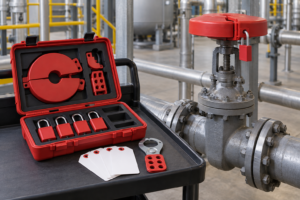
A gate valve controls flow by moving a gate through the line, and its handwheel may require several turns between open and closed. Closing it is an operating action; securing it is an energy-control action. A correctly selected gate valve lockout encloses or restrains the operating parts so an unplanned handwheel movement cannot casually restore flow.
The written procedure should identify the valve, energy source, safe position, nearby valves, pressure or temperature hazards, and the person authorized to apply the control. The device supports that procedure but does not replace shutdown, isolation, draining, venting, or a safe try test. Where the valve is part of a double-block-and-bleed arrangement, both isolation points and the bleed verification must be named.
A Gate Valve Lockout must control the handwheel and stem
Before purchase or field use, record handwheel diameter, thickness, stem arrangement, clearance above and around the wheel, required open or closed position, and the number of locks needed. A rising stem, a chain-operated wheel, or an obstructed pipe rack can change the device required. A gate valve lock is useful only when it captures the actual operating geometry and leaves the lock and tag accessible.
Apply the device after the valve is in the safe position named by the procedure. Confirm that its cover or restraint seats fully, cannot be lifted away without removing the lock, and does not contact a hot surface or block the pressure gauge, drain, or vent needed for verification. Then attach the personal lock and identification tag; each exposed authorized employee should retain individual control during group work.

A Gate Valve Lockout should be compared by fit and work conditions
Product selection should compare performance and total ownership risk, not only unit cost. A device that installs quickly but slips under load can create rework, permit delays, and an unsafe assumption. The useful comparison is whether the device remains identifiable, lockable, inspectable, and durable in the actual work area.
| Approach | Physical restraint | Verification need | Best application | TCO consideration |
|---|---|---|---|---|
| Tag only | Warning without physical restraint | Higher; equivalent tagout protection must be justified | Only where the written program permits it | Low purchase cost, higher human-factor exposure |
| Padlock on an existing lock point | Good if the valve is designed for it | Confirm position and stored energy | Lockable handles or engineered isolation points | Efficient, but limited by geometry |
| Dedicated gate-valve device | Restrains the handwheel or stem | Fit check plus line-specific try step | Common gate-valve handwheels and retrofit points | Lower substitution and rework risk when specified well |
| Multiple isolation points | Several barriers with controlled bleed | Pressure checks at named points | Critical lines and high-consequence maintenance | More setup, potentially lower incident cost |
| Application | Primary challenge | Specification focus | Field checkpoint |
|---|---|---|---|
| Indoor steam or process line | Heat, pressure, and repeated maintenance | Material, temperature range, wheel fit | Visual fit and gauge response after isolation |
| Outdoor or corrosive area | Moisture, chemicals, and UV exposure | Material compatibility and marking durability | Inspect for cracking, corrosion, and legibility |
| Group maintenance | Protection across workers and shifts | Lock points, hasp or lockbox, ownership rules | One personal lock for each exposed employee |
| Contractor or EPC service | Handover and removal authority | Permit, tag, contact, and shift-change controls | Confirm the written procedure before release |
A ball valve lockout uses a different quarter-turn geometry and should not be substituted for a handwheel device merely because both products are called valve lockouts.
A Gate Valve Lockout supports compliance only inside the written program
OSHA 29 CFR 1910.147 applies to servicing where unexpected energization, start-up, or release of stored energy could injure employees. It addresses procedures, authorized and affected employees, training, periodic inspection, protective devices, and verification. OSHA regulates the employer’s energy-control program; it does not blanket-certify every commercial lockout product as OSHA-approved.
ANSI/ASSP Z244.1 provides a consensus framework for hazardous-energy control and alternative methods. ISO 45001 supports management-system controls, accountability, and continual improvement. CE and RoHS may matter to product documentation and destination-market requirements, but neither proves that a valve is isolated or that a device fits. Marketing claims should match available technical records and the destination market.
A Gate Valve Lockout selection starts with field measurements
- Map the valve: record handwheel and stem dimensions, safe position, line energy, and nearby obstructions.
- Define the verification: name the gauge, drain, vent, visual indicator, or other safe try method.
- Trial the hardware: install it under controlled conditions and confirm lock access, tag visibility, and removal.
- Plan the people: specify personal locks, group hasps or lockboxes, contractors, and shift handover.
- Control the supply: retain the compatible-valve list, inspection record, and replacement trigger.
QD LOTO can support industrial buyers with configurable lockout/tagout hardware and sourcing documentation. For group maintenance, a multiple-lockout hasp can keep each exposed employee’s personal lock in the control chain. A valve lockout device should be judged against the site’s procedure, dimensions, environment, and inspection method; the honest procurement question is whether it remains effective during the full maintenance task.
Frequently Asked Questions
What is a gate valve locking device?
It is a physical device that encloses or restrains a gate-valve handwheel or stem so the valve remains in the required safe position. The authorized employee adds a personal lock and tag, then controls stored energy and verifies isolation. The device must match the valve’s dimensions and the employer’s written procedure.
What are the four types of lockout devices?
There is no single universal four-part classification for every program. Common groups include electrical controls, valve and fluid-line controls, mechanical controls such as blocks or restraints, and group lockout hardware such as hasps or lockboxes. The site’s hazard assessment should determine the categories and device list.
Can you lock a gate valve?
Yes, when the valve can be placed in the required safe position and a compatible device can prevent operation. The worker must still isolate connected energy, relieve or restrain residual pressure, and verify the safe state. A lock on the wrong point or an undersized cover does not establish effective isolation.
What is a valve lock?
A valve lock is a lockout device designed to prevent operation of a specified valve handle, handwheel, stem, or actuator. It is hardware within a lockout/tagout program, not a substitute for shutdown, stored-energy control, or verification. Select it by operating geometry, environment, lock access, and the safe position required.
References
- OSHA 29 CFR 1910.147, The control of hazardous energy
- OSHA Lockout/Tagout eTool
- CCOHS lockout and hazardous-energy control guidance
The reliable sequence is identify, isolate, lock, control stored energy, verify, and only then service. For the right lockout/tagout valve hardware, contact QD LOTO with valve type, handwheel dimensions, environment, and group-work requirements.