
Summary: A dependable Lockout For Breaker program begins with a device that physically restrains the identified breaker handle, then proves isolation before work starts. OSHA 29 CFR 1910.147 governs the employer’s energy-control program; its rules require energy-control devices to be durable, standardized, substantial, and identifiable, and used exclusively for energy control. Record the breaker make, pole arrangement, handle geometry, and available clearance before specifying devices, then use a documented zero-energy verification step for every job.
Reliable Lockout For Breaker selection starts with breaker handle geometry
Circuit breakers are convenient isolation points, but they are not interchangeable interfaces. A breaker can be miniature, moulded-case, multi-pole, panel-mounted, or part of equipment with more than one energy source. The procurement question is therefore not simply whether a device is called a breaker lockout; it is whether the selected device engages the actual handle in its OFF position and fits the written energy-control procedure.
Start with a panel survey. Photograph the handle from the operating side, record its width in millimetres, note whether the handle sits proud of or recessed into the face, and identify nearby obstructions such as escutcheons or adjacent poles. These details determine whether a clamp-style, pin-out, pin-in, tie-bar, or manufacturer-specific device can hold the handle in the required position without fouling the enclosure.
A practical fit check is a controlled installation inspection: place the device on the de-energized breaker, secure the assigned personal lock, and check that the handle cannot be moved toward ON. This is a fit and functional check, not a certification test. For equipment with an identified 7.7 mm handle-width requirement, buyers can review this Lockout For Breaker product page against their own recorded dimensions before approving a sample.
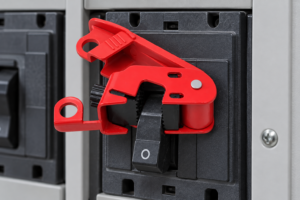
Verify the zero-energy state, not only the handle position. Moving a breaker to OFF and applying a lock is an isolation action; it is not proof that hazardous energy is absent. The authorized employee should follow the site procedure to shut down, isolate all relevant sources, release or restrain stored energy, and verify isolation with an appropriate attempt-to-start or test method after personnel are clear. Electrical testing must be performed by qualified persons and with suitable test practices for the task; the final verification should be recorded where the employer’s procedure requires it.
A Lockout For Breaker comparison makes hidden costs visible
The lowest unit price can create the highest lifecycle cost if fit failures force maintenance teams to improvise, delay a shutdown, or hold multiple unsuitable variants in the storeroom. The following comparison is a procurement framework, not a claim that one device type suits every breaker.
| Selection dimension | Handle-specific or pin-style device | Clamp-style device | Commercial implication |
|---|---|---|---|
| Compatibility evidence | Usually tied to a defined breaker family or handle interface | Depends on measured clamping range and clearance | Keep breaker records with the approved device |
| Installation efficiency | Can be quick when the match is confirmed | May suit varied handle profiles after fit checking | Train users on the approved method, not visual similarity |
| Durability control | Inspect pins, body, and locking point before issue | Inspect clamping surfaces and fastener condition | Replace damaged devices under the site inspection plan |
| Returns and rework risk | Higher when breaker family was assumed incorrectly | Higher when handle thickness or access was not measured | Sample on representative panels before volume purchasing |
| Total cost of ownership | Lower when a documented match reduces field exceptions | Lower when one approved range genuinely covers surveyed assets | Include survey, training, spares, and audit time in the decision |
An illustrative calculation makes the point: a device that avoids one delayed maintenance isolation can offset a modest unit-cost difference, but the actual result depends on downtime cost, work frequency, and the quality of the facility’s records. Do not present this logic as a product performance guarantee; use it to justify a controlled fit trial.
An application-led Lockout For Breaker matrix improves device selection
Build the selection list around where and how the breaker is used. A facility may need more than one approved design because an MCC bucket, a local machine panel, and an emergency generator panel can use different breaker constructions even when their ratings seem similar.
| Application | Information to capture | Suitable selection approach | Documentation action |
|---|---|---|---|
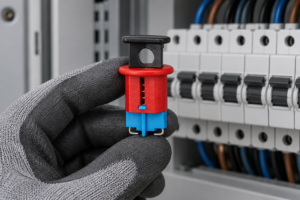
| Miniature circuit breakers in distribution boards | Toggle profile, pole arrangement, rail or face access | Confirm a dedicated miniature-breaker design on the actual model | Add panel ID and device reference to the procedure |
| Moulded-case breakers | Handle width, handle travel, recessed or projecting face | Compare measured geometry with an approved handle-specific device | Retain photographs from the fit approval |
| Mixed-fleet maintenance areas | Asset list, recurring tasks, clearance restrictions | Use a controlled set of approved variants, not a single assumed universal option | Map each variant to equipment families |
| Generator transfer and service work | Main, feeder, transfer, and stored-energy isolation points | Review breaker lockout for generator service within the complete energy-control procedure | Coordinate electrical and mechanical isolation steps |
For broader handles within a confirmed clamping range, a buyer may compare a grip-tight circuit breaker lockout during the sample and approval stage. The device page is a starting point for comparison, not a substitute for the site’s measured application review.
Compliance makes a Lockout For Breaker procedure defensible
OSHA 29 CFR 1910.147 addresses the employer’s control of hazardous energy program. It requires the employer to establish procedures, train affected roles, conduct periodic inspections, and use lockout or tagout devices that meet the durability, standardization, substantiality, and identification criteria in the rule. It does not certify individual breaker lockout devices; a supplier should not market a device as OSHA-certified merely because it is intended for use in a program governed by that regulation.
ANSI/ASSP Z244.1 provides useful context for hazardous-energy control practices, while ISO 45001 provides occupational health and safety management-system context. Neither reference should be converted into an unverified product certification. For destinations outside the United States, buyers should align the procedure, labels, training records, and product claims with the applicable local legal and customer requirements.
A documented Lockout For Breaker program helps buyers procure with confidence
- Survey representative panels. Capture model information, handle measurements, pole configuration, access restrictions, and photographs for each equipment family.
- Approve fit by procedure. Have authorized users perform a supervised installation and handle-restraint check on representative equipment before purchase order release.
- Specify ownership and identification. Match personal locks, tags, device identification, and issue controls to the employer’s written energy-control program.
- Plan for group work. Where more than one authorized employee works on the equipment, use the site’s group-lockout method so each person maintains personal control; a device cannot replace that procedural responsibility.
- Buy evidence with the product. Request dimensional information, use guidance, lot traceability where available, and clear records of which assets each approved device covers.
QD LOTO can support procurement teams with circuit breaker lockout options and product information for application review. The prudent buyer still treats fit confirmation, written procedures, and worker training as site-specific decisions rather than as claims supplied by the product alone.
Frequently Asked Questions
How do you lock out a circuit breaker?
Follow the employer’s documented energy-control procedure: notify affected employees, shut down the equipment, isolate the breaker and any other energy sources, and apply the assigned lockout device and personal lock. Release or restrain stored energy, then verify the zero-energy state using the approved attempt-to-start or test method. Do not begin work merely because the breaker handle appears to be OFF.
What is a breaker lockout device?
A breaker lockout device is a physical device intended to restrain a circuit breaker handle in the required isolation position so a personal lock can be applied. Its suitability depends on the handle geometry, clearance, and the site’s procedure. It is one component of energy control, not a substitute for shutdown, verification, training, or documentation.
What are the common types?
Common types include miniature circuit breaker devices, moulded-case breaker handle devices, clamp-style devices, pin-in devices, pin-out devices, and multi-pole or tie-bar arrangements. The names describe mechanisms, not universal compatibility. Confirm the device on the actual breaker family before adding it to the approved list.
What are the seven LOTO steps?
A commonly taught seven-step sequence is: prepare for shutdown, notify affected employees, shut down equipment, isolate energy sources, apply lockout/tagout, release or restrain stored energy, and verify isolation. OSHA’s rule requires an effective energy-control program and procedures; a site’s sequence must address its actual hazards. For generator work, breaker lockout for generator isolation is only one part of assessing electrical, mechanical, and stored-energy sources.
References
- OSHA: 29 CFR 1910.147, The control of hazardous energy (lockout/tagout)
- OSHA: Control of hazardous energy
- eCFR: 29 CFR 1910.147 current text
- Canadian Centre for Occupational Health and Safety: Lockout
The reliable principle is simple: a breaker lockout earns its place only when the device, the breaker, and the verified energy-control procedure agree. When your next audit, outage plan, or distributor specification calls for a miniature-breaker option, review the miniature circuit breaker lockout and contact QD LOTO to discuss the measurements and documentation needed for your application.