
Summary: Lockout Tagout Electrical work must isolate every identified source, physically secure the energy-isolating device, and verify the isolation before service begins. OSHA’s control-of-hazardous-energy rule, 29 CFR 1910.147, distinguishes an energy-control program from simply switching equipment off; buyers should document panel types, choose devices that fit the operating mechanism, and test the procedure at the point of use.
Lockout Tagout Electrical Controls Energy at the Breaker
Electrical energy can appear through a main breaker, a local disconnect, a back-fed circuit, stored energy, or an unexpected control command. A practical program therefore combines written procedures, authorized-employee training, device compatibility, and a verification step. The details matter most when a facility manages mixed breaker brands, multiple voltages, or contractors working on the same asset.
Isolation starts with the authorized employee identifying all energy sources, shutting down the equipment, operating each isolating device, applying locks and tags, releasing or restraining stored energy, and verifying isolation. OSHA 29 CFR 1910.147(d) sets out these sequence elements; paragraph (d)(6) specifically requires verification before work starts. A “zero-energy” condition is a work-state decision, not a visual assumption about one handle.
Match the lockout to the mechanism, not the panel label
A circuit breaker lockout should clamp or engage the actual breaker handle without preventing the panel door from closing where that is operationally required. For miniature breakers, a dedicated miniature-breaker device can be more repeatable than a general-purpose clamp. Record handle width, pole count, throw direction, available clearance, and whether the breaker can be locked in the off position; these five observations prevent most fit surprises during a shutdown.
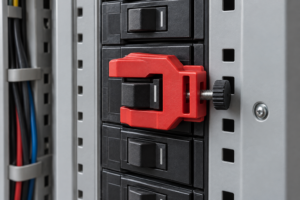
Verification is a separate control, not a final glance
After applying personal locks, follow the site’s approved verification method: test for absence of voltage with a properly rated instrument, attempt a normal start where appropriate, and return controls to neutral. NFPA 70E is commonly used in U.S. electrical-safety programs to frame electrically safe work conditions; its applicability and the test method must match the facility’s risk assessment and local rules. Test instruments themselves need a known live-source check before and after absence-of-voltage testing.
Lockout Tagout Electrical Compares Devices by Fit, Workflow, and TCO
The lowest unit price can increase shutdown cost if operators need to search for adapters, cannot lock every point, or replace damaged parts after a failed fit. The illustrative comparison below treats total cost of ownership as the combined effect of device fit, setup time, training consistency, and replacement frequency; it does not assign a universal price.
| Device approach | Best-fit use | Compatibility check | Maintenance and TCO tendency |
|---|---|---|---|
| Dedicated miniature-breaker device | Repeatable MCB patterns | Breaker series, handle profile, pole arrangement | Lower workflow variation when panels are standardized |
| Adjustable clamp device | Mixed breaker handles and retrofit panels | Jaw range, clearance, off-position stability | Broader coverage may reduce the number of SKUs |
| Lockout hasp with personal locks | Group maintenance | Hole diameter and number of authorized workers | Improves ownership clarity; inspect for deformation |
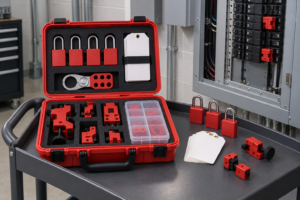
| Portable kit | Mobile technicians and dispersed assets | Contents against the site energy-control procedure | Reduces search time when replenishment is controlled |
For an illustrative calculation, a team that loses 6 minutes locating an incompatible device across 40 planned isolations per month gives up 240 minutes of productive maintenance time. The result is not a product-performance claim; it is a reason to standardize the kit against actual panels and review usage records quarterly.
Build the kit around the work order
| Work-order condition | Useful device group | Evidence to keep |
|---|---|---|
| Single-pole MCB service | Model-specific MCB lockout and keyed padlock | Breaker photo and fit confirmation |
| Multi-pole molded-case breaker work | Clamp or handle-width device sized to the breaker | Pole count, handle dimension, off-state test |
| Multi-person repair | Multiple-lock hasp and individual locks | Authorized-worker lock list and release process |
| Field response or contractor work | Organized electrical lockout kit | Issue log and replenishment checklist |
Lockout Tagout Electrical Aligns Procurement With Procedure and Compliance
In the United States, OSHA 29 CFR 1910.147 governs the control of hazardous energy for covered servicing and maintenance activities. OSHA’s Control of Hazardous Energy guidance explains the program elements, while ASSE/ASSP Z244.1 provides broader guidance on lockout, tagout, and alternative methods. ISO 14118 addresses prevention of unexpected start-up; it is a machinery-safety standard, not a blanket product certification for every lockout device.
Procurement claims should remain specific. A seller can describe materials, dimensions, testing records, and intended breaker compatibility; it should not claim a complete program is “OSHA compliant” based on a kit alone. Unsupported claims can create rejected tenders, rework, or unsafe procedures, especially when a destination market applies different electrical codes or employer duties.
QD LOTO can support this process with configurable device choices and sourcing documentation. Pair a suitable device with a non-conductive nylon padlock selected for the site’s identification and key-control practice; the final procedure remains the employer’s responsibility.
Frequently Asked Questions
What is Included in an Electrical Lockout Kit?
An electrical lockout kit commonly contains breaker lockouts, padlocks, tags, hasps, and sometimes cable or plug lockouts. The correct contents depend on the site’s written procedures and actual breaker inventory. Compare kit contents to an isolation-point list before issuing it to technicians.
How does a circuit breaker lockout work?
It holds the breaker operating handle in the off position so it cannot be moved to energize the circuit while a personal lock is applied. The device must match the breaker geometry and leave no practical way to operate the handle. Verify the off state using the approved site method before work begins.
Which lockout device fits a single-pole or multi-pole breaker?
Single-pole miniature breakers often need a model-specific device, while multi-pole molded-case breakers may need an adjustable clamp or a device matched to handle width. Pole count alone is not enough: check the handle profile, clearance, and the manufacturer’s stated range. A trial fit on the de-energized panel is the fastest defensible confirmation.
Are electrical lockout kits OSHA compliant?
A kit is not, by itself, OSHA compliant. Compliance depends on the employer’s energy-control program, procedures, training, periodic inspections, and correct use under the applicable rule. Ask suppliers for product information, then validate the complete program against 29 CFR 1910.147.
References
- OSHA, 29 CFR 1910.147—The control of hazardous energy
- OSHA, Control of Hazardous Energy
- UK HSE, INDG291—Guidance on the isolation of energy
When your next panel survey turns into a sourcing decision, QD LOTO can help you assemble a practical Lockout Tagout Electrical solution around your breaker data and maintenance workflow. Contact QD LOTO to discuss device selection and documentation.