
Lockout Locks: begin with the energy-isolation interface
A practical selection starts at the energy-isolating device: disconnect handle, breaker, valve, plug, pneumatic fitting, or mechanical restraint. The employer must establish procedures for the machine and verify isolation before work, according to OSHA’s hazardous-energy-control guidance. Measure hole diameter, clearance, lock-body obstruction, required shackle reach, and whether an accessory is needed; a device that can be attached is not necessarily one that prevents operation.
Lockout Locks should be selected as personal control devices with a durable identification method that makes the authorized employee readily identifiable. Record the lock body dimensions, shackle diameter and usable length in the isolation register, not only in a purchasing description. That record is especially important where one machine has more than one energy source.
Shackle material and length are functional choices
Steel shackles can suit higher-abuse locations, while nonconductive nylon shackles may be specified where electrical exposure or conductivity is a concern. The choice must follow the documented hazard assessment and the manufacturer’s stated limits. Longer reach can solve clearance issues but can also create unwanted operating space; test the proposed combination on the actual isolator with the equipment de-energized.
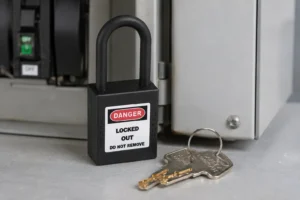
How a lockout tagout lock supports individual control
OSHA requires lockout devices to be durable, standardized within the facility, substantial enough to prevent removal without excessive force or unusual techniques, and identifiable. Those are program criteria, so a buyer should ask for dimensional drawings, material information, operating instructions, and identification options rather than accepting an “approved” label. A product claim cannot transfer the employer’s duty to develop and enforce the procedure.
lockout tagout lock selection should also define the keying plan before an order is released. For personal protection, the usual control principle is one authorized employee retaining control of the key to the device they apply. If a master-key or supervisor-access arrangement is proposed, the written removal procedure, authorization, communication, and documented employee protection need careful review.
Identification and key systems must survive the work cycle
Names, photographs, department markings, serial identifiers, and key records serve different purposes. Build the required identifier into the specification and make replacement traceable; do not rely on color alone, particularly where contractors, multiple shifts, or several plants share a site. OSHA’s annual periodic inspection requirement also gives the employer a reason to examine whether these controls still work in field use.
Locks for lockout tagout in group and shift-change work
Group servicing changes the hardware question into a control-of-work question. Each authorized employee needs personal protection from the hazardous energy, while the group procedure must account for the coordinator, method of applying devices, and transfer of protection during shift changes. A multi-person hasp can provide multiple personal attachment points; it does not by itself establish the required group procedure.
locks for lockout tagout are most dependable in group work when their role is visible in a written sequence: isolate, attach group hardware, apply each person’s device, test or otherwise verify the isolation, and control the handover. The HSE’s maintenance safety guidance similarly stresses isolation and prevention of inadvertent start-up. Procurement should therefore include compatible hasps, lock boxes, tags, and documented handoff steps—not only padlocks.
Flexible devices still require measured interfaces
Cables can be useful where several valve handles or awkward points must be restrained together, but cable routing, diameter, termination, and access to the control all need physical confirmation. Consider a cable lockout device only after the interface survey shows that a rigid device cannot provide the needed restraint. This is a specification decision, not an all-purpose substitute.
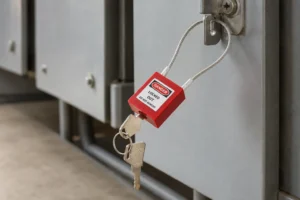
Compare safety-lock specifications by total control cost
A lower unit cost can be misleading when replacement, unclear keys, failed fit trials, delayed maintenance, or retraining are added. The following comparison is a procurement framework, not a performance ranking; confirm all dimensions and environmental limits with the supplier’s current documentation.
| Decision dimension | What to compare | Program consequence |
|---|---|---|
| Physical fit | Shackle diameter, usable length, body clearance, accessory compatibility | Reduces site modifications and failed attachment attempts |
| Environment | Material, corrosion exposure, temperature and chemical guidance | Supports durable use between inspections |
| Key control | Keyed-different plan, key records, controlled replacement process | Preserves individual accountability |
| Identification | Employee marking, serial traceability, label durability | Supports field recognition and audit follow-up |
| Lifecycle cost | Fit trials, spares, documentation, retraining and returns | Shows the illustrative TCO beyond unit price |
Lockout Locks should be sampled on the highest-risk and most awkward isolators before a fleet purchase. An illustrative review can compare the cost of a small field trial with the time lost if a standardized device later fails to fit a frequently serviced asset. Label that calculation as local planning, because actual downtime and labor rates vary by plant.
A dimension matrix makes ordering more defensible
| Application condition | Specification question | Evidence to retain |
|---|---|---|
| Electrical isolation | Does the proposed shackle and breaker accessory fit without energizing exposure? | Measured point, procedure and manufacturer instructions |
| Wet or corrosive area | What material guidance applies to the actual chemicals and temperature? | Supplier data and site assessment |
| Multiple workers | How many personal devices attach, and where is group control documented? | Group procedure and field trial |
| Contractor work | How are identity, issue/return, and shift handover controlled? | Site rules and training record |
| Complex geometry | Is a cable or specialized accessory necessary after measurement? | Photograph, dimensions and approved method |
Standards context, verification, and claims discipline
lockout tagout lock documentation should distinguish legal duties from voluntary context. OSHA 29 CFR 1910.147 is a US workplace regulation that applies to covered servicing and maintenance; applicability depends on the work and equipment, so facilities should assess their own scope. Its verification requirement means an authorized employee confirms isolation before starting work, using the written procedure and safe test methods appropriate to the equipment.
ANSI/ASSP Z244.1 is a consensus standard addressing hazardous-energy-control alternatives and program practice, while ISO 45001 is a management-system standard for occupational health and safety. Neither is a certification of an individual padlock. For machinery placed on the EU market, consult the European Commission’s machinery requirements alongside destination-market obligations; a supplier must not market an ordinary device as carrying a regulatory certification it does not hold.
Review claims as carefully as dimensions
Ask a supplier to separate what the device is made to do from what the site program must do. Useful evidence includes a current drawing, instructions for use, material declaration, key-system description, label options, and any stated environmental limitations. Treat a reference to a regulation or consensus standard as a prompt to examine scope, not as proof that the item independently satisfies every workplace duty. This review also helps distributors avoid repeating unsupported claims in catalogues, tenders, or customer training material.
Verification is an operating step, not a product feature
After shutdown and isolation, release or restrain stored energy as the procedure requires, then verify that isolation before servicing. The exact verification method may involve attempted start, meter testing by a qualified person, pressure confirmation, or a mechanical check; it must match the hazard and the employer’s procedure. Restore controls to a safe state after the test attempt.
A procurement checklist for locks for lockout tagout
Before issuing a purchase order, use a checklist that joins EHS, maintenance, and sourcing:
- Map every energy-isolating device and retain measured fit data.
- Specify shackle geometry, material, identification, and key-control requirements.
- Run a representative field trial, including wet, awkward, and multi-worker points.
- Match accessories to documented procedures and train authorized employees on the final configuration.
- Set replacement, lost-key, contractor, and periodic-inspection records before deployment.
locks for lockout tagout become easier to source responsibly when suppliers can provide configurable identification, compatible accessories, and documentation that supports the site’s procedure. At this stage, QD LOTO can be considered for a configured safety-padlock and accessory review; validate the selected combination on the equipment, including a miniature circuit-breaker lockout where the isolation point requires it.
Frequently asked questions
What is a lockout lock?
It is OSHA’s hazardous-energy-control standard, 29 CFR 1910.147. It requires covered employers to establish and use an energy-control program, train employees, inspect procedures periodically, and verify isolation before servicing. Its applicability should be checked against the work being performed.
What are the 7 steps of LOTO?
It is a method of controlling hazardous energy during servicing or maintenance. An energy-isolating device is placed in a safe position, secured with a lockout device or tagout system as applicable, and the worker verifies that the equipment cannot start or release energy unexpectedly.
What is a lockout tagout lock?
LOTO is the common abbreviation for lockout tagout. In practice it combines equipment-specific procedures, authorized employees, physical isolation devices, communication, and verification; a tag alone does not provide the same physical restraint as a lockout device.
What type of locks can be used for lockout tagout?
The authorized employee prepares for shutdown, notifies affected employees, shuts down the equipment, isolates energy, applies the prescribed devices, controls stored energy, and verifies isolation before work. The procedure must also govern restoration after tools and people are clear.
What type of locks can be used for Lockout Tagout?
It is needed when servicing or maintenance exposes employees to unexpected energization, start-up, or release of stored energy, subject to the standard’s scope and specific exceptions. Employers should evaluate the task rather than rely on an equipment label or a general schedule.
What is a Lockout Tagout lock?
Many programs summarize the sequence as preparation, notification and shutdown, isolation, application of control devices, stored-energy control and verification. Exact steps and restoration requirements should follow the employer’s equipment-specific procedure; OSHA does not make a generic six-step poster a substitute for that procedure.
References and the buying decision
HSE: Health and safety in motor vehicle repair and associated industries
European Commission: Machinery
The dependable choice is the one that fits the isolator, preserves individual control, and remains usable when the work gets complicated. When your team is ready to match documented requirements to configurable devices, review QD LOTO’s industrial safety padlock range and contact the team with your isolation list for a specification discussion.