
When a maintenance supervisor in Suzhou isolated a packaging-line conveyor for a jam-clearing repair, he attached a familiar keyed padlock to the disconnect, then watched a second technician arrive with the same key pattern and a different understanding of who owned the work. The visible failure was immediate: the isolation point looked secured, but personal control was unclear. The correction was not simply a “better” lock; it was a selection and key-control problem within the energy-control procedure.
Padlock Lockout protects maintenance work when energy is isolated
A lockout padlock is the personal control element used after an energy-isolating device has been placed in a safe position. A Padlock Lockout plan connects that physical control to the authorized employee and written procedure. It is not a substitute for identifying every energy source: electrical, pneumatic, hydraulic, mechanical, thermal, chemical, or gravity-related energy may need to be isolated and dissipated. The critical distinction is procedural—29 CFR 1910.147 applies to servicing and maintenance where unexpected energization, start-up, or release of stored energy could cause injury.
For a single authorized employee, the preferred arrangement is straightforward: one person applies one uniquely identified lock and retains control of the key. For group work, a Padlock Lockout system uses a hasp, group lock box, or comparable group procedure so each authorized employee can apply a personal device. A 38 mm body is common in industrial safety-padlock ranges, but body size alone does not determine whether a device fits a disconnect handle, valve cover, or lock box.
Lockout padlocks establish personal control during the procedure
OSHA’s sequence is more important than the color or brand of the lock. An authorized employee prepares for shutdown, notifies affected employees, shuts down the equipment, isolates each energy source, applies the lockout device, releases or restrains stored energy, and verifies isolation before work starts. Padlock Lockout depends on verification with appropriate precautions; attempting a normal start after clearing personnel is a common method, but it does not replace checking the particular energy sources named in the procedure. In that sequence, lockout padlocks preserve the visible record of personal control.
Lockout padlocks should be assigned to people rather than shared casually across shifts. The lock body, label, engraving, or tag should identify the authorized employee, and spare-key policy should explain who can access a key, under what written authorization, and how removal is recorded. A master-key system may simplify administration, yet it can weaken the personal-control principle unless access is tightly restricted. Issued lockout padlocks should therefore be reconciled when employees change roles or leave the site.
Material choice follows the environment and isolation point. Nonconductive nylon components are often selected around electrical work; corrosion-resistant construction may matter in wet or chemical-exposed areas; and shackle clearance must fit the hasp or device without allowing easy defeat. For an electrical application, a non-conductive nylon padlock may be a practical product starting point, subject to the employer’s procedure and site conditions. These lockout padlocks still require a fit check at the installed isolation point.
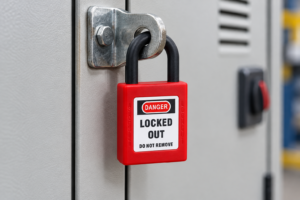
Lockout tagout padlocks should be compared beyond initial purchase cost
Buyers often compare only unit price and shackle material, but the operational cost of an unclear lock assignment can be much higher: delayed troubleshooting, a disputed removal, retraining, or a failed audit trail. When lockout tagout padlocks are compared, key control and identification deserve the same attention as material. The following comparison separates practical factors from compliance claims. It does not replace a site risk assessment or the machine-specific energy-control procedure.
| Decision factor | Dedicated safety padlock system | General-purpose hardware-store padlock |
|---|---|---|
| Personal identification | Can be labeled, numbered, and assigned by employee | May lack a consistent identification method |
| Key control | Can be specified as keyed different, keyed alike, or managed master-key access | Keying and duplicate-key control may be inconsistent |
| Device compatibility | Selected with hasps, lock boxes, and isolation devices in mind | Shackle geometry may not fit the application |
| Visual standardization | Supports a recognizable site program and inspection routine | Mixed appearances can obscure ownership |
| Total-cost tendency | Higher setup discipline; lower ambiguity during maintenance | Lower upfront cost; potentially higher control and replacement burden |
In this sense, lockout tagout padlocks are a controlled system component, not an isolated purchasing line item. An illustrative calculation is useful: if a standardized program prevents one 30-minute delay for a four-person maintenance crew, its value depends on the site’s labor and downtime costs, not on a universal dollar figure.
Application selection for Padlock Lockout starts with the isolation point
Selection should begin with the energy-isolating device, then move outward to the lock, hasp, cable, lock box, and identification method. A Padlock Lockout specification should record the dimensions that matter at the actual isolation point. Measure shackle diameter, usable clearance, and body interference there; a padlock that looks adequate in a catalogue can be unusable beside a recessed breaker handle or crowded valve wheel. The same review confirms whether lockout tagout padlocks will work with the required hasp or lock box.
| Application | Primary selection question | Typical system fit | Inspection focus |
|---|---|---|---|
| Electrical disconnect | Is nonconductive construction and handle clearance needed? | Nylon-bodied padlock with a compatible breaker or disconnect lockout | Verify the disconnect cannot be returned to ON |
| Multi-person mechanical maintenance | How will each worker retain personal control? | Personal locks on a hasp or keys controlled through a group lock box | Confirm every authorized employee has applied and removed a device |
| Valve isolation | Can the valve device accept the required shackle and stay secured? | Padlock paired with a valve lockout or cable lockout | Check valve position and stored-pressure release |
| Wet or corrosive area | Will the lock remain operable and identifiable in service? | Material and label system selected for exposure | Inspect corrosion, label legibility, and key operation |
Procurement should request a sample fit check before broad rollout, specify the keying architecture in the purchase order, and retain a controlled register of issued locks. The order should also state how lockout padlocks will be marked, issued, and replaced. QD LOTO can support buyers who need configurable identification and application-specific lockout hardware; its lockout padlocks can be evaluated alongside the site’s actual devices and documented procedure. This review gives lockout tagout padlocks a defined role in the wider isolation system.
Lockout padlocks support an OSHA energy-control program, but do not receive OSHA certification
OSHA 29 CFR 1910.147 is an employer-duty regulation, not a product-approval scheme. Under the standard, lockout devices must be durable for the environment, standardized within the facility in at least color, shape, or size, substantial enough to prevent removal without excessive force or unusual techniques, and identifiable as devices used for energy control. The employer must also establish, document, and use procedures; train employees; and conduct at least an annual inspection of each energy-control procedure. Lockout tagout padlocks are evaluated within that employer program rather than approved by OSHA as individual products.
That is why a claim that a padlock is “OSHA certified” should be avoided unless it is carefully explained as something else. OSHA does not certify individual padlock products. ANSI/ASSP Z244.1 provides consensus guidance on hazardous-energy control and can help organizations assess program practices; ISO 45001 addresses occupational health and safety management systems. Neither statement makes a particular padlock automatically compliant, nor does either replace applicable local regulations or the employer’s written procedure.
For suppliers and distributors, accurate claims reduce commercial risk: describe materials, dimensions, keying options, identification, and intended use, then let the purchaser determine fitness within its energy-control program. This helps prevent a customer from treating lockout tagout padlocks as proof that a machine has been safely isolated. Clear documentation also keeps lockout tagout padlocks tied to their intended use.
Frequently Asked Questions
What is a lockout padlock?
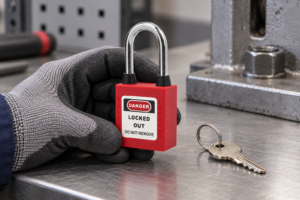
A lockout padlock is a lock used to secure an energy-isolating device or a compatible lockout device during servicing and maintenance. It normally identifies the authorized employee who applied it and supports that employee’s personal control of the isolation. The padlock is one part of a complete hazardous-energy control procedure, not the procedure itself.
What makes a padlock OSHA-compliant?
OSHA does not certify a padlock as compliant. The employer’s program must use lockout devices that meet the standard’s durability, standardization, substantiality, and identification requirements and must apply them through compliant procedures, training, and periodic inspection. The same evaluation applies to lockout tagout padlocks against the intended environment and the facility’s program.
What materials are used for lockout padlocks?
Common configurations use nylon or other nonconductive materials for the body and, where appropriate, the shackle; metal shackles and corrosion-resistant constructions are also used for particular environments. The right choice for lockout tagout padlocks depends on exposure, electrical considerations, required clearance, and compatibility with the lockout device. Material alone is not evidence of program compliance.
Can I use standard padlocks from a hardware store?
A standard padlock can only be used if it meets the employer’s energy-control requirements and works within the written procedure; many general-purpose locks are not selected or managed for that purpose. Confirm identification, key control, durability, standardized use, and compatibility before relying on one. When in doubt, use a purpose-specified lockout system and document the selection decision.
References
- OSHA, 29 CFR 1910.147—The control of hazardous energy (lockout/tagout).
- OSHA, Control of hazardous energy.
- eCFR, 29 CFR 1910.147 current text.
- Canadian Centre for Occupational Health and Safety, Lockout.
The lasting principle is simple: a lock is trustworthy only when the person, procedure, key, and isolation point all agree. For a sourcing review before your next maintenance shutdown, compare QD LOTO’s industrial insulation safety padlock with your device dimensions, key-control plan, and authorized-employee training records, then contact the team to discuss a suitable configuration.