
When maintenance supervisor Elena in Toledo, Ohio, encountered a jammed conveyor, she issued an available red padlock and her technician locked the disconnect. Within minutes, the key came out before the shackle was closed, and a second employee could not tell who controlled the lock. This is an illustrative, anonymized scenario, but its reversal is realistic: the problem was not simply a defective lock; it was an incomplete specification and issue process.
A safety lockout padlock supports lockout/tagout control
Under OSHA 29 CFR 1910.147, lockout/tagout addresses servicing and maintenance where unexpected energization, startup, or stored-energy release could injure employees. The rule requires energy-control procedures, employee training, and periodic inspection; a padlock is a device within that system, not a substitute for it. Normal production operations are generally outside the scope unless servicing exposes employees to covered hazards or an exception applies.
A Safety Lockout Padlock should be standardized by color, shape, or size and identified for the authorized employee. OSHA requires lockout devices to be durable, standardized, substantial, identifiable, and used exclusively for energy control. It does not approve, certify, or endorse individual padlock models, so “OSHA-certified padlock” is not a defensible purchasing claim.
Start with the isolation point: measure the hole or hasp clearance, confirm the necessary shackle length, and check exposure to moisture, chemicals, conductive parts, dust, heat, and impact. A compact 38 mm nylon-shackle option may suit some electrical or corrosion-sensitive locations, but only a site risk assessment can establish compatibility.
Construction, keying, and identification should be compared
The buyer should treat safety padlocks lockout tagout performance as a combination of construction and administration. Key-retaining cylinders help prevent a key from being removed while the shackle is open, but this feature does not prove that the correct employee owns the lock or that all energy sources were isolated. OSHA’s control of hazardous energy guidance should therefore be read alongside the employer’s machine-specific procedure.
| Decision | Preferred evidence | Risk if overlooked |
|---|---|---|
| Shackle material | Material declaration and use limits | Conductivity, corrosion, or poor fit |
| Key-retaining action | Physical sample check in open and closed states | Unlocked device left at the point |
| Key system | Documented keyed-different, keyed-alike, and master-key hierarchy | Unauthorized or accidental opening |
| Identification | Legible owner name/number and durable label method | Unclear personal control |
| Lifecycle support | Replacement-key policy and controlled key records | Hidden reissue and audit costs |
Keyed-different locks are the normal basis for personal lockout because each employee uses a unique key. Keyed-alike sets can be appropriate for a defined application under a written procedure, while master keys require restricted custody, documented emergency-removal authorization, and auditable issue records. The lowest unit price can become the higher total cost when key codes are duplicated, labels detach, or replacements cannot be matched to the approved system.
The padlock must match the application
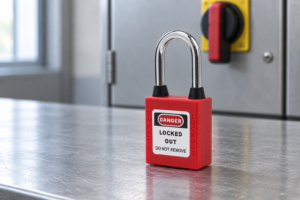
No single body or shackle material is best everywhere. Nonconductive materials can reduce an electrical conduction path, but “nonconductive” should be supported by material information and used within stated limits; it does not remove the duty to de-energize and verify isolation. A steel shackle may offer different mechanical and temperature characteristics, while stainless or coated hardware may be preferred where corrosion is a concern.
| Application dimension | Selection focus | Procurement check |
|---|---|---|
| Electrical enclosure | Nonconductive shackle/body where risk assessment requires it | Clearance, material data, and site approval |
| Outdoor or washdown | Corrosion and label durability | Environmental limits and sample exposure review |
| Compact disconnect | Shackle diameter and usable clearance | Measure the actual lock hole |
| Group lockout | Personal-lock ownership plus hasp or lockbox capacity | Procedure for every exposed employee |
| Contractor work | Distinct identification and coordination | On-site employer/contractor exchange of procedures |
For broader program design, the CCOHS lockout guidance reinforces the sequence of identifying energy sources, shutting down, isolating, locking, controlling stored energy, and verifying isolation. Requirements must still be assessed for the destination jurisdiction; ISO 45001, if used, is an occupational health and safety management-system standard, not a padlock product certification.
The system must be specified, issued, and inspected
A defensible specification converts hazards into controlled attributes. QD LOTO can be asked for configuration details and documentation, but the employer or buyer remains responsible for determining fitness for the intended machinery, environment, procedure, and jurisdiction.
- Map the use: list isolation devices, hole sizes, environmental exposures, and group-lockout arrangements.
- Define control: specify keyed-different or another justified hierarchy, unique employee identification, key custody, and lost-key response.
- Review samples: test fit on representative equipment and verify key retention, label legibility, and shackle closure; an insulated 38 mm padlock configuration is one candidate where its documented properties match the assessment.
- Control issue: record lock ID, key code, assigned employee, issue date, return, and authorized replacement.
- Inspect the program: include locks in the OSHA 1910.147(c)(6) periodic inspection, performed at least annually, and remove damaged or unreadable devices from service.

For Safety Lockout Padlock procurement, request a controlled key chart, material information, labeling options, drawings with shackle dimensions, and a change-notification process. For safety padlocks lockout tagout governance, sample checks at receipt and periodic field inspections are more useful than relying on catalog language alone.
Frequently Asked Questions
What is a safety lockout padlock?
It is a padlock designated exclusively for hazardous-energy control and assigned within an employer’s lockout/tagout program. Its role is to hold an energy-isolating device in a safe position and identify the authorized employee who applied it.
How is a safety lockout padlock different from a regular padlock?
A lockout padlock is standardized, identifiable, substantial, durable for its environment, and reserved for energy control. A general security padlock may resist theft, yet lack personal identification, controlled keying, key retention, suitable materials, or exclusive-use governance.
What are the main features of a lockout padlock?
Common features include a high-visibility body, employee identification, key-retaining operation, a controlled cylinder, and a shackle selected for fit and exposure. Buyers should verify each feature from drawings, samples, and supplier documentation instead of assuming that color alone makes a lock suitable.
What does key-retaining mean on a safety padlock?
Key-retaining means the key normally cannot be removed while the shackle is open. It encourages the lock to be closed before the key leaves the user’s hand, but it does not replace employee assignment, verification, or key-control procedures.
References
- OSHA: 29 CFR 1910.147, The Control of Hazardous Energy
- OSHA: Control of Hazardous Energy overview
- Electronic Code of Federal Regulations: 29 CFR 1910.147
- CCOHS: Lockout/Tagout guidance
The durable lesson is simple: a padlock protects people only when its construction, key control, identification, and daily procedure work as one system.
To compare a documented product option, review QD LOTO’s non-conductive nylon padlock and contact the team with the isolation-point, environment, and key-plan requirements.