
Summary: Campus protection works best when physical security, emergency planning, and maintenance controls are treated as connected layers. Safety Solutions for facilities work should distinguish hazardous-energy control from access control, while school safety solutions should assign an owner, an equipment inventory, and a documented verification step. For covered servicing, OSHA’s lockout/tagout standard requires energy-control procedures; districts should map equipment and roles before buying devices.
Safety Solutions and school safety solutions: define the campus scope first
A campus security program has several purposes: deter or manage unauthorized access, communicate during an emergency, support orderly response, and prevent injuries during routine operations. A facilities safety program adds another purpose—controlling hazardous energy while boilers, air handlers, kitchen equipment, electrical panels, pumps, and similar assets are serviced. These functions overlap in governance, but their controls are not interchangeable.
For example, a classroom door lock is an access-control decision; a lockout device on an electrical disconnect is a maintenance control. The latter should be selected for the energy-isolating device and used under a site procedure. OSHA’s 29 CFR 1910.147 control of hazardous energy standard requires procedures for covered equipment, training for affected roles, and periodic inspection of each procedure at least annually. It does not certify a particular padlock as an OSHA product.
Build a layered operating model around people, doors, and equipment
Separate access controls from energy isolation
Physical-security planning may address visitor entry, locked exterior openings, communications, supervision, and coordination with local responders. SchoolSafety.gov provides federal school-safety resources that support a layered, risk-informed effort rather than a single hardware purchase. District leaders can use that approach to keep life-safety, operational, and maintenance decisions connected without asking one product to solve every risk.
Hazardous-energy control begins with the asset: identify electrical, mechanical, hydraulic, pneumatic, thermal, gravity, and stored-energy sources that may be present. A written procedure should identify the machine, its isolating points, shutdown and isolation sequence, stored-energy release or restraint, lock application, and verification before service begins. One missing step can matter as much as the device itself, especially where contractors and in-house staff share a building.
Make the work visible and verifiable
Facilities teams need a simple chain of custody for planned work: notify affected people, shut down, isolate, apply personal control, release or restrain residual energy, and verify isolation before work starts. Verification is an active step, not a tag on a panel. In practice, a district can record the equipment identifier, authorized employee, date, shift, and return-to-service status in the work order or energy-control record.
A written Safety Solutions plan for maintenance should identify the owner of each procedure, the devices assigned to the job, and the point at which an authorized employee confirms zero-energy conditions. That evidence helps leaders distinguish a stocked cabinet from a usable control system.
Equipment selection should follow the point of isolation. A push-button lockout cover may help prevent operation of a compatible control during servicing, while a device designed for a disconnect addresses a different point in the energy path. Compatibility should be confirmed in the field; a nominal voltage or a product photograph alone is not a fit test.
Compare control layers by decision value, not by a single unit price
Procurement teams often receive proposals that place perimeter hardware, communications equipment, training, and maintenance supplies in one budget discussion. A comparison that keeps their intended outcomes distinct is more useful than a universal ranking.
| Control layer | Primary purpose | Typical owner | Evidence of readiness | Maintenance and total-cost consideration |
|---|---|---|---|---|
| Access and visitor management | Manage entry and account for visitors | Campus operations and administration | Entry procedure, visitor workflow, operating checks | Hardware life, staffing, software administration, and response drills |
| Emergency communications and procedures | Support clear, coordinated action | Administration, safety, and local partners | Current plans, exercises, accessible instructions | Updates, training time, testing, and integration with existing systems |
| Facilities hazardous-energy control | Protect workers during servicing | Facilities and EHS leadership | Equipment-specific procedures, annual inspections, training records | Device compatibility, replacements, kits, contractor coordination, and downtime avoided |
| General emergency supplies | Support defined response tasks | Campus operations | Inventory, locations, inspection dates, assigned users | Shelf life, replenishment, storage access, and exercise findings |
The total cost of a lockout/tagout program includes more than padlocks. It includes asset surveys, procedure writing, training, device assignment, periodic inspection, and lost time when a technician must leave the job to find the right device. An illustrative planning calculation might compare one avoided repeat visit and one avoided scheduling delay against the annual cost of maintaining organized, compatible kits; it should not be presented as a guaranteed return.
Budget owners should also decide how school safety solutions are governed across facilities, security, and administration. Shared oversight can prevent duplicated purchases while preserving separate requirements for access control, emergency readiness, and hazardous-energy work.
Use an application and cost-driver matrix before standardizing equipment
| Campus application | Energy or operational issue | Selection question | Main cost driver | Useful control evidence |
|---|---|---|---|---|
| Electrical panels and disconnects | Unexpected energization | Does the device fit the actual isolating point and permit personal control? | Panel variation, labeling, and device assortment | Current diagram, procedure, verification record |
| HVAC and boiler-room assets | Electrical, mechanical, thermal, or stored energy | Are all energy sources and shutdown steps identified? | Multi-energy complexity and contractor coordination | Asset-specific sequence and annual inspection |
| Kitchen and custodial equipment | Electrical, gas, motion, or steam hazards | Can the procedure be used reliably across shifts? | Equipment diversity and replacement turnover | Authorized-user training and point-of-use instructions |
| Portable maintenance response | Delay locating assigned devices | Can a technician carry the needed personal controls to the job? | Storage, replenishment, and accountability | Kit check and assigned-device record |
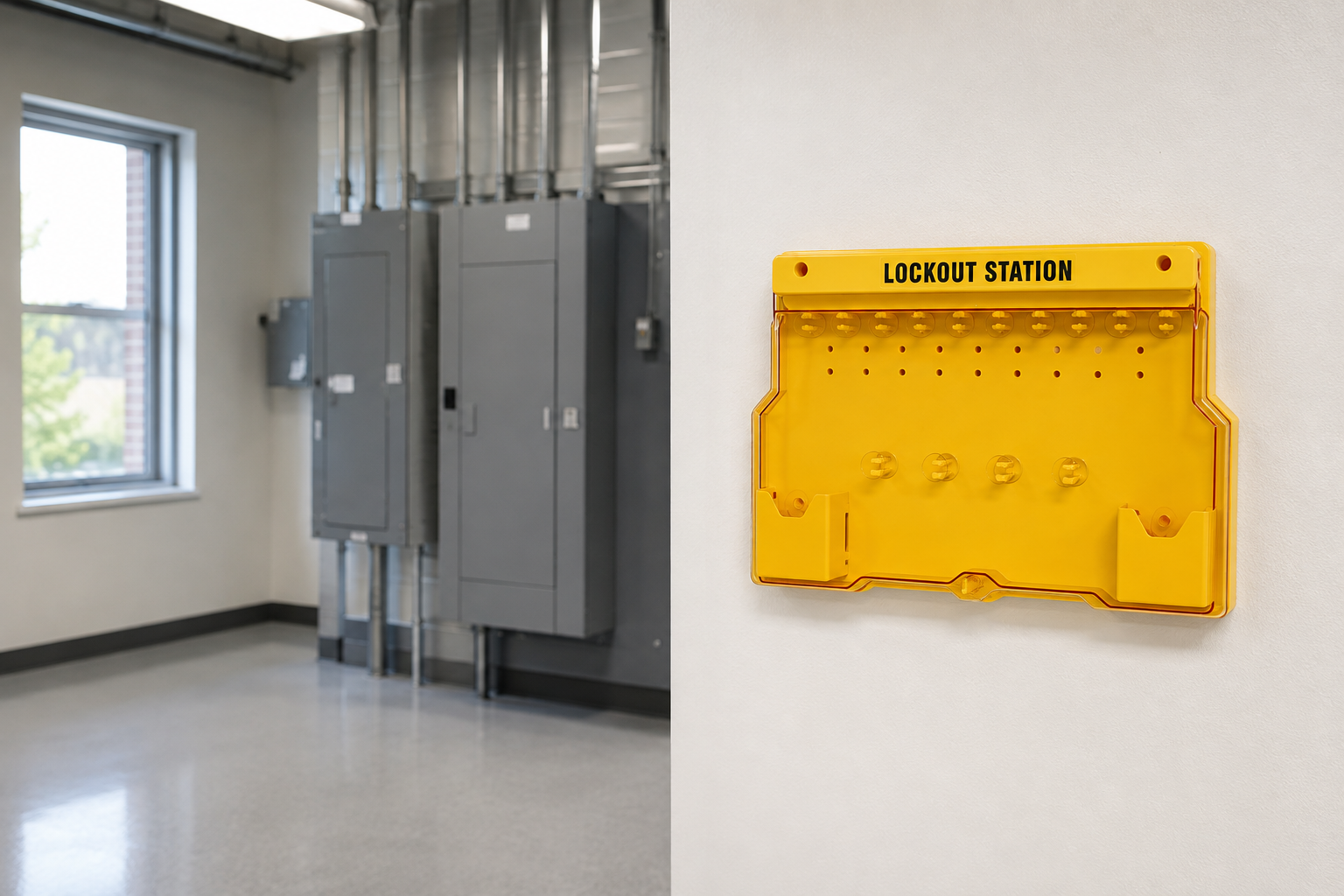
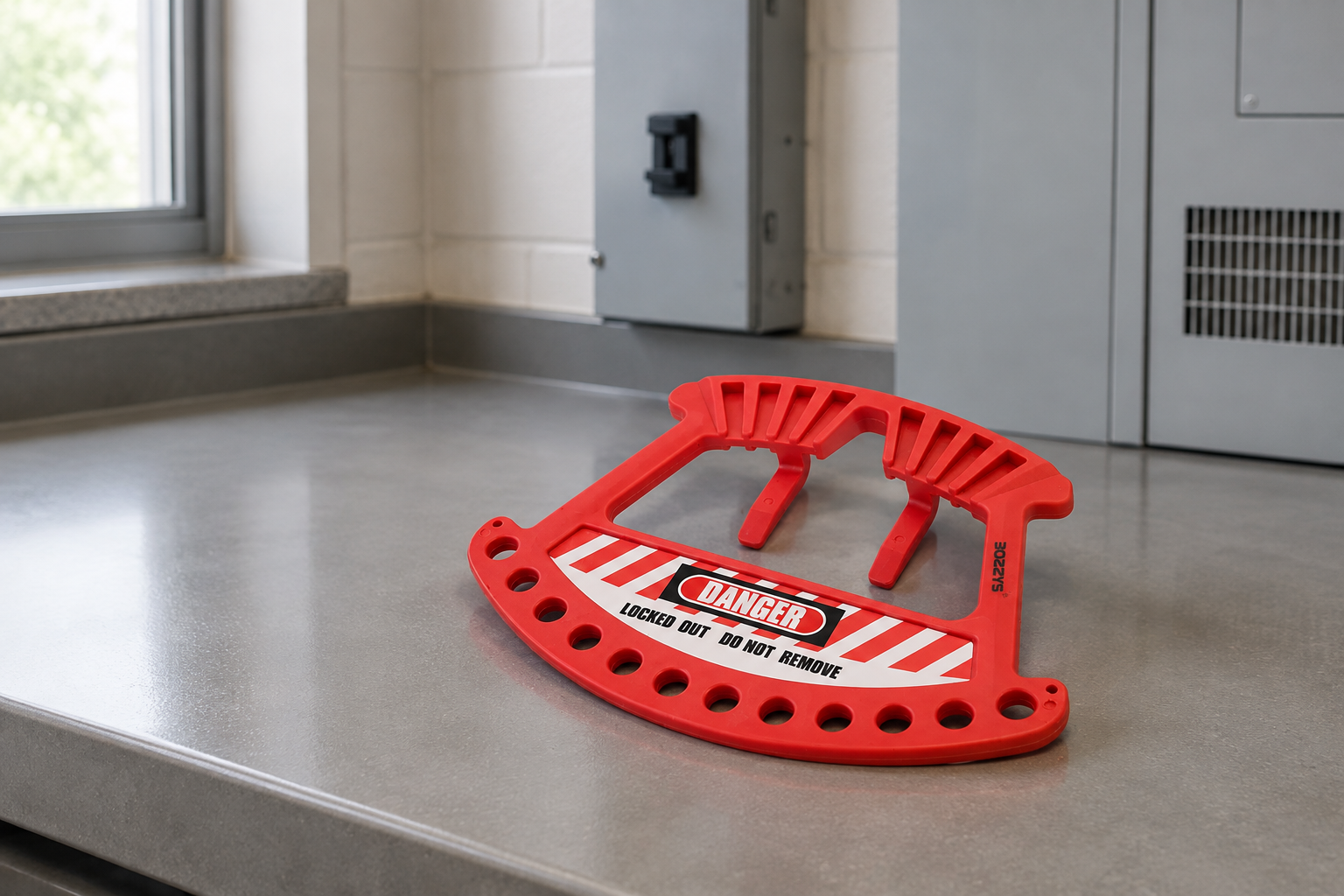
For portable work, a padlock storage carrier can support organization when it is paired with site procedures and clear personal-control rules. A wall-mounted station can improve availability in a fixed maintenance area, but it should not become a substitute for determining who applies each lock and how equipment is verified.
Apply standards accurately and avoid claims that outrun their scope
OSHA 29 CFR 1910.147 addresses the control of hazardous energy during servicing and maintenance for covered U.S. workplaces. Its applicability depends on the task and equipment; procurement teams should consult their safety professionals for district-specific application. The rule sets employer duties and program elements, so it should not be used to imply that a lock, tag, station, or kit is itself OSHA-certified.
OSHA’s Process Safety Management information concerns highly hazardous chemicals and is more specialized than most routine school maintenance programs. It can still be useful conceptually: process discipline, management of change, training, and emergency planning are management-system practices, not product features. ISO 45001 is an occupational health and safety management-system standard; its ISO publication page describes the standard’s scope, but a supplier’s product listing should not be marketed as ISO 45001-certified unless the claim is independently supported and clearly scoped.
Commercially, unsupported compliance language creates avoidable risk: it can confuse bidders, complicate approvals, and leave a buyer with devices that do not match the site procedure. Tender documents are stronger when they state the actual isolating devices, environmental conditions, identification needs, and required documentation rather than naming an unverified certification.
Procurement language for Safety Solutions should therefore name the intended application and evidence expected after installation or issue. This makes a classroom-security purchase, an emergency-preparedness purchase, and a maintenance-control purchase comparable without treating them as the same category.
Select campus maintenance controls through an auditable procurement process
- Inventory the work, not only the buildings. Group assets by maintenance task and energy source, then photograph or document each energy-isolating point.
- Specify compatibility and identification. Ask how a control fits the actual point of isolation, how personal ownership is shown, and how warnings remain legible in the expected environment.
- Plan for people and handoffs. Define authorized users, affected employees, contractor coordination, shift changes, and return-to-service authority before issuing equipment.
- Test a representative sample. Pilot the written procedure on a small, varied asset group; correct the procedure and device list before district-wide standardization.
QD LOTO supplies lockout/tagout equipment that can support this facilities-maintenance layer, including devices, personal locks, and storage options. A non-conductive nylon padlock, for example, should be assessed against the documented task, assigned-user process, and physical compatibility; it is not a door-locking or student-lockdown product.
Teams reviewing school safety solutions can use the same disciplined approach: define the outcome, confirm applicable requirements, test the workflow, and retain evidence that the control can be used as intended. That sequence is especially useful when multiple departments share the same campus portfolio.
Frequently asked questions
What is process safety?
Process safety is the disciplined prevention and management of releases or events involving hazardous processes, particularly where complex systems or hazardous chemicals are involved. In a school context, its ideas can inform how leaders manage change, training, and emergency planning, but it is not a synonym for classroom security or routine lockout/tagout. Review the actual hazard and applicable regulation before adopting terminology or controls.
What safety solutions does my organization need?
Start with a risk assessment that separates access, emergency response, worker safety, and facilities maintenance. The needed controls depend on the campus layout, student population, local response arrangements, equipment inventory, and work performed. A documented gap analysis should identify both operational procedures and equipment, rather than beginning with a catalogue.
What safety equipment should every school have?
There is no universal equipment list that fits every school. Basic needs are determined by local codes, emergency plans, building systems, and the work completed on site; facilities teams also need task-appropriate controls for hazardous-energy servicing. The practical next step is to assign owners to each control category and inspect readiness on a scheduled basis.
What door locks improve school safety?
Door-locking choices should be evaluated with district policy, fire and building requirements, accessibility, supervision, and emergency-response planning in mind. SchoolSafety.gov resources support a layered, risk-informed approach instead of a single-product answer. Lockout/tagout products used for maintenance should not be presented as door security hardware.
How do I evaluate a safety solutions provider?
Ask whether the provider can explain product fit, identification options, documentation, availability, and limits of use without overstating compliance. Request clear specifications that can be matched to an asset inventory and procedure set, then pilot selected items on representative equipment. Procurement should distinguish a product’s stated features from an employer’s regulatory responsibilities.
What products are needed for a school lockdown?
A lockdown plan should be developed with district leadership, local responders, and applicable codes; the appropriate products depend on the building and plan. Communications, access procedures, training, and drills may be as important as hardware. QD LOTO’s hazardous-energy-control equipment is intended for campus facilities maintenance, not for student lockdown or door barricading.
References and next step
- OSHA, 29 CFR 1910.147: The Control of Hazardous Energy (Lockout/Tagout)
- OSHA, Process Safety Management
- SchoolSafety.gov, federal school-safety resources
- ISO, ISO 45001 Occupational health and safety management systems
The strongest campus program makes the next safe action clear before an emergency or maintenance task begins. When a district is standardizing hazardous-energy controls for its facilities team, QD LOTO can help buyers evaluate suitable lockout/tagout equipment and documentation needs; review compatible lockout control options and contact QD LOTO to begin a site-specific discussion.