
When a Facility EHS Manager in Ohio, USA, named Maya Chen, reviewed a representative near miss, a technician had closed a process valve, attached a warning tag, and begun line work. During shift change, another employee moved the handle; the pressure gauge rose. The valve was not defective. The root cause was a tag on a nearby support and no physical restraint at the energy-isolating point. Valve isolation therefore requires a hardware-and-procedure decision.
A Safety Valve Lockout closes the gap between shutdown and isolation
Closing a handwheel or quarter-turn handle is an operating action, not a barrier against re-opening. A Safety Valve Lockout holds the energy-isolating device in its safe position. That matters on steam, compressed-air, hydraulic, chemical, fuel, and other lines where unexpected flow can create pressure, temperature, toxic, motion, or fire hazards.
Under the eCFR, a line valve is an energy-isolating device because it prevents transmission or release of energy. The procedure must still cover notification, shutdown, isolation, stored-energy control, and verification. The lockout device is the physical control that keeps a casual handle movement from undoing isolation.
A Safety Valve Lockout controls stored pressure and human error
Closing a valve stops new energy but may leave pressure trapped between valves, in a cylinder, or in a hose. CCOHS guidance calls for locking the valve, bleeding residual pressure, and checking gauges or other indicators. A double-block-and-bleed procedure should name both isolation points, the bleed path, and the readings that confirm a safe state.
Personal locks, clear identification, and a controlled shift handover reduce accidental restoration. For group work, each authorized worker needs personal protection through a hasp or lockbox. A valve lockout device should show the safe position, resist removal, and leave room for the required lock and tag.
For quarter-turn service, a ball valve lockout constrains the handle until the authorized employee’s lock is removed. Select it by handle thickness, travel, clearance, and required on or off position; a universal-looking part is not automatically compatible.
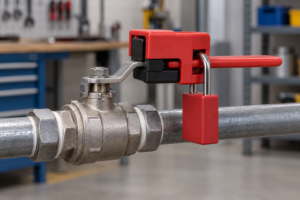
A Safety Valve Lockout must fit the valve and the work process
Compatibility is more than pipe size. Record valve type, handle dimensions, operating angle, nearby piping, temperature, chemicals, UV exposure, and the number of locks required. A device that slips, contacts a hot surface, blocks the wrong position, or cannot accept the shackle is a process risk, whatever its catalog appearance.
| Approach | Physical restraint | Verification | Best fit | Total-cost risk |
|---|---|---|---|---|
| Tag only | Warning only | High; equivalent protection may be required | Where the written program permits tagout | High human-factor risk |
| Padlock on an existing tab | Good when designed for the valve | Moderate; confirm safe position | Lockable handles or isolation points | Low cost, limited compatibility |
| Dedicated valve lockout device | Positive restraint at the operating point | Moderate; address stored energy | Retrofit protection for common geometries | Lower rework risk when specified correctly |
| Double-block-and-bleed with lockout | Multiple barriers plus controlled bleed | Higher; line-specific pressure checks | Critical lines and high-consequence work | Higher setup, potentially lower incident cost |
The lowest unit price is not always the lowest ownership cost. A compatible, legible device can reduce substitutions, permit delays, and audit failures. For personal locks, a non-conductive nylon padlock may suit the employer’s risk assessment and site specification.
| Situation | Challenge | Control focus | Checkpoint |
|---|---|---|---|
| Quarter-turn ball valve | Quick movement; limited clearance | Device holds the required position | Thickness, travel, clearance, position visibility |
| Gate or globe valve | Handwheel, stem, or chain needs enclosure | Block operation without blocking inspection | Wheel diameter, stem, tag access, durability |
| Pressurized pneumatic or hydraulic line | Residual pressure remains | Lockout, bleed, gauge check, verification | Pressure rating, vent, reaccumulation, test method |
| Outdoor or corrosive process area | Moisture, chemicals, and UV | Compatible hardware and markings | Material, temperature, marking, inspection interval |
| Group maintenance or contractor work | Protection across people and shifts | Personal locks on hasp or lockbox | Lock points, ownership, removal procedure |
A Safety Valve Lockout fits the energy-control standards that govern the job
OSHA 29 CFR 1910.147 covers servicing where unexpected energization, start-up, or stored-energy release could injure employees. It requires procedures, training, inspections, protective hardware, and verification. OSHA regulates the employer’s program; it does not blanket-certify every padlock or valve device.
ANSI/ASSP Z244.1 is a consensus framework for hazardous-energy control and alternative methods. ISO 45001 supports management-system controls. CE or RoHS may apply to product documentation and destination markets, but neither proves an effective isolation procedure. Request material, dimensional, environmental, and documentation data; avoid unsupported certification claims.

Inspection connects the device, pressure check, and written control step.
A repeatable program starts by specifying a Safety Valve Lockout for real plant conditions
- Map the point. Record valve type, dimensions, energy source, safe position, stored energy, and nearby equipment.
- Define verification. Name the gauge, bleed point, visual check, functional try, or other safe method, including reaccumulation checks.
- Test the fit. Confirm installation, locking, tagging, inspection, and removal without unusual force or hazardous contact.
- Plan people and shifts. Set rules for personal locks, groups, contractors, and handover.
- Control supply. Keep the specification, compatible-valve list, inspection record, and replacement trigger.
QD LOTO can support specification with configurable hardware and sourcing documentation for distributors, EPC teams, and industrial users. The test is whether the device, lock, tag, and procedure work together on the valves employees service. For group work, a multiple lockout hasp may support the written method.
Frequently Asked Questions
How do you lock a valve?
Notify affected employees, shut down the equipment, close the correct energy-isolating valve, and apply a compatible device and personal lock. Relieve or restrain residual energy, then verify isolation by the equipment-specific method before work begins.
How do you use a ball valve lockout?
Place the device over or through the quarter-turn handle in the required safe position, then attach the lock and tag. Confirm that the handle cannot move and that the device does not obstruct pressure release or verification. Check dimensions and clearance before deployment.
What is the purpose of a safety valve?
A safety valve protects a system from excessive pressure by opening or relieving pressure under defined conditions. It is not an energy-control procedure: relief and isolation manage different hazards. Maintenance may require both pressure protection and a locked isolation point.
What are the five stages of lockout?
Many programs summarize them as preparation and notification, shutdown and isolation, lockout with stored-energy control, verification, and controlled restoration. OSHA 1910.147 adds training, periodic inspection, group-work, and shift-change rules. The site’s written procedure controls.
References
- OSHA 29 CFR 1910.147, The control of hazardous energy
- OSHA Control of Hazardous Energy
- eCFR 29 CFR 1910.147
- CCOHS Lockout/Tag out guidance
The strongest isolation is identifiable, lockable, verifiable, and transferable across shifts. A Safety Valve Lockout makes that principle visible at the valve, while the procedure proves the line is safe to service. For product selection and the broader lockout/tagout locks category, contact QD LOTO with valve type, dimensions, environment, and group-work needs.