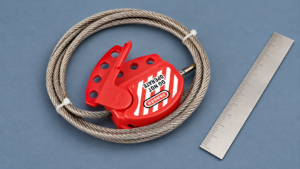
A cable lock secures objects with a flexible cable
A cable lock is a device that restrains objects using a flexible cable secured by a locking mechanism. Ordinary security cable locks help deter theft by securing items such as bicycles or tools.
In industrial energy control, a cable lock is a cable lockout device used to hold an energy-isolating device in a safe position under a documented procedure. It does not itself eliminate hazardous energy or verify zero energy; those steps require the specified isolation and verification process.
Which cable lock features determine a safe fit?
Record whether it holds a valve, disconnect, handle or several points; measure the path and largest bend. Confirm reach without side loading, full closure and padlock or hasp compatibility.
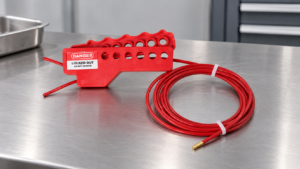
Coated steel may aid handling or documented insulation and corrosion needs; stainless may suit another environment. The choice still depends on verified material, diameter and length. A cable lock controls equipment only when geometry, cable and lock interface match.
Trial the device before approval. Check line of sight, pinch points, sharp edges, worker access and bypass handles. A tag supports communication but does not replace physical lockout where feasible.
How should a cable lock be applied across energy sources?
Write the sequence around energy sources: notify affected employees; shut down; isolate electrical, mechanical, hydraulic, pneumatic, thermal or chemical sources; apply the device; release or restrain stored energy; and verify before exposure. A cable can connect points, but cannot release pressure, discharge a capacitor or prove a valve seated.
Coordinate electrical use with the disconnect procedure and test instrument; for process lines consider pressure, temperature, gravity and backflow. Link the step to the energy-control record and inspection process. The safety padlock gives personal control; the cable supplies physical restraint where it fits.
Train authorized and affected roles, group lockout, shift change and removal. Try the control where safe, test for absence of energy, and return controls to neutral or off as required.
What does a cable lockout comparison reveal for procurement?
The phrase cable lockout is often used for the complete application, while a cable lock may be one component. Compare the following dimensions before treating products as interchangeable.
| Dimension | Flexible cable device | Single-point cover or clamp | Security cable |
|---|---|---|---|
| Coverage | Can reach multiple designed points | Usually one defined handle, valve or plug | Needs a separate engineered application |
| Fit | Path, bend radius, diameter and lock hole govern fit | Opening and jaw geometry govern fit | May lack lockout interface data |
| Handling | Flexible; coated or retractable options aid storage | Fast for a standardized control | Convenience does not establish isolation |
| Evidence | Use documented cable, body and environmental data | Use documented material and range | Security ratings do not equal energy-control suitability |
| Procedure and cost | Routing and verification; can reduce device changes for one designed route | Defined single-point steps; efficient for repeatable controls | Low purchase cost can create rework if fit fails |
How do you select a cable lock for your facility?
Use this short buying sequence:
- Map each energy-isolating point and the stored-energy hazards; include alternate feeds and backflow.
- Measure the route, bend radius, control opening and lock-hole or shackle interface at the equipment.
- Choose cable diameter, length, coating or stainless construction from the current fit data; avoid inferring performance from color or a security rating.
- Trial the device with the authorized lock, hasp and gloves, then document the try-test and zero-energy verification step.
- Set inspection, cleaning, replacement and shift-change rules and train the people who use them.
QD LOTO supplies cable-lockout devices for industrial energy control. Public examples include M-L07 (3 mm, 2 m PVC-coated steel), M-L08 (3 mm, 2 m stainless), M-L01 (5/32 in [4 mm] flexible multi-stranded steel with integrated hasp) and M-L06 cable security lockout. Verify the current datasheet and equipment fit; QD LOTO makes LOTO devices, not generic security padlocks or unrestricted cable.
Frequently Asked Questions
What is a cable lock used for?
Cable locks secure energy-isolating controls: valves, disconnect handles, designated points. Cable routing and body hold position; an authorized lock prevents removal. Shutdown, stored-energy control and verification remain required.
What is a cable lockout?
Cable lockout is the application of a cable-based device within a lockout/tagout procedure. It may cover one control or connect multiple points, depending on the device design. The term does not describe a universal size, material or isolation capability; use the specific model’s fit data and procedure.
What is the difference between a cable lock and a cable lockout?
A cable lock is the physical device; cable lockout is the method and work-control step that uses it. The method includes notification, shutdown, isolation, restraint of stored energy and verification. A cable lock alone cannot confirm that a system is de-energized or depressurized.
What are steel cable locks used for?
A steel cable lock is used where a designed cable device routes around or through an energy-isolating control. Coated steel and stainless versions suit different handling and environmental needs only when documented. Confirm diameter, length, bend radius, lock compatibility and corrosion exposure.
References
When your team is ready to compare current QD LOTO options, review the 2 m cable lockout product against the equipment drawing, then contact QD LOTO for model fit and documentation. Browse the complete LOTO product range for the next specification step.