
Summary: A lockout box is a controlled container for keys used during group lockout; OSHA 29 CFR 1910.147 requires employers to establish energy-control procedures and use lockout devices that hold an energy isolating device in a safe position. For multi-person work, the practical action is simple: isolate, lock, verify, deposit keys, then let every authorized worker apply and remove only their own lock.
A Lockout Box Turns Key Custody Into a Visible Group Procedure
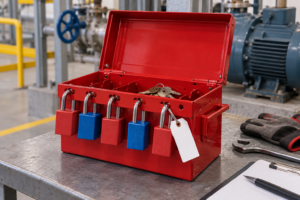
This group box supports hazardous-energy control when several people, trades, shifts, or contractors work under the same isolation. The primary authorized employee secures the machine’s isolation keys inside the box, and each worker applies a personal lock so the keys cannot be removed until all people are clear.
A Lockout Box is a portable or wall-mounted container with lock points for multiple authorized employees. It is used after equipment has been isolated, locked, and tested for zero energy. The box does not replace written procedures, training, or verification; it gives those controls a physical custody point supervisors can inspect.
The technical value is traceability. In a single-person task, one worker may lock one isolating device. In a group task, a cell or utility skid may involve electrical, pneumatic, hydraulic, and stored-gravity energy. A controlled key box prevents release until every personal lock is removed.
Key control is the center of the method
The normal sequence is to shut down, isolate energy sources, apply lockout devices, verify zero energy, place isolation keys in the box, and require every exposed worker to add a personal lock. The box should have enough lock holes for crew size plus shift-change margin, and its design should make missing keys or forced access obvious.
Group work changes the risk profile
In group servicing, the weak point is often handoff, not hardware strength. If one shift removes a lock before another signs on, or if a contractor assumes someone else verified isolation, the control chain breaks. Good group lockout boxes make custody visible, repeatable, and easy to audit.
A Lockout Box Should Be Compared With Adjacent Lockout Tools Before Purchase
Buyers often confuse a lock box, hasp, padlock station, and document cabinet. They can all support lockout/tagout, but they control different failure modes.
| Tool | Best use | Control strength | Limit to watch |
|---|---|---|---|
| Lock box | Multi-person work where isolation keys need shared custody | Prevents key removal until locks are cleared | Fails if keys are not deposited and counted |
| Lockout hasp | Several workers locking one energy-isolating point | Simple, low-cost, direct point control | Not ideal for many keys or many isolation points |
| Padlock station | Storage and issue control for locks and tags | Improves availability and housekeeping | Does not control active job keys by itself |
| Permit or document holder | Keeping procedure sheets, permits, and sign-off forms visible | Supports communication and audit records | Does not physically secure isolation keys |
For simple single-point tasks, a multiple-lockout hasp may be enough. For a crew maintaining several isolating devices, a lockout tagout box gives better custody control because one controlled release point governs all collected keys.
A Lockout Box Must Be Sized Around Crew, Energy, and Shift Conditions
Specification should start with the job, not the catalog photo. Count the maximum number of authorized employees, isolation keys, contractor locks, and shift-transfer locks at the same time. A box with twelve lock holes may suit a maintenance cell; an EPC project may need several boxes.
| Application condition | Typical specification focus | Useful buying check |
|---|---|---|
| Small maintenance crew, 2-6 people | Portable steel box, clear lock points | Confirm lock-hole spacing fits site padlocks |
| Production line overhaul, 6-12 people | Higher lock capacity and visible key deposit area | Consider a portable group lockout box with matched padlock capacity |
| Contractor or EPC work | Numbered locks, job labels, supervisor control, documentation space | Require a sign-in record that matches personal locks |
| Wet, chemical, or outdoor area | Corrosion resistance, drainage, label durability, color visibility | Check material data and environmental limits |
Hidden cost often appears as waiting time. If employees queue to apply locks, if the box travels between assets, or if keys are hard to identify, the procedure may be followed poorly. As an illustrative calculation, ten workers waiting six minutes each equals one labor-hour lost before repair begins.
A Lockout Box Supports Compliance Only When the Energy-Control Program Is Correct
OSHA 29 CFR 1910.147 regulates the employer’s control of hazardous energy. It does not issue a blanket product certification for a commercial box. The employer must establish procedures, train employees, inspect the program periodically, and provide devices that are durable, standardized, substantial, and identifiable.
ANSI/ASSP Z244.1 is often used as a best-practice reference for lockout/tagout and alternative methods, while ISO 45001 frames occupational health and safety management systems. CE and RoHS may matter for product documentation, market access, or restricted substances where applicable, but they should not be presented as proof that a site procedure complies with OSHA. Unsupported certification language can mislead distributors, procurement teams, and auditors.

A Lockout Box Selection Should Be Based on Procedure Fit, Not Only Price
Procurement should ask five practical questions. How many people may be exposed? How many keys must be stored without mixing systems? Will the box move with the job or stay at a control point? Are labels and lock numbers visible? Can the supplier provide consistent padlocks, tags, and documentation?
QD LOTO supports industrial buyers with configurable lockout/tagout products, including boxes, padlocks, tags, and accessories. For sites standardizing several departments, matching the box with compatible lockout tagout locks helps simplify training and replenishment.
Frequently Asked Questions
What are the 7 steps of a lockout/tag out procedure?
A common seven-step sequence is preparation, notification, shutdown, isolation, lockout/tagout application, stored-energy release, and verification of zero energy. Site procedures may add return-to-service or contractor-control steps, but verification before work is the critical gate.
How does a lockout box work?
After isolating and locking the equipment, the authorized person places the isolation keys inside the box. Each exposed worker applies a personal lock, and the keys cannot be removed until every worker removes their own lock.
What are the five stages of lockout?
A compact five-stage model is prepare, isolate, lock and tag, verify, and restore. Many sites expand these steps for communication and group transfer; the selected model must match the employer’s written procedure.
What are the requirements for lockout equipment?
Under OSHA language, lockout devices must be durable, standardized, substantial, and identifiable. In purchasing terms, the device should resist the work environment, use consistent color or shape rules, withstand removal, and show who applied it.
References
The closing principle is simple: a Lockout Box does not create safety by existing; it creates control when the last key cannot leave before the last person is clear. If your facility is standardizing group lockout for maintenance cells, utilities, or contractor work, QD LOTO can help review box capacity, padlock compatibility, and documentation needs.