
Summary: A plug lock isolates portable equipment by containing its plug and blocking access to the receptacle. Good selection depends on plug dimensions, cord exit, lock clearance, environment, and the site’s written LOTO sequence. Confirm the enclosure on a representative de-energized plug, control stored energy, and verify isolation before work begins.
How a plug lock prevents unexpected energization during service
A plug lock is a physical enclosure that prevents an electrical plug from being inserted into an outlet while equipment is being serviced. In a maintenance shutdown, the enclosure gives an authorized worker a visible point for a personal lock and tag. It is a hardware control within a larger hazardous-energy procedure, not a substitute for identifying every source and verifying the safe state.
The normal failure a plug lock addresses is simple: someone reconnects a cord while another person is inside the danger zone. The device surrounds the plug or connector, closes around the cord, and provides an opening for an authorized employee’s lock. With the plug physically inaccessible, a warning tag remains visible and the responsible worker retains control of the isolation point.
A plug lock is effective only when the plug can be fully contained and the enclosure cannot be pulled off without removing the applied lock. The procedure should still cover notification, shutdown, disconnection, release of stored energy, verification, and controlled restoration. Test instruments and PPE may be required for the task, but they do not replace the physical restraint.
For contractors or shared workshops, record the equipment ID, plug type, lock owner, and verification result. That record helps a supervisor distinguish a deliberate isolation from an unplugged cord that could be reconnected by anyone.
Which plug lock features matter for industrial equipment
Selection starts with the plug rather than the catalog name. Measure the plug body, width, thickness, grounding configuration, cord diameter, and the clearance around the receptacle. Check whether the closure accepts the shackle diameter used by the site and whether the tag remains legible after the device is locked.
| Application class | Typical plug or task | Enclosure consideration | Evidence to retain |
|---|---|---|---|
| Light-duty portable tools | Compact 2-prong or 3-prong cord set | Check body width, prong clearance, and cord exit | Measured sample and approved plug family |
| Industrial molded plugs | Oversized cap, strain relief, or angled body | Allow internal depth and a closure that cannot pull off | Fit trial on the largest connector |
| Contractor or shared equipment | Several users, handoffs, and temporary assets | Provide visible tag space and personal-lock access | Issue record and lock-count rule |
| Harsh or outdoor service | Heat, oils, chemicals, impact, UV, or moisture | Review material, inspection interval, and label durability | Environmental review and inspection date |
Use a compatible Plug Lockout when the plug is the isolation point. If the equipment is hard-wired, a plug enclosure is the wrong control; isolate the disconnect or breaker with a device designed for that geometry. A circuit-breaker lockout can address the upstream point when the written procedure identifies it as the controlling isolator.
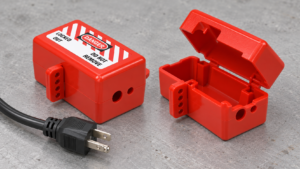
How plug lock sizing supports reliable electrical plug lockout
An electrical plug lockout should be tested on the actual plug and receptacle combination used at the site. Confirm that the plug cannot reach the outlet when the enclosure is locked, that the cord is not sharply bent, and that the closure does not damage the insulation. A device that fits one extension cord may not fit a molded industrial connector.
Two-prong and three-prong plugs can have different body shapes even when their nominal current rating is similar. Grounding pins, strain reliefs, angled bodies, and oversized caps all affect the required internal space. Ask for a drawing or sample when dimensions are uncertain, and document any plug family that requires a different enclosure.
For a mixed maintenance area, combine plug controls with visible storage. A lockout station can keep approved devices, tags, and personal locks available, but its inventory does not prove that a particular plug is isolated. The worker applying the lock remains responsible for the site verification step.
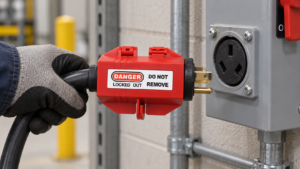
How plug lock use fits a documented LOTO process
OSHA 29 CFR 1910.147 addresses employer responsibilities for controlling hazardous energy where the standard applies. A plug lock supports the isolation step, while the employer’s procedure defines authorized employees, shutdown sequence, stored-energy release, verification, periodic inspection, and restoration. Product color or packaging is not a compliance certification.
Before approving a device, walk down the task with the people who will perform it. Identify alternate feeds, battery backup, capacitors, pneumatic movement, and any remote start function. If the plug does not remove all hazardous energy, add the other isolation points to the procedure and lock them with suitable devices.
QD LOTO can support a measured specification for portable equipment, including device samples and sourcing documentation. Keep the plug dimensions and user requirements with the purchase record instead of selecting from a photograph alone.
Frequently Asked Questions
How does an electrical plug lockout work?
It encloses the plug and cord connection so the plug cannot be inserted into a receptacle. An authorized employee applies a personal lock and tag to the enclosure, then releases or restrains residual energy and verifies the equipment is safe under the written procedure.
How do you install a plug lockout?
Notify affected people, shut down the equipment, unplug it, place the plug inside the correctly sized enclosure, close the enclosure, and apply the personal lock and tag. Confirm that the enclosure cannot be removed or opened without the lock, then perform the required verification before starting work.
What plug sizes can it fit?
Fit depends on the device model and the plug’s body, prongs, strain relief, and cord diameter. Use the manufacturer’s dimensional range and verify a representative sample. Do not infer compatibility from voltage, current rating, or the number of prongs alone.
Can it lock 2-prong and 3-prong plugs?
Some enclosures accommodate both, while others are designed for a specific body size or grounding-pin arrangement. Check the published opening and internal clearance, then conduct a physical fit trial. If either plug cannot be fully contained, select a different device or isolate the upstream disconnect.
References:
- eCFR, 29 CFR 1910.147, The control of hazardous energy
- Canadian Centre for Occupational Health and Safety, Lockout
- UK HSE, HSG253: The safe isolation of plant and equipment
- UK HSE, Provision and Use of Work Equipment (PUWER)
The practical definition is straightforward: a plug lock blocks reconnection, while the LOTO procedure proves that all hazardous energy is controlled. Measure first, apply the device correctly, and verify before work begins.
When your plug survey is ready, review the QD LOTO product range with the device dimensions, user count, and destination-market documentation required for your shutdown.