
Summary: Electrical safety lockout is a physical and procedural control preventing unexpected energization during service. OSHA 29 CFR 1910.147 defines employer duties for hazardous-energy control—it does not certify any specific device. Before purchase, map every disconnect, match the lockout to the installed geometry, and verify the de-energized state under the written procedure.
The term covers devices and work controls that keep a breaker, disconnect, switch, plug, or other energy-isolating point safe. A lock restricts movement, but only notification, shutdown, isolation, stored-energy control, and verification address the exposure. This distinction matters to EHS teams, supervisors, distributors, and contractors.
Electrical Safety Lockout prevents unexpected energization when isolation points are controlled
A reliable sequence identifies every source, including secondary feeds, control circuits, and stored energy. After shutdown, an authorized employee applies the device and personal lock, controls residual energy, and performs the site’s approved absence-of-voltage verification. The lockout is a control point, not proof that the circuit is dead.
For breaker handles, a Electrical Safety Lockout device should be checked on a representative de-energized panel. Confirm restraint, shackle access, and secure fit during a handle test; record the approved breaker family so later work orders do not rely on appearance.
A mismatch can trigger a stop-work event, extend an outage, encourage improvised controls, and create inconsistent contractor practice. Fit records and repeatable verification reduce those costs while preserving duties under OSHA 29 CFR 1910.147.
Electrical Safety Lockout choices differ by device geometry and work sequence
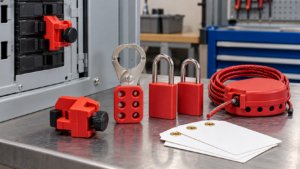
An electrical lockout program uses compatible electrical lockout devices, including breaker restraints, switch covers, plug controls, and hasps. Each option works only when its contact points match the isolation device and the sequence gives every exposed person personal control. A quarter-turn switch should not be treated like a miniature breaker.
| Control point | Typical approach | Fit evidence | Workflow effect | TCO consideration |
|---|---|---|---|---|
| Breaker | Clamp-on or screw-secured lockout | Handle width, profile, poles, clearance | Fast isolation after family approval | Fewer returns after sample testing |
| Disconnect or selector switch | Switch cover or dedicated lockout | Faceplate, travel, mounting access | Maintains visible OFF control | Efficient for repeated switch families |
| Plug or cord | Plug enclosure or cable restraint | Plug dimensions, cord exit, closure | Supports portable and contractor work | Reduces improvised temporary controls |
| Multiple workers or sources | Hasp or group lock box | Lock count and handover rules | Preserves individual control | Needs inventory and release ownership |
For a toggle or rotary control, evaluate a dedicated electrical switch lockout against the same sequence: isolate, lock, control stored energy, verify. Choose the device technicians can apply without blocking adjacent controls or forcing the component.
Electrical Safety Lockout compliance rests on procedure, verification, and evidence
In the United States, OSHA 29 CFR 1910.147 addresses employer control of hazardous energy where it applies. ANSI Z244.1 is consensus guidance on lockout/tagout and alternatives; ISO 45001 is a management-system framework. These references do not turn a catalog item into universal product certification; applicability depends on task, equipment, jurisdiction, and the employer’s program.
CE or RoHS statements may matter for certain products and markets, but only within their actual scope. They are not proof that an electrical lockout program meets OSHA duties. Specifications should state materials, dimensions, intended use, testing records, and document ownership without unsupported promises.
Evidence normally includes the procedure, training records, periodic inspection, device identification, and verification that residual energy is controlled. A product supports those controls; the site remains responsible for qualified employees and confirming the safe state before contact.
Electrical Safety Lockout selection becomes actionable through a measured buying guide
- Survey each point and record handle dimensions, direction, clearance, and maximum users.
- Approve a physical sample on a de-energized device; test restraint, access, and removal under the procedure.
- Set quantities from simultaneous work, personal-control rules, contractors, spares, storage, and replacement.
- Assign owners for inspection, replenishment, training, and evidence before issue.
QD LOTO can support a measured specification with configurable lockout devices, sample review, and sourcing documentation. For shared maintenance areas, a safety padlock lockout station may help keep approved devices visible and accountable, provided its inventory matches the site’s group-lockout method and maximum user count.

Field application should confirm fit, personal control, and access to the verification point before work starts.
Frequently Asked Questions
What is an electrical lockout device?
An electrical lockout device prevents normal operation of a breaker, disconnect, switch, or plug while a worker’s lock is applied. It supports the written sequence but does not replace shutdown, stored-energy control, or verification. Confirm geometry and procedure before use.
What are the different types of electrical lockout devices?
Types include circuit-breaker, switch, plug, cable, hasp, and group lock-box systems. The right type depends on shape, access, environment, and user count. A representative fit trial is more reliable than selecting by voltage or product name.
What are electrical safety devices?
Electrical safety devices can include lockout hardware, warning tags, disconnects, barriers, test instruments, and PPE, depending on the task. Their functions differ: a lockout restrains an isolating point, while a tester helps verify absence of voltage. Use each within its design limits and qualified-person requirements.
What are the four types of LOTO?
Many programs describe four phases: preparation; shutdown and isolation; lock/tag application with stored-energy control; and verification before work. Terminology varies, so the written procedure controls. Afterward, follow documented inspection, lock removal, and controlled restoration steps.
References:
- OSHA 29 CFR 1910.147, The control of hazardous energy
- CCOHS, Lockout
- HSE HSG253, The safe isolation of plant and equipment
- HSE, Provision and Use of Work Equipment (PUWER)
The durable principle is simple: a lockout protects people when the hardware fits the isolation point and the procedure proves the energy is controlled.
When your panel survey is ready for a documented device plan, review QD LOTO products and contact the team with your equipment photos, dimensions, user count, and destination-market documentation needs.