
When a purchasing engineer in Milwaukee replaced a maintenance team’s hasps, the chosen model passed through the isolation lug but left too little space for the team’s padlocks to close together. In this illustrative scenario, the order was held for review. The failure came from checking jaw size alone, while overlooking the complete lock-and-hasp arrangement.
Summary: Choose an aluminum lockout hasp or steel hasp lockout model by its verified geometry, required personal-lock capacity and documented environmental suitability. Under 29 CFR 1910.147(f)(3), group lockout must provide protection equivalent to personal lockout. Material names and hole counts cannot establish that result without a workable procedure and a fit review.
A hasp lets multiple personal padlocks secure a suitable point. This guide concentrates on material and configuration purchasing decisions. The existing explanation of how a lockout hasp works covers its basic operating role.
Compare complete constructions, not just material labels
“Aluminum” and “steel” describe only part of a product specification. A hasp can combine a metal body, a different-metal spring or pivot, and a polymer grip or label. Surface treatment, moving parts and geometry all affect whether the item suits the intended environment and use.
Section 1910.147(c)(5) requires devices to withstand the environment for the maximum expected exposure period and be substantial enough to resist removal without excessive force or unusual techniques. It does not declare one hasp material suitable for every workplace, prescribe a universal alloy, or turn a coating into an electrical-protection rating.
| Purchasing dimension | Aluminum hasp: verify | Steel hasp: verify | Decision evidence |
|---|---|---|---|
| Construction | Body alloy, moving parts and surface treatment | Jaw/body construction, plating or coating and moving parts | Current model drawing and material description |
| Fit | Jaw opening, closure path and occupied space | Jaw opening, interlocking features and occupied space | Sample applied to the intended attachment point |
| Personal locks | Hole layout and actual padlock-body interference | Hole layout and actual padlock-body interference | All required locks close without obstructing each other |
| Exposure | Suitability of the complete assembly for site conditions | Suitability of the complete assembly for site conditions | Manufacturer evidence and defined inspection criteria |
| Handling and issue | Actual item mass, identification and replacement availability | Actual item mass, identification and replacement availability | Measured sample information and approved issue process |
Do not rank two models on “strength,” corrosion life, temperature tolerance or sparking behavior without comparable evidence for the complete products. An aluminum body is conductive, and a coated steel hasp should not be treated as an insulating barrier merely because its grip is covered.
Check three interfaces in the installed arrangement
The three interfaces to examine are the isolation point to jaw, the hasp closure mechanism, and the padlock shackle to hole. This is an inspection framework, not a numerical test requirement in OSHA. It translates the device application and verification duties in 1910.147(c)(4) into purchasing checks.
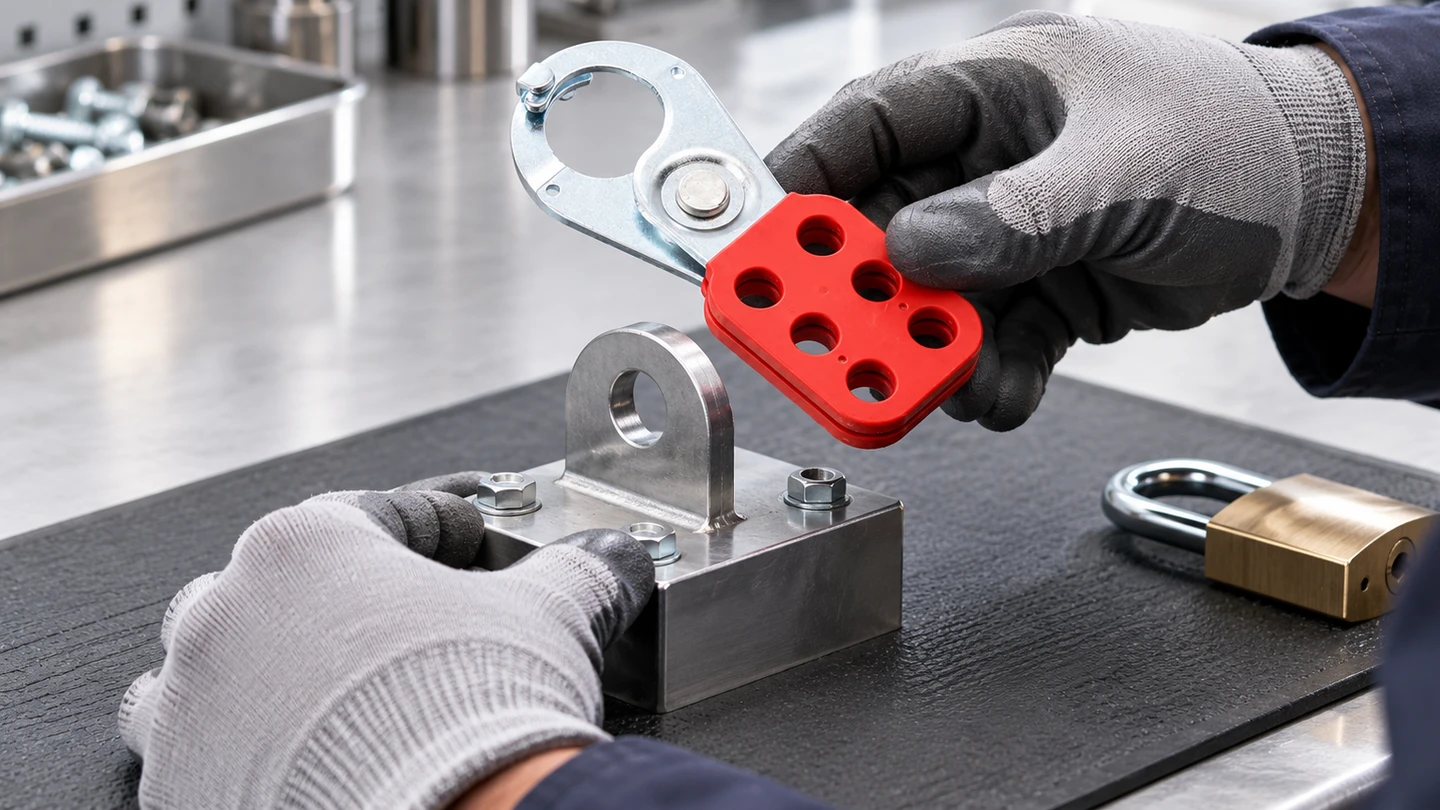
First, the jaw must engage the intended locking feature without relying on an uncertain partial closure. Second, the hasp must close fully and retain its intended locking relationship. Third, the selected padlocks must fit and close while leaving the hasp secured as intended. Check the complete arrangement under the site’s approved procedure.
Jaw opening and padlock-hole diameter are different dimensions. Neither tells the buyer whether the padlock bodies will collide when several workers attach their locks. Obtain dimensions with clearly identified measurement locations and use the actual selected padlock sample.
There is no universal OSHA jaw size. For example, QVAND’s published steel-hasp listing identifies M-D03 with a 25 mm jaw and M-D04 with a 38 mm jaw. These are model examples, not evidence that either jaw fits your isolator. Ask for a current drawing and reconcile any inconsistent catalog dimensions before ordering.
Establish usable personal-lock capacity
Count the workers who need protection at the point under the chosen procedure. Then check the device’s documented capacity and the actual lock arrangement. A marketing title, visible aperture count or general “multi-worker” claim cannot resolve every interaction between a hasp and bulky padlock bodies.
| Application dimension | Evidence needed | Action if unresolved |
|---|---|---|
| One isolation point, multiple workers | Required personal locks fit simultaneously and the hasp remains secured | Review a suitable larger configuration or approved group arrangement |
| Several isolation points | Procedure defines every point and each worker’s protection | Evaluate a documented group lockbox or comparable system |
| Closely spaced hardware | Closed hasp and padlocks clear guards, adjacent devices and required access | Reject the configuration or review a compatible alternative |
| Shift or crew change | Defined responsibility and continuous protection during transfer | Resolve the handover procedure before issue |
| Harsh environment | Complete-assembly suitability and inspection/replacement criteria | Request evidence rather than assuming the material is adequate |
QVAND’s steel-hasp page describes a six-padlock configuration. Treat that as a supplier-stated capacity to confirm against the selected model and actual personal locks. Do not extend it to every steel hasp or use it as a limit prescribed by OSHA.
Section 1910.147(f)(3) permits group lockout devices, group lockboxes or comparable mechanisms within a compliant group-control arrangement. It requires each authorized employee to attach and remove their personal device as work begins and ends. A hasp does not eliminate coordination when more than one crew or department participates.
Inspect exposure, wear and identification
CCOHS emphasizes maintaining protective hardware and defining responsibilities within the lockout program. For a particular hasp, the inspection should consider closure operation, deformation, corrosion, damaged moving parts and readable identification where used. Define rejection criteria using the manufacturer’s instructions and the employer’s procedure.
A seized pivot or damaged closure is a reason to remove the item from issue and investigate, not a reason to force it into place. A deteriorated coating can also prompt review of underlying condition and environmental suitability. Do not assign a replacement interval without evidence for the product and exposure.
Distinguish the hasp’s condition check from the periodic procedure inspection in 1910.147(c)(6). The procedure inspection must occur at least annually. It does not mean that a damaged device may remain in service until the next annual inspection.
For U.S. general-industry work, 1910.147 establishes applicable program and hardware duties. CCOHS discusses Canadian practice with reference to CSA Z460. Neither source provides a blanket material approval or product certification. Obtain separate supporting evidence for any electrical, hazardous-location or special-environment claim.
Approve a sample and control substitutions
Use five approval steps: identify the isolation point, confirm the required personal locks, review the current drawing, perform the controlled sample-fit check, and record the accepted model/revision. QVAND’s lockout hasp range can support the initial shortlist. Make the final decision from the specified product and actual application.
For a steel example, compare the M-D03/M-D04 steel hasp listing with a current drawing. For an aluminum option, request corresponding construction and capacity documentation. Treat a material substitution as a new review when geometry, closure, finish or lock clearance changes.
Total cost includes the sample review, issue administration, inspection, replacements and disruption caused by rejected fit. As a hypothetical calculation, a $3 unit saving across 20 hasps is $60. A $90 return-and-reorder exercise would exceed that saving before delay is counted. These figures illustrate a purchasing comparison and are not QVAND prices or measured project results.
Frequently asked questions
Is an aluminum lockout hasp better than a steel hasp lockout?
There is no universal winner. Compare the complete products for geometry, required personal locks, environmental suitability and documented mechanical performance. A material label cannot replace the application review.
How many padlocks can a lockout hasp hold?
Capacity is model-specific and must be checked with the intended locks. Hole count alone does not show whether all padlock bodies can fit without interference or whether the closure works as intended.
Can a coated steel hasp be used as electrical insulation?
Do not assume so. A polymer grip or surface coating does not establish a verified insulating rating for the complete assembly. Follow applicable electrical work practices and obtain evidence for any specific protective claim.
What dimensions matter when selecting a hasp?
Check the jaw opening, closure path, padlock-hole geometry and occupied space with all required locks. Confirm dimensions from a current drawing and validate the actual arrangement under the employer’s procedure.
Does a group lockout hasp replace a group lockbox?
They serve different arrangements and are not automatically interchangeable. Choose the group-control method from the equipment’s isolation points, participating employees and procedure requirements. Multiple isolation points may require a coordinated arrangement beyond one hasp.
References
- 29 CFR 1910.147, via Cornell LII, especially (c)(4)–(6) and (f)(3)–(4).
- CCOHS: Lockout/Tag out, responsibilities and hardware context.
- CCOHS: Hazardous Energy Control Programs, energy-source and residual-energy context.
The useful comparison is the complete hasp-and-padlock arrangement at the real isolation point.
Ask QVAND for a model-specific hasp quotation and sample review. Include the isolation-point photographs, required personal-lock count, padlock dimensions and environmental conditions.