
When Miguel Santos, a maintenance planner in Baton Rouge, prepared a night-shift conveyor repair, a warning tag detached as the cabinet door opened. The shift lead stopped the job before anyone touched the equipment, exposing a missing specification for attachment, visibility, and coordination with the lockout procedure.
How Does a Danger Tag Fit OSHA Lockout?
In lockout/tagout, the warning must be clear at the energy-isolating point. OSHA’s 29 CFR 1910.147 places tags inside a procedure covering notification, shutdown, isolation, stored energy, verification, and return to service. A nylon safety padlock can provide personal control when the written procedure calls for a non-conductive body.
A Danger Tag communicates the hazard, prohibited action, responsible person, and job status. A lockout device physically restrains the isolator, while a personal padlock gives an authorized worker control over removal under the written procedure. For group work, each exposed authorized employee may need personal control through a hasp, lockbox, or equivalent arrangement.
What Should danger do not operate tags Say?
The primary message should be direct: “DANGER—DO NOT OPERATE.” Supporting fields identify equipment, authorized employee, date, and work order. Keep the signal word readable when the tag is handled.
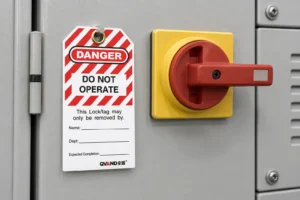
Each danger do not operate tags specification should define the attachment method, writable area, print contrast, and exposure limits. Test it with the cabinet opened and closed, during housekeeping, and during the planned work sequence. A reinforced eyelet, cable, or tie is useful only when it stays secure and does not allow operation while attached.
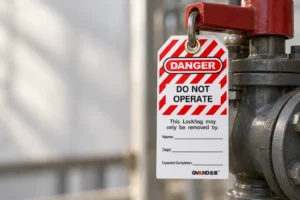
Paper suits clean indoor tasks; synthetic or coated stock suits moisture, oil, abrasion, or repeated handling. State exposure and replacement rules rather than claiming a tag is “indestructible.”
A standard for danger do not operate tags should define replacement and disposal so an obsolete warning cannot be mistaken for an active control.
When Do danger barricade tags Support Boundaries?
Some tasks need a warning at the isolator and a visible boundary around an open cabinet, work zone, or access route. danger barricade tags can identify the boundary and responsible team, but a tag is not a physical barricade. Map both approach directions, then document placement and visibility after shift change. A padlock storage carrier can organize tags and group accessories.
Compare Tag Options by Control Value
Compare visibility, writable area, attachment security, environmental resistance, replacement discipline, and reading distance—not color alone. Actual suitability depends on the substrate, printing, hardware, and site conditions.
Printed tags suit clean indoor isolation; synthetic or coated tags suit wet or oily areas; write-on tags capture assignment details; large boundary tags improve approach visibility when used with a barrier.
Choose Dimensions by Application
Set size from reading distance, attachment area, and required information. A small tag may force the signal word into fine print; an oversized one may snag, block an equipment label, or fold out of view. Measure the real isolation point and approach path.
For compact breaker cabinets confirm eyelet, height, and handle clearance; for large disconnects confirm reading distance; for outdoor or washdown areas confirm stock, print, and replacement rules; for group lockout confirm hasp or lockbox capacity.
Issue the tag with compatible hardware. A nylon safety padlock may fit a documented polymer-body preference, while a grip-tight circuit breaker lockout may suit a compatible handle. Neither link proves that the complete assembly is suitable; assess fit, materials, and procedure separately.
Standards and Compliance
OSHA 29 CFR 1910.147 addresses covered U.S. servicing and maintenance. It requires an energy-control program, procedures, training, and periodic inspection. The regulation governs employer responsibilities; it does not issue a product certificate for a tag. OSHA’s Control of Hazardous Energy guidance explains the sequence and roles, but the employer must still isolate energy, address stored energy, verify the condition, and control return to service.
For international projects, HSE and CCOHS guidance provides context, but destination-market law and product evidence control the decision. Do not claim “OSHA approved” or “zero energy” without precise support.
Procurement Checklist
- Map the reader, hazard, isolation point, and approach route.
- Define the signal word, prohibited action, identification fields, and languages.
- Measure attachment, clearance, reading distance, and exposure.
- Test the tag with the planned lockout device, cabinet movement, shift change, inspection, and removal process.
QD LOTO can be considered for configurable lockout/tagout components and sourcing support. Record the model, application, compatible hardware, inspection owner, and replacement rule. Review a portable lockout tagout bag when tags and devices travel between work areas.
Frequently Asked Questions
What is a Danger “Do Not Operate” tag?
It is a warning label or card applied to equipment or an energy-isolating point to communicate that operation is prohibited during a controlled task. It supports the lockout/tagout procedure but is not a physical restraint or proof that hazardous energy has been eliminated.
What is the purpose of a danger tag?
Its purpose is to give affected employees and nearby people an immediate warning about the prohibited action and equipment status. It may also identify the responsible person, date, or work order. Apply it where it remains visible and connect it to physical isolation and verification.
Is a danger tag a physical lockout device?
No. A tag communicates a warning; a lockout device helps physically secure an energy-isolating mechanism. A tag must not be described as equivalent to a lock unless the applicable procedure and regulatory conditions support that method.
Should a danger tag be used with a padlock?
In many lockout applications, the tag is used with a padlock and compatible device so communication and physical restraint are visible together. The exact combination depends on the equipment, written procedure, and individual or group work process.
What does “Do Not Operate” mean?
It means the identified equipment or control must not be operated while the warning is in place. The phrase must connect to a procedure stating who may apply or remove it and what verification is required before return to service.
References
- OSHA, 29 CFR 1910.147: The Control of Hazardous Energy
- OSHA, Control of Hazardous Energy
- UK HSE, INDG291: Lock-off and tag-out guidance
- CCOHS, Lockout/Tagout
The strongest warning is visible, understandable, and connected to the isolation procedure. Standardize the message, measure the attachment point, and verify the control system. Review each Danger Tag and danger barricade tags requirement with QD LOTO when you need documented tags, locks, and devices. Make the warning visible, make the isolation real, and make removal accountable.