
When Daniel Reed, an electrical maintenance supervisor in Houston, Texas, isolated a conveyor control panel before a planned contactor replacement, he fitted a personal lock to the disconnect and asked a technician to test the handle. The lock body cleared the panel, but its short shackle could not fully engage the hasp; the team stopped when the lock shifted during the test. The visible failure took seconds, while the useful reversal took longer: the root cause was not simply a poor lock. The site had not specified shackle clearance, key control, material requirements, or the number of people who might need personal control during one outage.
How does a Loto Padlock support electrical equipment lockout?
An electrical lockout padlock gives an authorized employee a visible, personal means of maintaining control over an energy-isolating device. It is one part of a procedure that normally includes notification, shutdown, isolation, application of the lock and tag, release or restraint of stored energy, verification, and controlled restoration. The padlock is therefore selected for the physical point of isolation and the work process, not simply for its color or catalogue name.
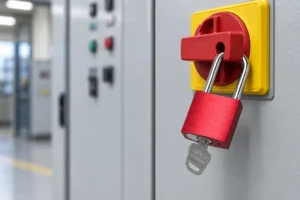
OSHA’s 29 CFR 1910.147 places the employer’s energy-control procedure at the center of covered servicing and maintenance. The rule distinguishes authorized employees who apply lockout or tagout from affected employees who operate or work near the equipment. That distinction matters when choosing locks: personal ownership and removal authority should be understandable to the people using the procedure.
Separate physical restraint from warning communication
A padlock physically helps prevent operation of a secured isolation point; a tag communicates the hazard, responsible person, and status required by the site process. Neither item substitutes for the other, and neither substitutes for verification. A lock that fits the shackle hole but cannot be identified, assigned, or removed under the written procedure is still a weak control in practice.
For group work, each exposed authorized employee may need a personal lock on a hasp, lockbox, or equivalent arrangement, depending on the employer’s procedure. The procurement question is not only how many locks exist, but whether every person who may be exposed can apply personal control without borrowing a key or relying on another worker’s promise.
Check fit at the actual electrical isolation point
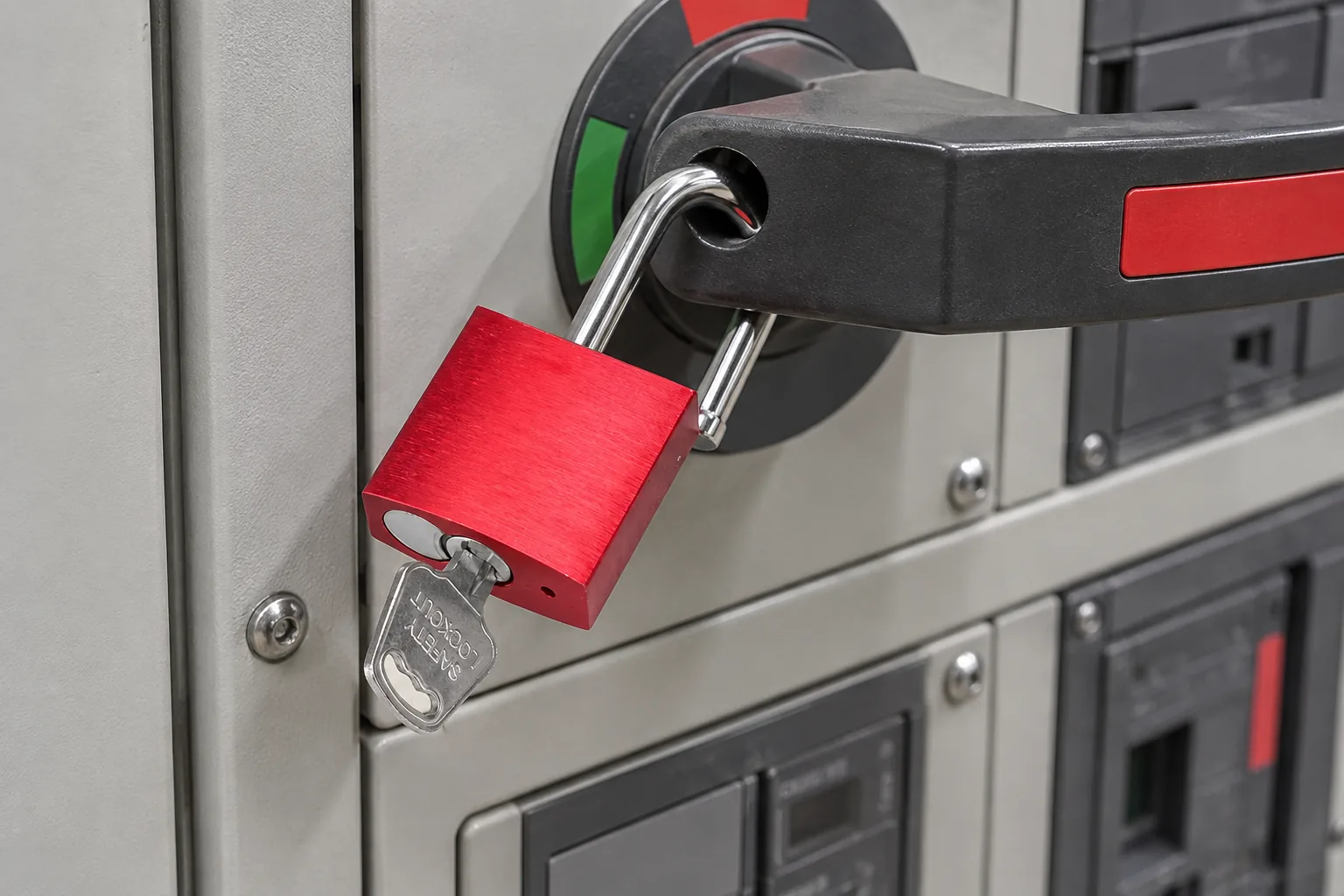
Before purchase, document the disconnect or breaker profile, lockout hole diameter, available clearance, operating direction, enclosure depth, and whether a hasp or lockbox will be used. A lock body that is too large can interfere with adjacent hardware; a shackle that is too short may not pass through the device; excessive clearance can allow an operator to manipulate the isolator while the lock appears to be installed. A controlled fit check on representative equipment is more useful than a photograph alone. Record that fit evidence with the selected Loto Padlock model so later replenishment follows the same specification.
What should a loto safety padlock specification include?
A practical specification starts with the hazard and user workflow, then states the physical and identification requirements that can be checked on receipt. The buyer should define the body material, shackle material and dimensions, keying arrangement, color or identification convention, environmental exposure, and documentation required for the intended application. Claims should remain limited to information the supplier can support with a drawing, material declaration, test record, or product-specific documentation.
| Specification area | Question for the buyer | Evidence to request | Why it affects the task |
|---|---|---|---|
| Body and shackle | Will the dimensions and materials suit the enclosure, device, and environment? | Dimensional drawing and material information | Prevents interference, poor fit, and unsuitable material assumptions |
| Key control | Should the key remain with the authorized worker, or is a controlled release required? | Key-retaining description and keying schedule | Aligns the lock with personal accountability and site procedure |
| Identification | How will the user and lock status be recognized at the isolation point? | Color, label, engraving, or numbering options | Supports visual accountability during individual and group work |
| Environment | Will the lock face dust, moisture, chemicals, temperature changes, or outdoor handling? | Care guidance and stated application limits | Helps the buyer plan inspection, cleaning, and replacement |
| Program fit | How will issue, storage, inspection, replacement, and removal be controlled? | Procedure cross-reference and inventory record | Converts a product purchase into a usable energy-control practice |
The term loto safety padlock should not be treated as a universal technical classification. One supplier may use it for a keyed-different personal lock, while another may describe a lock intended for electrical work by its polymer body or color. Compare the actual construction and use conditions, then record the selected model against the equipment and procedure it supports. A second loto safety padlock requirement may be needed for a different environment or keying group; do not assume one line item covers every task.
For applications where a polymer body is preferred, buyers can review QD LOTO’s nylon safety padlock product information. The link is a starting point for specification review, not proof that every polymer lock is suitable for every energized or potentially energized environment. Electrical work still requires the employer’s risk assessment, isolation method, and verification step.
When is a padlock for loto the right choice?
A padlock for loto is the right choice when it can be assigned to the responsible person, physically secure the selected isolation arrangement, and remain legible and serviceable for the task environment. It is less about a generic product category than about a documented relationship between the lock, the isolation device, and the authorized employee. A lock should never be selected solely because it resembles equipment already used on another machine. In a multi-site program, specify each padlock for loto by application and custody rule rather than ordering a visually similar substitute.
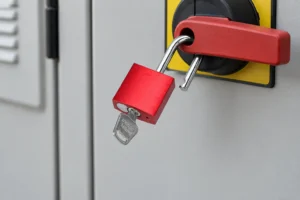
Keying deserves particular attention. Keyed-different locks can support individual ownership when each worker keeps a unique key. Keyed-alike groups can simplify controlled access for a defined team or department, but they require a clear rule for who holds the common key and when it may be used. A master key may improve emergency administration in some programs, yet it also creates a control point that needs documented custody; it should not quietly undermine personal lock removal rules.
Key-retaining and non-conductive are separate decisions
Key retention describes what happens to the key while the shackle is open or the lock is being applied. Non-conductive construction describes an electrical property of specified materials and components under defined conditions. These are separate specification questions. A buyer may need key retention for accountability and a polymer body for a particular exposure concern, but one feature does not prove the other.
Likewise, a colored lock is easier to see but is not automatically insulated, corrosion-proof, or compliant with a site’s electrical work requirements. Ask for the exact product information and application limits. Avoid describing a lock as “shock-proof,” “electrically safe,” or certified to a regulation unless the claim is supported, scoped, and appropriate for the destination market.
Compare electrical lockout padlock options by control value
Unit price can hide the operational cost of an unsuitable lock: extra fit checks, replacement after environmental damage, lost time locating a key, or a work stoppage when a group needs more individually controlled locks. The comparison below is a procurement framework, not a ranking. Actual suitability depends on the lock design, site procedure, and equipment inventory.
| Option | Typical use | Control strength | Compatibility or maintenance concern | Total-cost consideration |
|---|---|---|---|---|
| Keyed-different personal locks | Individual authorized-worker control | Clear personal ownership when key custody is disciplined | Requires accurate assignment and replacement-key control | Supports accountability; inventory administration takes time |
| Keyed-alike team set | Defined department or repeated team workflow | Convenient access within a controlled group | Common keys must not become uncontrolled shared access | Can simplify replenishment; key governance is the main cost driver |
| Non-conductive-body model | Tasks with a documented material preference | May support a specified electrical-risk control | Do not infer performance beyond supplied material and test information | Review task suitability, care, and replacement conditions |
| Compact short-shackle model | Restricted clearance at a lockout device | Can reduce interference when the opening is suitable | May not reach through a thick hasp or enclosure attachment | Good fit can reduce delays; measure before standardization |
| Longer-shackle model | Devices needing additional reach | Can engage a larger hasp or lockbox arrangement | Extra clearance may create an unintended manipulation path | Use only where measured geometry and procedure support it |
The honest comparison is therefore “fit and control per task,” not “most features per lock.” An illustrative calculation might compare the annual carrying cost of an organized, compatible inventory with one avoidable maintenance delay and one emergency replacement cycle. The result will vary with labor rates, outage frequency, travel time, and the number of sites; it should be calculated locally rather than advertised as a guaranteed saving.
Size the lockout inventory by application and user count
Inventory planning should begin with the work map. Count the authorized employees who may need personal locks at the same time, identify the isolation devices they use, and note whether the equipment is indoors, outdoors, mobile, or exposed to contamination. Then set a replenishment rule for lost keys, damaged locks, unreadable tags, and new equipment. A tidy cabinet with too few assigned locks is not a complete control system.
| Application | Useful dimensions or attributes to confirm | Recommended inventory emphasis | Field check before issue |
|---|---|---|---|
| Compact breaker cabinet | Shackle diameter, inside height, body width, and adjacent-handle clearance | Compact personal locks plus compatible breaker devices | Apply the lock with the device installed and test the secured position |
| Disconnect with hasp | Hasp opening, shackle reach, body clearance, and lock count | Individually identified locks sized for all exposed workers | Confirm every person can maintain personal control |
| Electrical room with mixed panels | Variation in lockout points, enclosure depth, and environmental exposure | Documented model range, spare units, tags, and organized storage | Fit-check a sample from each equipment family |
| Contractor or mobile maintenance | Carrying dimensions, weather exposure, identification, and custody | Portable carrier or bag with assigned personal locks and replacement tags | Reconcile kit contents before departure and return |
| Multi-person outage | Concurrent users, transfer points, lockbox capacity, and key control | Personal locks plus hasps or group-control equipment | Walk through shift change and removal authority in the procedure |
For storage and transport, a portable safety padlock storage carrier can be evaluated alongside the lock specification. A carrier is useful only when the site defines who checks it, where it is stored, and what happens when a lock or key is missing. The container supports the workflow; it does not replace training or the machine-specific procedure.
Standards and compliance: make precise claims about the product and program
OSHA 29 CFR 1910.147 addresses control of hazardous energy for covered U.S. servicing and maintenance. It requires an energy-control program with procedures, employee training, and periodic inspections, while also setting expectations for lockout and tagout application and removal. The regulation governs the employer’s program within its scope; it does not issue a product certificate for a padlock or kit.
OSHA’s Control of Hazardous Energy guidance is useful for explaining the sequence and responsibilities behind lockout/tagout. It reinforces a basic procurement principle: the device must support an established process. A lock that is physically attractive but cannot be identified, assigned, inspected, or removed under that process creates a documentation and implementation gap.
ANSI/ASSP Z244.1 information from ASSP covers lockout/tagout and alternative methods as a consensus-standard topic. Buyers should read the applicable edition and seek competent safety advice for their workplace; they should not convert a standard reference into an unsupported statement that a particular padlock is “ANSI certified.” A test method, consensus standard, and legal regulation have different scopes.
For international supply, destination-market requirements, equipment design, and the exact marketing claim should be reviewed together. The same material or keying description may be relevant in one application and insufficient in another. Keep supplier evidence tied to the model and revision purchased, and separate product documentation from the employer’s training, inspection, and risk-assessment records.
Select the lock through a documented procurement process
- Map the isolation points. Record the equipment identifier, device type, clearance, lockout method, and environmental conditions from the actual electrical installation.
- Define personal control. Decide keyed-different, keyed-alike, key-retaining, or other arrangements from the written procedure and group-work needs.
- Request checkable evidence. Obtain dimensions, materials, keying details, care guidance, and any product-specific test information relevant to the claim.
- Pilot representative equipment. Apply the lock with the planned hasp or device, test the secured position, and review the workflow with authorized and affected employees.
- Control the inventory. Assign ownership, storage, inspection, replacement, and key custody so shortages are found before a scheduled shutdown.
QD LOTO can be considered when a distributor, contractor, or end user needs configurable lockout/tagout components and a documented way to compare them with installed equipment. For a mixed electrical fleet, buyers may also review the grip-tight circuit breaker lockout and confirm its fit separately from the personal-lock specification.
A good purchasing file records the chosen model, intended application, compatible device or hasp, keying schedule, and inspection owner. That information supports repeat orders and makes a future change in equipment easier to evaluate. It also keeps a product claim from being mistaken for a claim about the employer’s entire safety program. Use the same record when replenishing a second Loto Padlock allocation for another authorized employee or site.
Frequently asked questions
What is a padlock in LOTO?
A padlock in lockout/tagout is a personal or controlled locking device used to help secure an energy-isolating point in a safe position during servicing or maintenance. It works with a tag, a written procedure, and verification of isolation; the padlock alone does not establish a complete energy-control program. Select it for the actual device, clearance, user responsibilities, and environment.
What is a LOTO safety padlock?
A LOTO safety padlock is a padlock intended to support a lockout/tagout workflow, commonly through visible identification, a defined keying arrangement, and compatibility with a hasp, lockbox, or lockout device. The phrase is not a universal certification category. Confirm the construction, dimensions, key control, and application limits against the site procedure.
Why are LOTO padlocks often non-conductive?
Some are specified with polymer components to reduce conductive exposure in applications where the material and design are appropriate. “Non-conductive” should not be assumed from color or product name, and it does not mean the lock is suitable for every electrical hazard or energized task. Review the supplier’s material information and the employer’s risk assessment before making that claim.
What is a key-retaining LOTO padlock?
A key-retaining padlock is designed so the key cannot be removed while the shackle is open, depending on the product design. This can help keep the key with the authorized worker while the lock is being applied, but the exact behavior should be confirmed in the product documentation. Key retention does not replace assignment, removal authority, or group-lockout rules.
Are LOTO padlocks available keyed alike?
Many industrial padlock programs can be specified as keyed alike, subject to the supplier’s available keying options and order requirements. Keyed alike can simplify a defined team workflow, but common access must be controlled so it does not defeat personal accountability. Ask for a key schedule and document who may hold or issue shared keys.
References
- OSHA, 29 CFR 1910.147: The Control of Hazardous Energy (Lockout/Tagout)
- OSHA, Control of Hazardous Energy
- UK HSE, INDG291: Lock-off and tag-out guidance
The strongest lockout decision is the one that still makes sense at the panel, in the hands of the person doing the work. When your equipment survey is ready, review QD LOTO’s portable lockout tagout bag as a storage and issue option, then contact QD LOTO to discuss a component mix aligned with your isolation points, key-control policy, and work process.