
Summary: Effective hazardous-energy control works only when each authorized employee can isolate, secure, tag, release stored energy, and verify the control before service begins. OSHA’s 29 CFR 1910.147 requires an energy-control program and a verification step; compatible padlocks with managed keying and identification space turn those requirements into a repeatable field process. Start with an equipment survey and match each device to the isolation point and written procedure.
Why Lockout Tagout padlock selection is part of energy control
A safety padlock is one component of an energy-control system, not proof that an asset is safe. OSHA’s control-of-hazardous-energy standard addresses the servicing and maintenance of machines where unexpected energization, start-up, or release of stored energy could injure employees. It calls for a documented program, employee training, periodic inspection, equipment-specific procedures where needed, and verification of isolation before work starts.
That distinction matters commercially. A padlock that resists routine use but cannot pass through the actual disconnect, valve cover, breaker lockout, or hasp creates workarounds, delays, and exposure. Conversely, a compatible device still fails the program if the team has not shut down all sources, restrained gravity or pressure, or tried the normal controls after clearing personnel. The named verification method in 29 CFR 1910.147 is testing or attempting to operate the machine after isolation, with safeguards to prevent exposure.
Fit, clearance, and durability are operational requirements
Measure the smallest usable opening, the needed shackle clearance, and whether multiple employees must secure the point. Many industrial padlocks use a 6 mm shackle diameter, but the appropriate diameter and length must be verified against the device and local procedure rather than assumed. Nylon shackles can help where electrical non-conductivity is part of the application assessment; steel shackles may suit other mechanical environments when conductivity and corrosion exposure have been evaluated.
Specify body material, shackle type, label area, key-retention behavior, and chemical or weather exposure in the procurement record. A simple 10-point sample check—opening clearance, shackle closure, key operation, label legibility, and condition after the site’s defined handling test—can catch a mismatch before a large rollout. This is an incoming-quality check, not a replacement for regulatory compliance testing or an energy-isolation procedure.
Lockout Tagout is effective when its physical devices, documented sequence, and verification practice all agree at the point of work.
Choose lockout tagout locks by the job, not by color alone
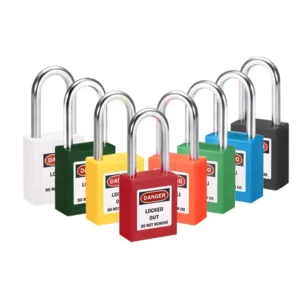
Color makes a lock easier to recognize at a glance, but it does not establish ownership or isolation. The practical decision is a combination of physical fit, worker identification, keying plan, and the number of people who must apply personal locks. In a group lockout, a hasp or group lock box must preserve the principle that each authorized employee applies and removes their own personal lock according to the employer’s program.
| Factor | What to compare | Operational implication |
|---|---|---|
| Shackle material and length | Clearance, electrical exposure, corrosion, and jaw thickness | Determines whether the lock can secure the specified point without an improvised workaround. |
| Keying | Keyed different, keyed alike, master-key or grand-master control | Balances individual control with authorized administrative recovery; document who controls exceptions. |
| Identification | Name label area, serial numbering, and color convention | Supports inspection and return-to-service checks; it does not replace a written procedure. |
| Group capacity | Hasp openings or lock-box process | Allows multiple personal locks where several people work on the same equipment. |
| Lifecycle control | Issue records, spare strategy, inspection, and replacement criteria | Reduces lost-key delays, ad hoc substitutions, and untraceable devices. |
For individual personnel identification on suitable isolation hardware, a color-coded steel-shackle safety padlock can be evaluated alongside the site’s material requirements. If shared key access is specifically authorized and controlled, a keyed-alike safety padlock option may simplify issue management, but it should never weaken the employer’s personal-lock and removal rules.
lockout tagout locks should be specified against the actual isolation interface, the number of workers, and the site’s documented key-control rules.
Build the selection around the isolation point and workforce
Start with an asset-level survey rather than a catalog-first purchase. List electrical, pneumatic, hydraulic, thermal, gravitational, and chemical sources; then identify the isolating device, stored-energy restraint, required attachment hardware, and the authorized employees likely to work together. ANSI/ASSP Z244.1 provides guidance on hazardous-energy control alternatives and methods; it is a consensus standard, not a product certificate or a substitute for applicable law.
| Application | Selection focus | Procedure check |
|---|---|---|
| Electrical disconnect | Shackle clearance, insulating material assessment, compatible breaker or disconnect device | Identify all feeds and test absence of energy using the site’s qualified-person process. |
| Valve isolation | Valve-lockout fit, corrosion exposure, and lock shackle reach | Block, bleed, restrain, or dissipate line pressure before verification. |
| Conveyor or rotating equipment | Multiple isolation points and group-lock capacity | Control electrical, pneumatic, hydraulic, and gravity energy; test normal start controls after clearing the area. |
| Contractor work | Clear labels, compatible devices, and documented key custody | Coordinate host and contractor procedures before service begins. |
The total-cost calculation is broader than unit price. An illustrative comparison is a site issuing 200 locks: a lower initial price can be erased by a handful of delayed jobs, replacements from poor fit, or supervisory time resolving unplanned key and removal events. Track device compatibility, inspection findings, lost-key incidents, and maintenance delays for one operating cycle before standardizing.
- Map each energy source. Confirm the isolation point, stored-energy controls, and verification method for every machine family.
- Measure real interfaces. Record jaw thickness, hole diameter, clearance, and the number of personal locks required at each point.
- Set a keying and removal policy. Define issuance, custody, spare handling, and the documented exceptional-removal process before buying.
- Pilot and inspect. Run representative tasks, then use the program’s periodic inspection to identify fit or procedure gaps.
- Standardize documented kits. Bundle compatible locks, tags, hasps, and device-specific hardware by equipment class.
Make the selection record usable during an audit
For each approved configuration, retain a short record that ties the part number to the equipment class, isolation-point dimensions, intended environment, keying assignment, label convention, and associated procedure. Include the date of the field trial and the person who confirmed fit. This gives procurement a defensible basis for repeat orders and gives EHS teams a practical starting point when equipment changes.
Review that record after significant modifications, new energy sources, or a recurring near-miss. OSHA requires the employer’s periodic procedure inspection at least annually; use the same cycle to compare the approved kit against how maintenance staff actually isolate the asset. A measured gap—such as one additional hasp position needed for a larger crew—is more useful than a general request for “stronger” hardware.
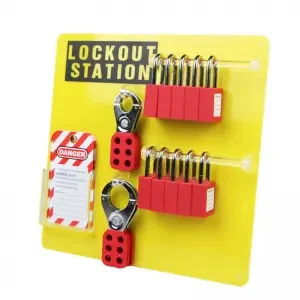
QD LOTO can support this review by discussing configurable safety padlocks, keying options, and related hardware against a buyer’s documented application requirements. For multi-worker points, review a multiple-lockout hasp designed for up to eight locks together with the site’s group-lockout procedure; capacity alone does not determine whether the arrangement is adequate.
Standards, regulations, and claims that procurement should separate
OSHA 29 CFR 1910.147 is a United States workplace safety regulation for the control of hazardous energy during servicing and maintenance. It sets employer program duties; OSHA does not certify individual padlocks. Purchasers should request documentation relevant to fit, identification, materials, and intended use, then confirm the employer’s procedure and training meet the regulatory scope.
ANSI/ASSP Z244.1 is a voluntary consensus standard addressing the control of hazardous energy and may inform program design, including alternatives where appropriate. Its use does not automatically demonstrate legal compliance. ISO 45001 specifies requirements for an occupational health and safety management system; it can frame organizational risk control and continual improvement, but it does not certify a particular lock or prescribe every device selection.
Destination market, task, and marketing claim all matter. A supplier assertion that a lock has OSHA product approval is unsupported because the agency regulates employers and does not operate a product-certification scheme. An imported product may also face customer documentation, labeling, or material expectations beyond the lockout program itself. Keep statements limited to supplied evidence and ask whether the product is being evaluated for a U.S. OSHA-covered workplace, another jurisdiction, or an ISO 45001 management-system context.
Lockout Tagout documentation should identify the authorized employee, the equipment-specific sequence, and the required verification step without relying on product claims.
Frequently asked questions about industrial safety padlocks
What is the difference between a safety padlock and an ordinary padlock?
Industrial safety padlocks are selected and managed to support a hazardous-energy control program, including identifiable ownership, appropriate keying, and compatibility with isolation hardware. An ordinary padlock may lack the fit, labeling, control process, or documented use needed by that program. Evaluate the device and the procedure together.
Must every worker use a personal lock during group work?
OSHA’s group lockout provisions require a level of protection equivalent to personal lockout, and the employer’s procedure should specify how each authorized employee maintains control. A hasp or lock box is often used so each participant can apply a personal lock. Supervisory lock removal should be governed by a documented, employer-defined process.
Are keyed-alike locks acceptable for hazardous-energy control?
They may be considered only within a controlled keying plan and the employer’s energy-control procedure. Keyed-different systems more directly support individual accountability, while keyed-alike arrangements can introduce access risks if control is weak. Review the task, workforce, and exception policy before choosing.
Does ISO 45001 require a particular lock brand or shackle material?
No. ISO 45001 is a management-system standard and does not prescribe a brand, lock model, or universal shackle material. Select material and geometry based on the energy source, environment, device fit, and applicable local requirements.
How often should lockout equipment be inspected?
OSHA requires periodic inspection of each energy-control procedure at least annually, with specified elements for the review. Device condition should also be checked through the employer’s issue, use, and replacement controls. Separate a procedure inspection from a product-performance claim.
References and the next procurement decision
- OSHA: 29 CFR 1910.147, The Control of Hazardous Energy
- OSHA: Control of Hazardous Energy resources
- ISO: ISO 45001 occupational health and safety management systems
A well-chosen lock is not a safety program; it is the visible proof that a disciplined program can be carried out at the isolation point. Before standardizing, compare devices against real equipment, real people, and a written verification process. For a nylon-shackle option and an application and keying review, contact QD LOTO about its safety padlock range.