
When an electrical maintenance planner in Indianapolis trialed a mini breaker lockout, the accessory sat against the toggle but shifted before the padlock was fitted. In this illustrative example, the sample was rejected before use. The cause was an unverified handle interface, not the breaker current rating or the accessory’s color.
Summary: Select an MCB breaker lockout from the exact breaker model, operating-mechanism geometry, intended padlock and surrounding clearances. Mechanical retention and electrical verification are separate acceptance tasks. Under 29 CFR 1910.333(b)(2)(iv), a qualified person must verify the deenergized condition before covered electrical parts are worked as deenergized.
“MCB” describes a miniature circuit breaker. “Mini breaker lockout” describes an accessory category, not a universal fit standard. This guide focuses on compatibility evidence and purchasing acceptance rather than offering an installation procedure for an unidentified circuit.
Identify the breaker and the actual locking interface
Collect the manufacturer’s name, complete breaker model or series, pole arrangement, handle details and available locking features. Record the installed configuration, including adjacent devices and enclosure clearance. Similar current ratings or rail-mounted appearances do not establish identical toggle geometry.
A manually operated circuit breaker can be an energy-isolating device under 1910.147(b). The lockout accessory’s role is to secure that isolator in the position specified by the approved procedure. A push button or control selector does not become an energy isolator because an accessory can cover it.
One breaker may not control every source. Identify possible alternate feeds and stored energy in the equipment-specific assessment. The circuits and equipment covered by 1910.333(b)(2)(ii) must be disconnected from all electrical energy sources, with hazardous stored electrical energy addressed as the rule requires.
Ask for photographs of the relevant accessible handle and locking feature when planning the order. Obtain them under the site’s established safe access rules. Product selection never justifies opening an enclosure or approaching exposed live parts without the appropriate qualification and procedure.
Compare attachment approaches without assuming interchangeability
Suppliers offer devices that engage designated pin features, clamp to a defined handle geometry, or work with a specified tie-bar arrangement. The category name helps form a shortlist. Acceptance still depends on the particular accessory and breaker combination.
| Approach | Interface to confirm | Evidence to request | Common unresolved issue |
|---|---|---|---|
| Pin-engaging design | Presence, position and geometry of intended pin features | Model-specific compatibility statement and instructions | Similar-looking features are not the specified attachment points |
| Clamp or screw-retained design | Handle profile and the approved clamping surface | Permitted fit range and installation method for the exact device | Accessory contacts the handle but does not retain it properly |
| Tie-bar-oriented design | The particular multi-pole handle or tie-bar arrangement | Approved breaker/device pairing and installed-clearance information | Assuming compatibility from pole count alone |
Section 1910.147(c)(5) requires lockout devices to be durable, standardized, substantial and identifiable. It does not define a universal MCB accessory or a current-rating-to-lockout lookup table. A “universal” product description should be narrowed to documented fit evidence before approval.
Use the circuit breaker lockout category for an initial shortlist. Keep MCB and molded-case breaker applications distinct unless the manufacturer specifically supports the same device for the named models.
Use a fit record that captures the whole assembly
A fit review must examine the accessory, breaker mechanism, padlock and installed surroundings together. Perform any trial only under the employer’s approved safe conditions and the device manufacturer’s instructions. Do not improvise tightening torque, filing, drilling or handle modifications to make an uncertain pairing work.
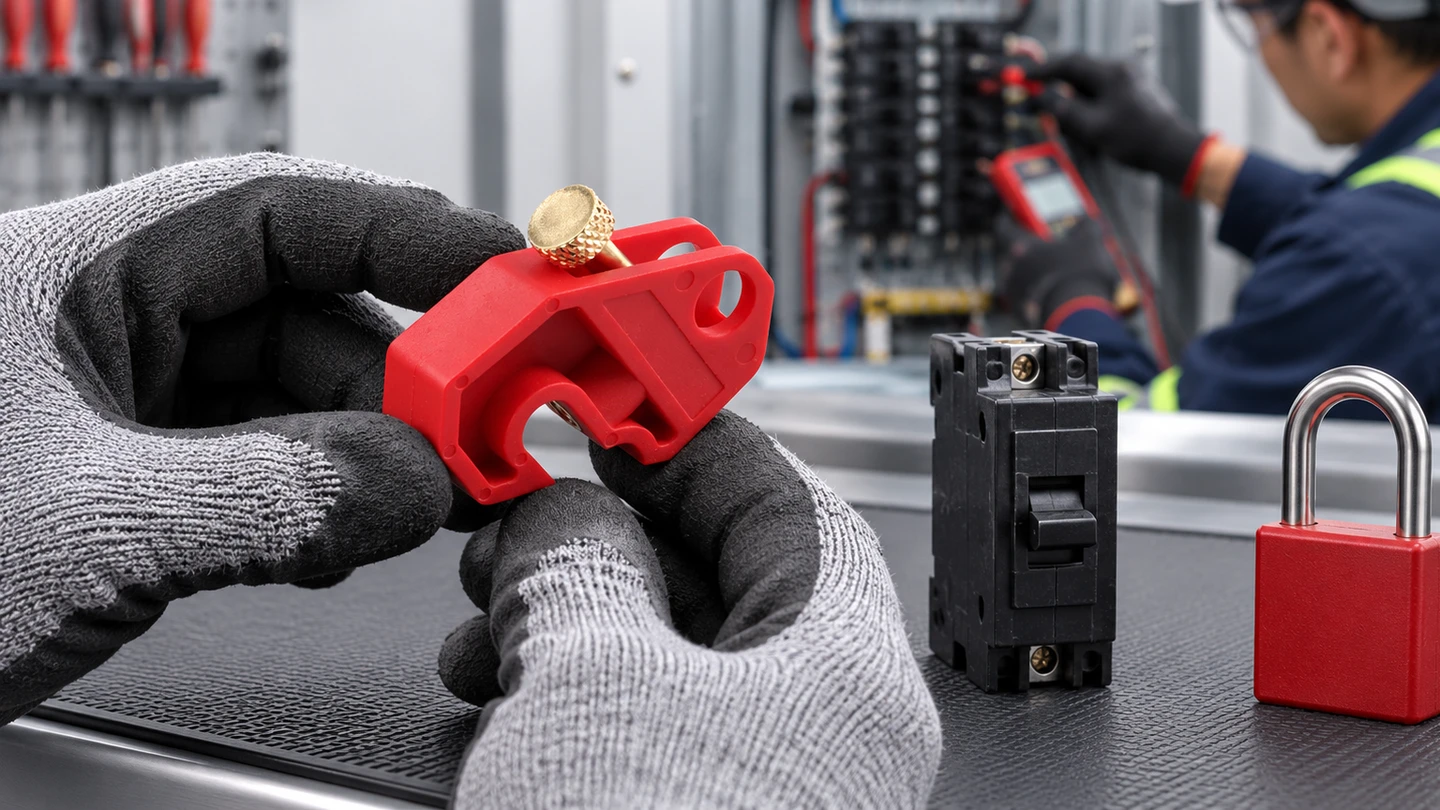
| Acceptance dimension | Record | Reason to hold approval |
|---|---|---|
| Breaker identity | Manufacturer, exact model and relevant operating mechanism | Model or interface cannot be confirmed |
| Accessory identity | Model, revision and manufacturer instructions | Catalog and instructions describe different installation methods |
| Mechanical retention | Approved application prevents operation as intended | Device slips, remains removable or leaves operating travel possible |
| Padlock fit | Actual shackle passes, closes and secures the mechanism as specified | Nominal hole size is the only evidence |
| Installed clearance | Adjacent controls and required enclosure access remain suitable | Lock body interferes with neighboring equipment or closure |
| Procedure reference | Isolation identification and verification responsibilities | Accessory approval is being used as proof of deenergization |
Keep shackle-hole size, recommended shackle diameter and permitted handle dimensions as separate fields. A quoted 8 mm opening, for example, would not by itself prove that a particular 8 mm shackle can be inserted and closed. That is a geometric example, not a specification for the product shown.
If different sections of a supplier page disagree about tools, clamp dimensions or shackle limits, request a current model-specific instruction sheet and sample. Resolve the discrepancy before adding the model to the approved device list.
Separate a retained handle from a verified deenergized circuit
The critical distinction is between the mechanical task and the electrical task. The accessory restrains an identified isolator. It does not measure voltage, locate an unexpected feed or control stored energy by itself. The OFF position is not a test result.
Section 1910.333(b)(2)(iv) requires a qualified person to verify that the equipment cannot restart and to use test equipment to test the circuit elements and electrical parts to which employees will be exposed. The test must address induced voltage and unrelated backfeed as specified. Follow the complete applicable electrical procedure and instrument instructions.
The rule’s specific requirement to check test equipment for proper operation immediately before and after the test applies in its text to circuits over 600 volts nominal. That wording is not advice to omit instrument checks at lower voltages: the employer’s applicable electrical work practice and instrument instructions still control the method. The voltage threshold is unrelated to whether a small accessory fits a breaker handle.
For machine servicing hazards, 1910.147 supplies applicable energy-control duties. Exposure to electrical hazards from work on or near conductors is addressed by Subpart S. Section 1910.333 explains when procedures complying with 1910.147(c) through (f) are also deemed to meet its lockout provisions, including the additional electrical requirements. Avoid treating those sections as interchangeable without reading their scope.
For broader equipment context, the electrical safety lockout guide discusses the relationship between hardware and the control procedure.
Specify a sample-based purchasing decision
Use five actions before a production order: identify the breaker, obtain the accessory instructions, check the actual personal padlock, review the complete installed arrangement under approved conditions, and record the accepted pairing. QVAND can be asked for current documentation and samples matched to the buyer’s photographs and breaker identification.
Review the basic MCB lockout product listing as a starting point for inquiry. Confirm the exact supplied variant and instructions before use, especially where a listing combines information for several models. Select the personal safety padlock alongside the accessory rather than after the accessory has been ordered.
Include fit validation and replacement administration in total cost. In an illustrative calculation, a $50 sample-and-review allowance is lower than a $75 return-shipment and handling charge. These are hypothetical budgeting figures, not actual QVAND prices or verified savings. Neither figure accounts for delayed maintenance.
OSHA requirements concern the employer’s applicable work practices and energy-control program. CCOHS guidance provides a separate Canadian context. Neither a molded “universal” description nor a generic compliance claim substitutes for product compatibility evidence, worker qualification or verification of the actual circuit.
Frequently asked questions
What is an MCB breaker lockout?
It is an accessory used with an appropriate lock to secure a miniature circuit breaker operating mechanism in the position required by an established isolation procedure. Its suitability depends on the exact breaker and accessory design.
Are mini breaker lockout devices universal?
Do not assume universal fit. Confirm the named breaker model, handle or pin features, padlock clearance and installation instructions. An accessory that touches the toggle may still fail to retain it correctly.
Can I choose the lockout device from the breaker amperage?
Amperage alone does not establish mechanical compatibility. Breakers with the same current rating can use different handles and locking features. Use the actual model identification and approved interface information.
Does locking an MCB OFF prove that the circuit is deenergized?
No. A qualified person must perform the required electrical verification for the covered work. The accessory does not detect backfeed, induced voltage or hazardous stored energy.
Do MCB lockouts need a screwdriver?
The requirement depends on the exact device and variant. Follow its current manufacturer instructions, including any specified tool or tightening method. Resolve conflicting product-page statements before use.
References
- 29 CFR 1910.147, via Cornell LII, isolator definitions and energy-control requirements.
- 29 CFR 1910.333, via Cornell LII, particularly (b)(2) for electrical lockout and verification.
- CCOHS: Lockout/Tag out, equipment-specific planning context.
- CCOHS: Hazardous Energy Control Programs, primary and stored-energy context.
A fit-approved accessory and a verified deenergized circuit answer different questions. The work procedure needs both answers.
Send QVAND your breaker model and fit-review requirements. Include the accessible interface photographs, intended padlock and installed-clearance constraints for a model-specific proposal.