
When a maintenance supervisor in Sheffield prepared a multi-worker job, the wall station looked well stocked but the team could not find the approved device for one isolation point. This illustrative scenario exposes a storage problem: visible equipment had been mistaken for task readiness. The remedy was to link the station inventory to real procedures and make replenishment accountable.
Summary: A group lockout station organizes ready supplies; it does not by itself protect a group working on equipment. Plan the inventory, personal-lock allocation, access and replenishment around actual jobs. 29 CFR 1910.147(f)(3) separately requires a group procedure with equivalent individual protection and defined responsibilities, including coordination where more than one crew is involved.
Define the station's role before choosing its contents
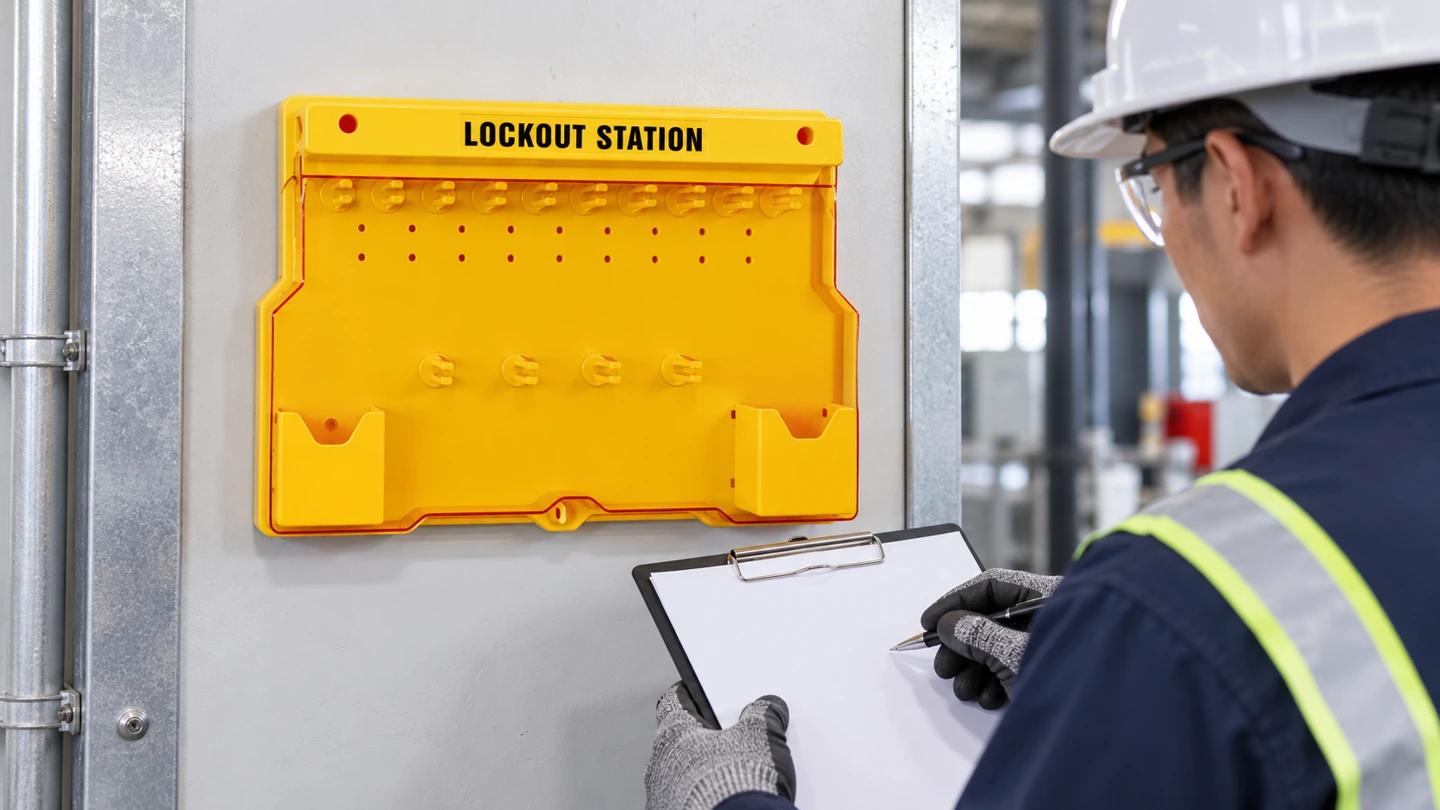
The phrase group lockout station may describe a wall board, cabinet or departmental issue point. Identify whether the purchase is for storage, portable job support or a group lockbox used in an approved procedure. A storage cabinet’s capacity is not evidence that it can perform an active key-control function.
List the area’s isolation points and approved devices, then distinguish personal locks, shared accessories, tags and consumables. Keep ready equipment separate from suspect returns and from records of locks already in use. An empty hook may mean an item is on an authorized job, missing or awaiting replacement; the inventory process must tell those cases apart.
| Item type | Storage question | Control needed |
|---|---|---|
| Personal padlocks | Who owns or receives each lock? | Issue and key records |
| Shared devices | Which isolation points require them? | Compatibility and availability record |
| Tags and attachments | What must be replenished? | Legibility and attachment specification |
| Group lockbox | Is it part of an approved procedure? | Separate key and participation control |
Separate ready stock from active-job protection
Place the station where authorized staff can obtain equipment without creating access conflicts. Review mounting, door opening, usable pockets, handling space and the route to jobs outside the department. Portable kits can support remote work, but their contents still need checking and return control.
For an active group job, the employer’s procedure defines isolation responsibilities and each worker’s participation. Do not move personal locks back to the station simply because a shift is ending. The shift-handover guidance discusses continuity, while the device inventory overview helps connect supplies to energy sources.
| Station decision | Review evidence | Owner to assign |
|---|---|---|
| Location and mounting | Access route, wall support and open space | Facilities or maintenance lead |
| Contents | Equipment procedures and approved devices | Department authorized lead |
| Returns | Condition and missing-item review | Issue-point owner |
| Replenishment | Trigger, lead time and approval route | Named stock controller |
Apply group-control requirements independently of storage
29 CFR 1910.147(f)(3) addresses group protection, responsibility, individual member exposure status and coordination of multiple crews. It requires each authorized employee to affix and remove a personal device to the relevant group mechanism as specified. The storage station cannot replace these controls, even if every worker’s lock is visible on its board.
Paragraph (c)(1) also requires procedures, training and periodic inspections, while (c)(6) specifies procedure inspections at least annually. A quick stock count is not that inspection. OSHA does not prescribe a universal wall-station capacity or certify a station as a complete compliant program. The job and destination-market requirements determine what the employer needs.
Choose storage around a named operating process
Confirm the equipment list, practical staff access, separation of personal and shared supplies, and a named replenishment owner. Check the proposed station dimensions and mounting instructions rather than ordering by appearance. QVAND storage options can be compared against that inventory, with active group-lockbox requirements evaluated separately. Account for consumables, portable kits and the time spent locating missing items when comparing cost; a larger cabinet does not solve an undefined issue process.
Frequently asked questions
What belongs in a group lockout station?
Include the approved devices needed by the department, personal-lock arrangements, tags, attachments and any approved group equipment. Build the list from procedures rather than a generic piece count.
How should a station distinguish stored equipment from locks on an active job?
Use issue and return records to distinguish ready stock, items assigned to work and suspect returns. The absence of a device should trigger a check, not an assumption that the job is safely isolated.
Who should be responsible for replenishing group lockout supplies?
Assign a named role with a replenishment trigger and purchasing route. Avoid leaving responsibility shared so broadly that nobody acts on a missing item.
What is a lockout station?
It is an organized storage or issue location for LOTO supplies. It is not automatically a group lockbox or proof of an established isolation.
How should portable kits support work away from a fixed station?
Use approved portable kits mapped to the remote equipment and check their contents before issue and after return. Access away from the wall station should not bypass personal-lock or procedure controls.
What mounting and space constraints should be checked before ordering?
Check the wall substrate, mounting method, station dimensions, door or cover movement and walk-up access. Confirm any load or environmental limitation from the actual product instructions.
How should station contents reflect the department’s actual isolation points?
Map contents to the actual isolators, compatible accessories and likely simultaneous work. Update the list when equipment or job scope changes instead of relying on a static catalogue kit.
References
- 29 CFR 1910.147 — Control of hazardous energy
- CCOHS — Lockout/Tag out
- CCOHS — Hazardous Energy Control Programs
A station makes equipment visible; an accountable procedure makes it ready for use.
Compare the relevant QVAND product options against your documented application, and contact the team with the actual equipment details, photographs and evidence requirements.