
When a maintenance buyer in Birmingham compared a first padlock delivery with the workshop’s lockout devices, the order looked correct until the sample shackle would not pass through a device hole. This is an illustrative procurement scenario, not a customer incident. The mistake was an incomplete interface specification: the purchase described a lock, but not the arrangement in which it had to work.
Summary: For padlock LOTO applications, choose from a documented requirement rather than color or catalogue appearance. Under 29 CFR 1910.147(c)(5), lockout hardware must satisfy durability, standardization, substantiality and identification requirements. Specify the body, shackle, keying and worker identification separately, then approve an actual sample against the site’s devices before ordering the batch.
Start with the isolation point and the personal-lock role
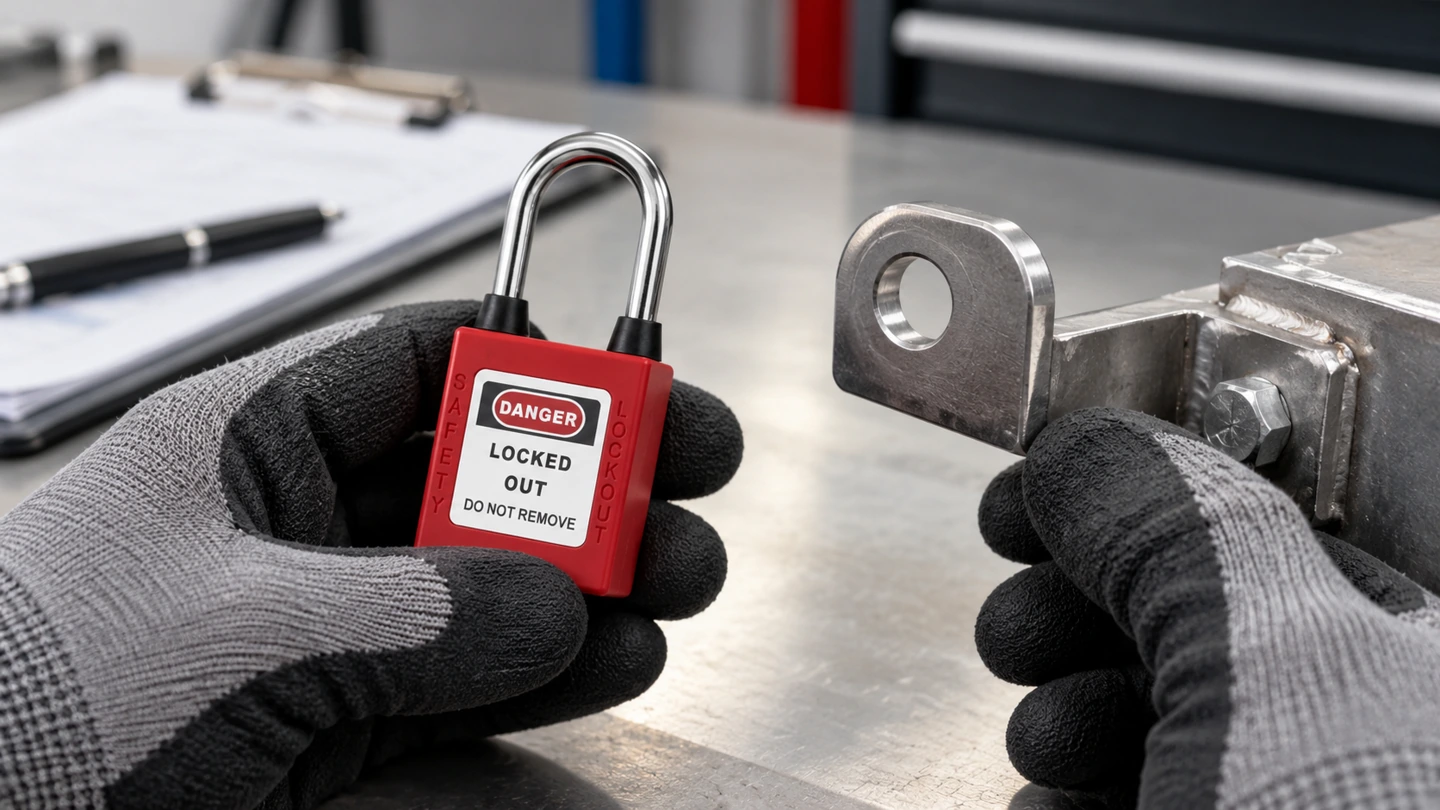
A padlock normally secures an energy-isolating device directly or retains a separate breaker, valve or hasp accessory. Its usefulness therefore depends on the entire interface. Record shackle diameter, usable internal height and width, body envelope and the clearance needed to insert and remove the key. A long shackle does not correct an oversized shackle diameter.
The first-order list should distinguish individually assigned locks from equipment locks used within an approved group arrangement. The employer controls who receives each key and how replacement keys are handled. Our key-control and shift-handover guide discusses that administrative boundary. Neither a keyed-alike set nor a master key is an automatic substitute for individual protection.
| Order item | Specify | Verify before approval |
|---|---|---|
| Body and shackle | Separate materials and dimensions | Written model specification and sample |
| Cylinder and keys | Keying arrangement and retention behavior | Key-to-lock allocation against the issue plan |
| Identification | Worker identifier and site standard | Legibility after the expected handling |
| Device interface | Hole, clearance and access constraints | Trial with the actual approved accessory |
Approve the sample before releasing the order
Use a controlled, deenergized sample review following the device manufacturer’s instructions. Check closure, opening, key access and whether nearby equipment obstructs the lock body. Acceptance of a loose padlock on a desk is not evidence that it fits every device in the department. Retain the accessory model and sample photograph with the order revision.
Ask for evidence tied to the supplied model when the quotation mentions insulation, temperature resistance or chemical suitability. A nylon body alone does not identify the shackle or cylinder material. The model description, declared test method and applicable conditions should agree; a generic certificate with no product mapping leaves the claim unresolved.
| Site condition | Purchasing question | Useful record |
|---|---|---|
| Outdoor or wet work | What exposure is documented? | Model-specific environmental statement |
| Several device families | Which interfaces were trialled? | Device-to-padlock compatibility list |
| Multiple employees | How are locks and keys assigned? | Issue register and controlled key schedule |
| Repeat orders | Can an alternative be substituted? | Approved sample and change-approval rule |
Separate a purchasing checklist from program compliance
29 CFR 1910.147(c)(1) requires an energy control program with procedures, training and periodic inspections. Buying compliant-looking hardware does not establish that program. Paragraph (c)(6) requires procedure inspections at least annually; that is different from a padlock’s pre-use condition check and is not a prescribed annual lock-replacement interval.
The standard concerns applicable US general-industry servicing hazards. Electrical work can also involve the separate work-practice requirements of 1910.333. Destination-market requirements and the employer’s task assessment determine applicability. OSHA does not issue a product certification called an OSHA-certified padlock. Refer to the wider lockout-device selection guide when assembling the rest of the isolation package.
Turn the approved sample into a controlled order
Freeze four items before release: the exact model specification, the keying and worker-allocation schedule, the approved device-fit record, and the incoming-inspection criteria. Require written approval before substitutions. QVAND can be included in that supplier review, but the buyer should request evidence for the actual ordered variant rather than infer performance from a product family name. Compare total acquisition cost using samples, marking, replacement keys, training time and rejected substitutions; no universal price or savings percentage is justified without a quotation.
Frequently asked questions
What information should accompany a first LOTO padlock order?
Send the application, separate body and shackle requirements, dimensions, keying arrangement, identification format, quantity and intended device interfaces. Include photographs and an approved-sample requirement where fit remains uncertain.
How should padlock samples be checked against the site's devices?
Trial the sample against each intended accessory and the available installation space under a controlled review. Retain the exact device models and outcome; a fit result for one combination does not approve every model.
Which supplier claims need written evidence before purchase?
Insulation, chemical resistance, temperature limits and any certification statement require evidence linked to the model and conditions. Ask what was tested and whether the supplied variant is covered.
What is padlock in LOTO?
It is a lock used as part of an established hazardous energy control procedure. Depending on the arrangement, it secures the isolator itself or retains another compatible lockout device.
How much does a LOTO padlock cost?
There is no reliable universal price because keying, shackle choice, marking, quantity and delivery terms change the quotation. Compare matched specifications and the cost of sample approval rather than unit price alone.
What should the employer control when replacement keys are issued?
The employer should control authorization, custody, issue records and the effect on individual protection. A replacement key must not become an informal way to remove another employee’s lock.
Why should lockout padlocks be dedicated to energy control?
29 CFR 1910.147(c)(5)(ii) reserves the identified devices for energy control rather than other purposes. Dedicated use helps prevent a maintenance lock from being confused with a general security padlock.
References
- 29 CFR 1910.147 — Control of hazardous energy
- CCOHS — Lockout/Tag out
- CCOHS — Hazardous Energy Control Programs
A first order is ready when the approved arrangement can be repeated, not merely when the color and quantity are correct.
Compare the relevant QVAND product options against your documented application, and contact the team with the actual equipment details, photographs and evidence requirements.