
When an electrical maintenance planner in Manchester selected an MCB lockout from a pin-in catalogue description, the sample did not engage the breaker’s intended features. This illustrative scenario was resolved by checking the exact breaker and device instructions, not by tightening the accessory harder. A familiar mechanism name had been mistaken for model-specific compatibility.
Summary: Pin-in, pin-out and clamp-on describe different attachment approaches, not universal breaker approvals. Select an MCB breaker lockout using the actual handle profile, available features, panel clearance and manufacturer instructions. Under 29 CFR 1910.333(b)(2), electrical deenergization includes isolation, lockout/tagging and verification; an accessory that fits does not itself prove absence of voltage.
Use mechanism names to shortlist, not to approve
Suppliers use pin-in and pin-out terminology for pin arrangements intended to engage particular miniature-breaker features. The details must be confirmed from the device drawing and compatible breaker information. Two breakers with similar fronts can differ in the geometry needed for reliable engagement. Do not infer a cross-brand mapping from the words pin-in or pin-out alone.
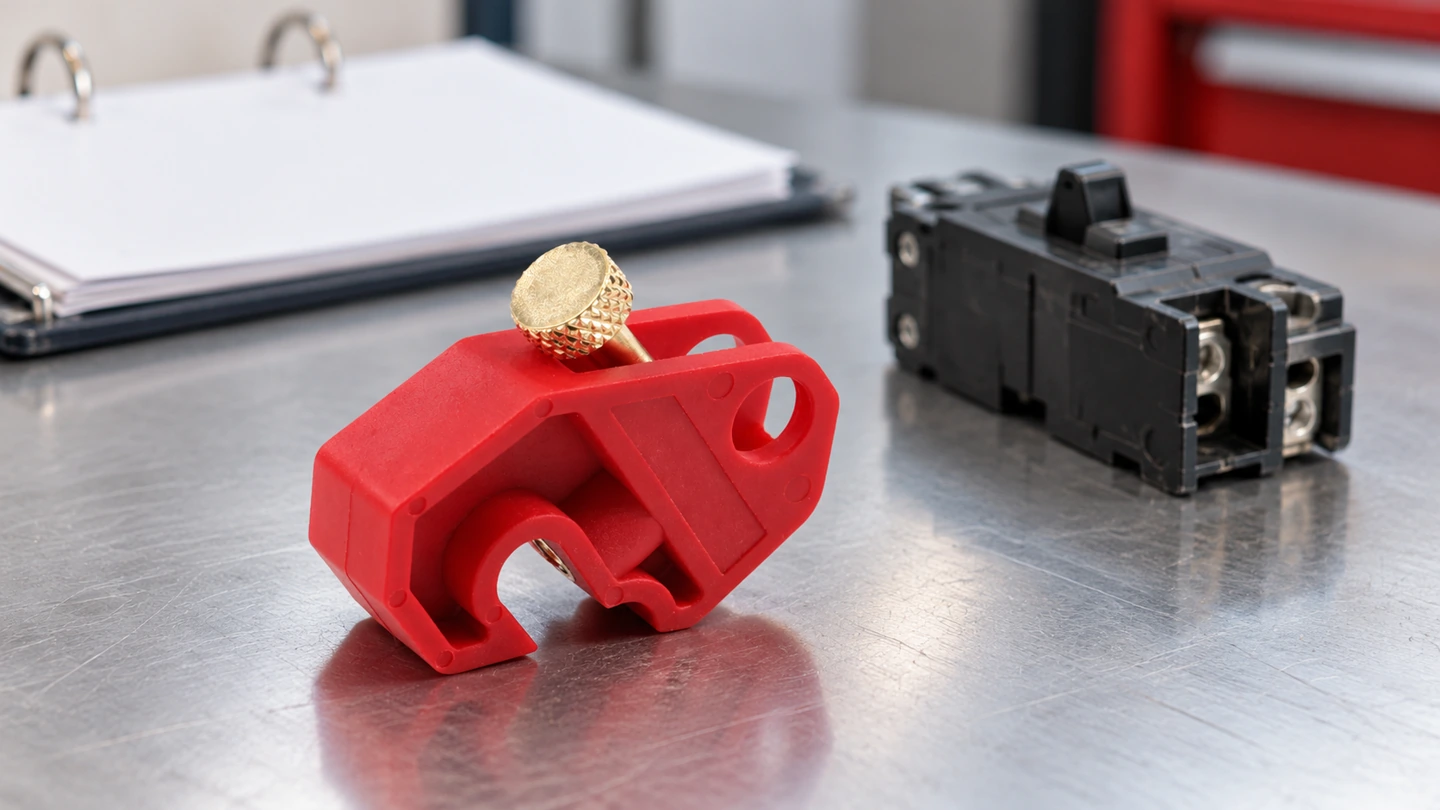
A clamp-on design secures around or against an appropriate handle feature under its instructions. That may provide another option when a pin arrangement is unsuitable, but it still depends on handle thickness, profile and the permitted fitting method. Tool-operated and tool-free designs need their own review; neither description guarantees fit.
| Approach | Selection question | Evidence required |
|---|---|---|
| Pin-in | Which pin and breaker features engage? | Supplier drawing and actual model trial |
| Pin-out | Does the specified arrangement match this breaker? | Instructions and approved fit record |
| Clamp-on | Can the clamp secure the actual handle correctly? | Profile review and instructed fitting trial |
| Any mechanism | Does the complete arrangement have clearance? | Padlock and enclosure-space check |
Trial-fit the selected mechanism to the actual breaker
Collect the breaker manufacturer, complete model identifier, pole arrangement and clear photographs before requesting a sample. Add the handle dimensions and any relevant holes or recesses, plus the adjacent-device and enclosure clearances. Current rating alone does not describe the mechanical interface.
A qualified person should arrange a controlled assessment that does not expose workers to energized parts. Fit the approved device according to its instructions, add the intended personal padlock and check access, retention and interference. Keep the actual breaker/device combination and result in a compatibility register. The mini-breaker selection guide provides broader background, while the energy-source overview explains the other hazards an electrical accessory cannot address.
| Record field | Why it matters | Review trigger |
|---|---|---|
| Breaker model and location | Links approval to actual equipment | Breaker replaced or relocated |
| Device model and revision | Identifies the instructed mechanism | Accessory substituted |
| Padlock and access | Checks the complete assembly | Personal-lock model changes |
| Photo and trial outcome | Makes the acceptance reproducible | Panel or enclosure altered |
Keep attachment, isolation and verification separate
29 CFR 1910.333(b)(2) addresses work on equipment or circuits that are deenergized. Its requirements include disconnecting relevant sources and checking for other conditions such as stored energy or backfeed, with verification by a qualified person as specified. A locked selector switch or push button does not automatically constitute supply isolation.
29 CFR 1910.147 has a different scope and includes applicable machine-servicing energy control and hardware requirements. An employer must determine which rules apply to the task rather than treating any MCB accessory as a complete compliance package. Avoid claims that an accessory is OSHA certified or universally compatible without evidence.
Approve the combination and control later substitutions
Start with the exact breaker, obtain the device instructions, trial the complete arrangement and retain the result with the equipment procedure. QVAND breaker lockouts can be assessed against that same record. Revalidate a changed breaker, padlock or enclosure rather than carrying approval forward by appearance. Procurement cost includes rejected samples and repeat panel visits, so a slightly cheaper device is not a saving if its compatibility cannot be demonstrated.
Frequently asked questions
How do pin-in and pin-out MCB lockouts differ?
They describe different pin arrangements used to engage the relevant breaker features. Confirm the supplier’s drawing and exact compatible models; the names alone do not establish a universal mapping.
When might a clamp-on device be needed instead?
Consider one when the actual handle and instructions support clamp attachment and the pin-type options are unsuitable. Trial the selected model rather than assuming clamp-on means universal.
Which breaker details should be checked before selecting an MCB lockout?
Record the manufacturer, full model, poles, handle profile, relevant pin features and surrounding clearance. Include the personal padlock and panel-cover access in the review.
How to lock an MCB?
Use an appropriate device under the equipment-specific procedure and its installation instructions. The authorized or qualified personnel must also perform the required isolation and verification; placing a lock on the handle is not the whole task.
What is a circuit breaker lockout?
It is hardware intended to secure a suitable circuit-breaker operating interface in the required position. Its suitability depends on the breaker, device and approved procedure.
How do pin-in and pin-out miniature breaker lockouts differ?
Their intended pin engagement differs, but terminology can be supplier-specific. Use the actual model instructions and a controlled fit review rather than a generic photograph.
When should a clamp-on breaker device be considered?
Consider it where the breaker geometry suits the specified clamp and the complete assembly has sufficient space. Retain the fit evidence and do not substitute a different clamp without review.
References
- 29 CFR 1910.147 — Control of hazardous energy
- CCOHS — Lockout/Tag out
- CCOHS — Hazardous Energy Control Programs
- 29 CFR 1910.333 — Electrical work practices
Approve a documented breaker-and-device combination, not a mechanism name.
Compare the relevant QVAND product options against your documented application, and contact the team with the actual equipment details, photographs and evidence requirements.