
When a panel-maintenance planner in Bristol reviewed a miniature-breaker lockout sample, it seemed to fit the handle until the intended padlock was added and the enclosure clearance was checked. This is an illustrative fit-review scenario. The rejected arrangement was not evidence of a defective breaker; the review had initially considered only the handle and ignored the full working envelope.
Summary: A mini breaker lockout must fit both the breaker and its installation space. Check adjacent devices, padlock-body movement, key access, cover clearance and the enclosure’s intended operating arrangement. 29 CFR 1910.333(b)(2) still requires task-appropriate isolation and verification; mechanical fit alone is not proof that an electrical circuit is deenergized.
Define the space needed by the complete arrangement
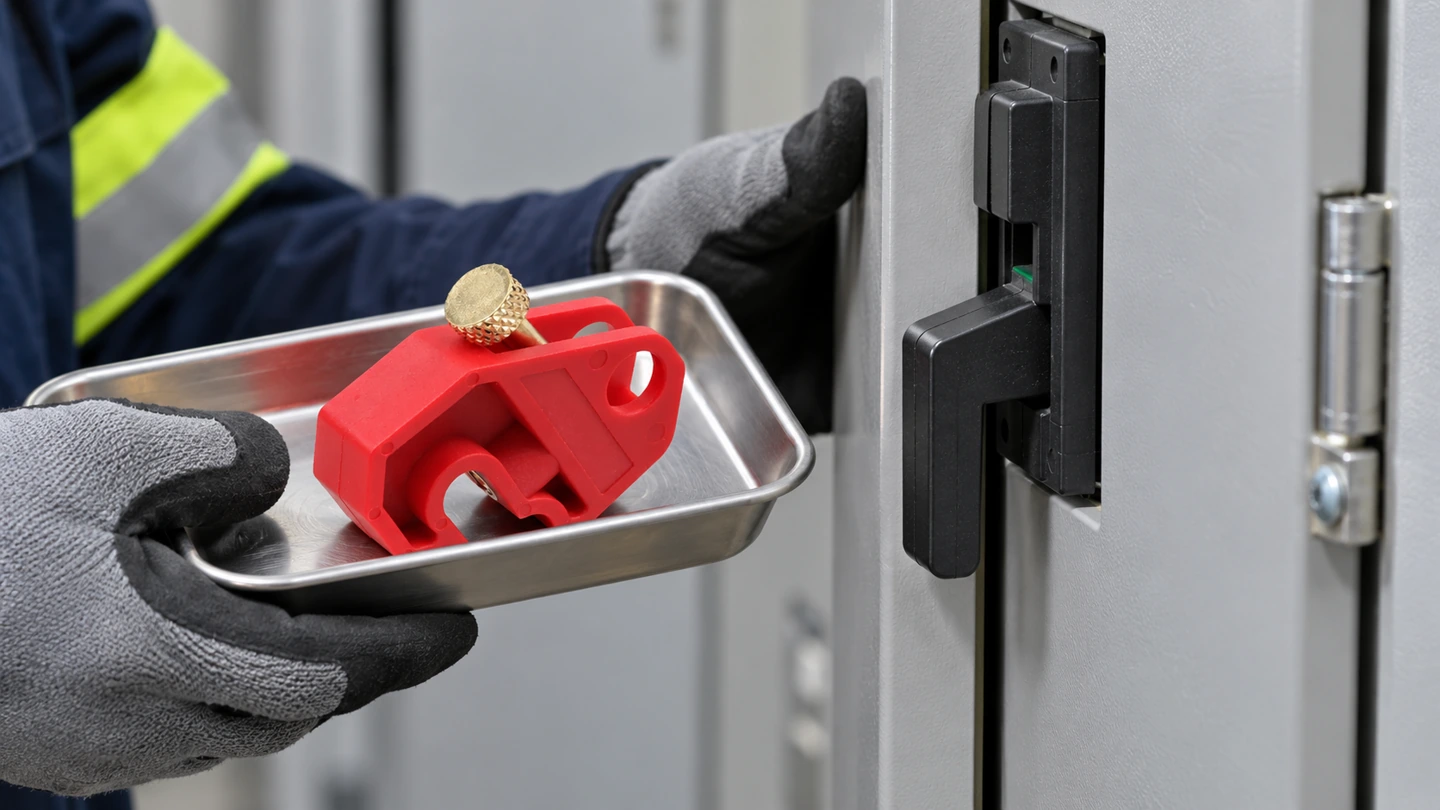
The assembly includes more than the small accessory on the toggle. The padlock body, shackle, operating screw or tool, key and worker access can all require space. A device that fits in an empty training fixture may behave differently between adjacent breakers or behind an enclosure cover.
Collect photographs that show the entire affected area as well as the handle detail. Ask qualified personnel to obtain any internal information safely; a purchasing exercise is not authorization to remove a cover or measure near exposed energized conductors. Record obstacles rather than guessing dimensions from a perspective photograph.
| Space to review | Possible limitation | Acceptance evidence |
|---|---|---|
| Adjacent breakers | Bodies or handles obstruct attachment | Actual arrangement reviewed |
| Personal padlock | Body swing or key access restricted | Specified padlock included in trial |
| Panel cover | Accessory obstructs intended cover arrangement | Manufacturer requirements checked |
| Door and enclosure | Protrusion or access conflict | Complete envelope documented |
Record the envelope of the whole fitted arrangement
Trial the sample in a controlled setting using the exact device and padlock models. Follow the breaker and lockout instructions; do not grind a handle, bend a clamp or over-tighten a screw to make an unsuitable design appear to fit. If a cover or door cannot be used as intended, escalate to the responsible electrical team rather than forcing it closed.
The record should distinguish what was actually checked from what remains unknown. A photo of the front cannot establish unseen rear interference, and a supplier’s generic universal claim cannot replace a model-specific acceptance. Compare the basic mini-breaker fit guidance and the wider device-selection context when defining the review.
| Inquiry item | Useful detail | Do not rely only on |
|---|---|---|
| Breaker identity | Manufacturer, model and poles | Amperage |
| Handle interface | Profile, dimensions and permitted engagement | Similar-looking photograph |
| Installation context | Adjacent equipment and enclosure constraints | Bench-top sample alone |
| Approval record | Device, padlock, trial and revision | Unqualified universal description |
Do not confuse lockout fit with breaker protection behavior
Whether a particular fitted arrangement affects a breaker’s operation or permissible protective behavior is a manufacturer-specific question. Do not promise that every breaker can still trip, or that every accessory is acceptable, without checking the relevant breaker and device instructions. A maintenance lockout is not a reason to hold a breaker energized.
29 CFR 1910.333 establishes electrical work-practice requirements within its scope, including qualified-person verification. 1910.147 addresses applicable machine-servicing energy control and requires suitable hardware under (c)(5). Neither provides a universal minimum panel-clearance dimension for every lockout assembly or certifies a product merely because it carries an OSHA-related description.
Make clearance part of the purchase approval
Approve four linked items: exact breaker identity, the attachment mechanism, the intended personal padlock and the enclosure arrangement. Keep unresolved cover or door conflicts out of the approved list. QVAND options can be reviewed against those records, including a controlled sample when photographs are insufficient. Consider the total cost of sample assessment, repeat visits and rejected deliveries; no percentage saving is meaningful without actual quotations and fit outcomes.
Frequently asked questions
Which clearances matter when locking a miniature breaker in a crowded panel?
Check adjacent breaker spacing, the accessory’s protrusion, padlock-body movement, key access and the intended cover and door arrangement. Use the actual combination rather than considering the handle alone.
Can a lockout fit the handle but interfere with the panel cover?
Yes, a device can engage the handle yet conflict with a cover, door or neighboring component. That is a reason to review the complete assembly against the relevant instructions.
What photographs and measurements should a supplier receive?
Provide the breaker make, model and poles, handle close-ups, dimensions and wider views of the enclosure. Any measurements near electrical hazards must be collected by appropriately qualified personnel under safe arrangements.
What is a lockout on a breaker?
It is a device used to secure an appropriate breaker interface within an energy control procedure. The approved fit and electrical isolation verification remain separate requirements.
Can a breaker still trip with a breaker lock?
Protective behavior depends on the actual breaker and fitted arrangement. Confirm it with the breaker and accessory manufacturers rather than assuming a generic answer applies to every product.
When should a clamp-on breaker device be considered?
Consider it only when the actual handle profile, attachment method and available space suit the specific clamp. Include the personal padlock in the approval trial.
How can panel-door clearance affect a fitted breaker lockout?
A protruding device or padlock can interfere with the intended enclosure arrangement. Verify clearance and follow manufacturer requirements; do not force a door or modify equipment to conceal an incompatibility.
References
- 29 CFR 1910.147 — Control of hazardous energy
- CCOHS — Lockout/Tag out
- CCOHS — Hazardous Energy Control Programs
- 29 CFR 1910.333 — Electrical work practices
The fitted assembly must suit the space in which it will actually be used.
Compare the relevant QVAND product options against your documented application, and contact the team with the actual equipment details, photographs and evidence requirements.