
When a maintenance supervisor in Glasgow returned a steel hasp to the issue point, its red grip still looked sound but the jaw no longer aligned consistently. This illustrative scenario shows why an inspection limited to surface appearance can miss a working defect. The response is a controlled condition review, not an assumption that fresh-looking coating means the whole assembly remains suitable.
Summary: Inspect a steel hasp lockout across four areas: finish condition, metal condition, closure alignment and personal-padlock interfaces. Separate cosmetic observations from defects that affect function, then apply manufacturer and employer acceptance criteria. 29 CFR 1910.147(c)(5) requires suitable hardware but does not specify a universal permitted rust depth or coating-loss percentage.
Treat coating condition as evidence to investigate
Scratches, blistering, peeling, exposed metal and corrosion deposits deserve inspection because the finish can influence environmental suitability. The significance depends on location, severity, service exposure and the supplied design. A small appearance change is not automatically a quantified loss of strength, while heavy coating can also conceal a condition that needs closer review.
Record what is visible without inventing a tolerance. Do not sand, grind, repaint or apply chemicals unless the manufacturer permits the method and the employer controls the work. An unauthorized repair may conceal damage or change fit. Review similar devices in the same area when a repeated exposure pattern is suspected.
| Observation | Question for review | Avoid assuming |
|---|---|---|
| Damaged coating | Is the substrate or working surface affected? | Every scratch has the same consequence |
| Corrosion deposits | What is the extent and location? | Appearance gives a remaining-life figure |
| Jaw misalignment | Does closure remain complete and reliable? | A red grip proves serviceability |
| Worn holes or pivot | Does the intended arrangement remain secure? | Any padlock that passes through is acceptable |
Inspect closure, alignment and the padlock holes
Check the hasp’s complete working movement according to its instructions, including the pivot, jaw engagement and padlock interfaces. Inspect in a controlled setting rather than manipulating a suspect device on an active isolation point. Compare the result with the approved sample and manufacturer guidance where available.
A distorted jaw or enlarged hole can change how the assembly behaves even if the operator can still close it by hand. Use the actual personal-padlock models to review access and interference, without forcing the parts. The hasp selection guide discusses the underlying dimensional checks, while the key-control guide addresses worker ownership when replacement is needed.
| Check | Useful record | Escalation trigger |
|---|---|---|
| Jaw engagement | Observed closure condition | Incomplete or unreliable engagement |
| Pivot and alignment | Movement and visible deformation | Loose, seized or distorted operation |
| Padlock holes | Condition and intended lock model | Wear or interference affecting use |
| Environment | Wetness, substances and cleaning practice | Repeated unexplained degradation |
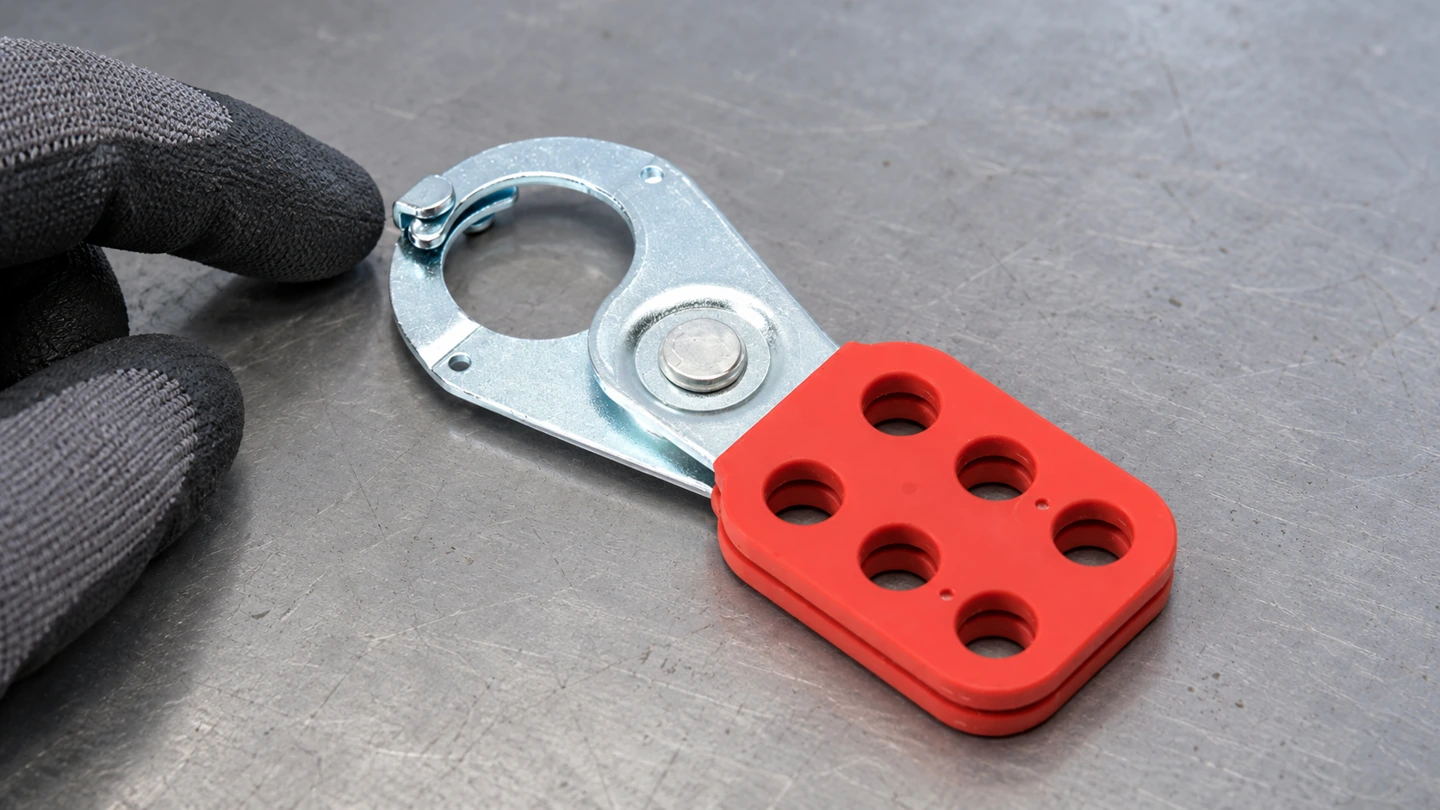
Keep a suspect hasp out of circulation without losing protection
If the device is in ready stock, segregate it and record the problem. If it is applied on an active job, the authorized team must preserve protection while following the employer’s controlled transfer or replacement procedure. Inspection is not authority to remove other employees’ locks or improvise a temporary arrangement.
29 CFR 1910.147(f)(3) governs applicable group arrangements; paragraph (e)(3) addresses device removal, including the documented exception when the applying employee is unavailable. Procedure inspections at least annually under (c)(6) are distinct from hardware condition checks. None of these clauses supplies a generic hasp corrosion acceptance table or a product certification.
Replace against the approved specification
Use four procurement controls: retain the defect observation, confirm the exposure and supplier acceptance criteria, approve the replacement’s jaw and padlock interfaces, and update the stock or issue record. QVAND steel hasps can be considered against those requirements. If several workers cannot attach their locks without interference, review the approved group arrangement rather than substituting a larger-looking hasp without a trial. The cost decision should include downtime, inspection and replacement logistics, not just coating appearance or unit price.
Frequently asked questions
How should a steel lockout hasp be inspected for corrosion?
Inspect the finish and exposed metal, with particular attention to working surfaces, edges, pivot and holes. Apply supplier and employer criteria; do not infer a strength value from a photograph of rust.
Can damaged coatings affect the suitability of a steel hasp?
They can affect suitability and may warrant review of the substrate and service environment. The actual consequence depends on the model and condition, so avoid a universal allowable coating-loss rule.
Which closure and alignment checks help identify a worn hasp?
Look for incomplete jaw engagement, distortion, unusual movement, a loose pivot or a closure that needs force. Segregate doubtful hardware and follow the supplier’s instructions.
What is a lockout hasp used for?
It allows multiple personal locks to participate at an appropriate isolation point. Its role depends on a compatible arrangement and the employer’s energy control procedure.
How do steel and aluminum hasps differ from nonconductive designs?
Both are metallic constructions and should not be treated as insulating merely because of a coating. A nonconductive design must be selected using verified complete-product evidence.
Which wear or corrosion defects should be checked before use?
Include pitting, distortion, cracks, damaged finishes, worn padlock holes and unreliable pivots or closure. Review whether the observed condition can affect the intended function.
When should a group lockbox be considered instead of a hasp?
Consider a group lockbox when access, practical capacity, several isolation points or crew organization makes direct locking at a hasp unsuitable. The employer must approve the complete group procedure and individual-protection arrangements.
References
- 29 CFR 1910.147 — Control of hazardous energy
- CCOHS — Lockout/Tag out
- CCOHS — Hazardous Energy Control Programs
Inspect the surfaces, but accept or reject the working assembly.
Compare the relevant QVAND product options against your documented application, and contact the team with the actual equipment details, photographs and evidence requirements.